
The digital backbone of the 2026 global economy relies almost exclusively on the speed, reliability, and bandwidth of fiber optic networks. From the sprawling data centers that power artificial intelligence to the Fiber-to-the-Home (FTTH) connections delivering gigabit internet to billions, the fiber optic cable itself often gets the glory. However, the unsung heroes of any high-performance network are the fiber optic accessories.
These components—ranging from precision connectors and robust enclosures to specialized installation hardware—are critical for ensuring signal integrity, mechanical durability, and long-term system reliability. As global internet penetration reaches 68% of the world population (5.5 billion users) , the demand for these accessories has never been higher.
In this comprehensive guide, we will delve deep into the world of fiber optic accessories, exploring market trends, essential product categories, installation best practices, and the latest technological advancements shaping the industry in 2026.
1. The Booming Fiber Optic Accessories Market: A 2026 Snapshot
Before diving into the specific products, it is crucial to understand the macroeconomic landscape driving the fiber optic components market. According to recent data from The Business Research Company, the global fiber optic components market—which includes the accessories we discuss here—has demonstrated remarkable resilience and growth.
The market was valued at $30.14 billion in 2025 and is projected to grow to $33.09 billion in 2026, reflecting a strong Compound Annual Growth Rate (CAGR) of 9.8% . This historic growth is fueled by the relentless expansion of telecommunications infrastructure and the early deployment of FTTH networks. Looking further ahead, the market is expected to reach $48.15 billion by 2030, driven by 5G densification, the expansion of hyperscale data centers, and the rise of AI-driven network optimization .
The United States remains a dominant force, holding roughly 31-38% of the global market share, with projections estimating the U.S. market to grow from $9.77 billion in 2025 to $23.70 billion by 2035 . Meanwhile, the Asia-Pacific region, led by China, is forecast to be the fastest-growing, with China’s market alone expected to hit $8.5 billion by 2026 .
Table 1: Global Fiber Optic Components Market at a Glance
Data aggregated from Research and Markets, The Business Research Company, and SNS Insider .
2. Core Categories of Fiber Optic Accessories
Fiber optic accessories can be broadly categorized by their function within the network: Connectivity, Mechanical Support & Protection, and Installation & Testing. Understanding the nuances of each category is essential for network designers and installers.
2.1 Connectivity: Connectors, Adapters, and Passive Components
At the heart of any fiber network lies the connection point. High-quality connectors and passive components are vital for minimizing signal loss (insertion loss) and preventing back-reflection (return loss) that can damage lasers.
Connectors
The connector market continues to evolve, balancing the need for higher density with ease of use. While legacy connectors like SC and LC remain ubiquitous, 2026 has seen a significant uptick in the deployment of high-density solutions.
- LC and SC Connectors: Still the workhorses of enterprise networking and FTTH. SC connectors are favored for their square, snap-in design, often used in PON networks, while LC connectors dominate data center patching due to their small form factor.
- MPO/MTP Connectors: These multi-fiber connectors are essential for 40G, 100G, and 400G data center links. They allow for the parallel transmission of data across 8, 12, or 24 fibers in a single ferrule. In AI data center infrastructure, 800G optical modules are increasingly reliant on these interfaces .
- Hardened Connectors: Designed for outside plant (OSP) environments, these connectors feature ruggedized mating mechanisms and environmental sealing to withstand moisture and dust without the need for protective enclosures at the drop point.
Passive Components
Beyond cables and connectors, passive optical components manage and direct light signals.
- Optical Splitters: The heart of any Passive Optical Network (PON), splitters divide a single optical signal into multiple paths (e.g., 1:32 or 1:64), allowing one fiber to serve many subscribers.
- Wavelength Division Multiplexing (WDM) Devices: As networks move to co-packaged optics and higher bandwidth, WDMs are critical. They combine or separate multiple wavelengths (colors) of light onto a single fiber, enabling bidirectional communication and capacity expansion. The IEC is currently developing new performance standards for C-band/L-band WDM devices for controlled environments .
- Optical Circulators: These three-port devices direct light sequentially from port 1 to port 2, and from port 2 to port 3, enabling advanced applications like bidirectional transmission over a single fiber or use in fiber amplifiers.
Table 2: Key Performance Standards for Fiber Optic Connectors (2026)
Source: International Electrotechnical Commission (IEC) and Defense Logistics Agency (DLA) .
2.2 Mechanical Support: Hardware for Aerial and Buried Plant
Fiber optic cables, especially those used in Outside Plant (OSP) applications, require substantial mechanical hardware to handle environmental stresses like wind, ice, and tension.
OPGW and ADSS Hardware
For aerial installations on power lines or poles, two cable types dominate: Optical Ground Wire (OPGW) , which replaces traditional static/shield wires on transmission lines, and All-Dielectric Self-Supporting (ADSS) cables, which are non-metallic and can be installed on lower voltage lines.
The accessories for these installations are mission-critical.
- Suspension & Tension Clamps: These clamps attach the cable to the pole or tower. Suspension clamps support the cable’s weight at intermediate points, allowing for some movement, while tension clamps (or dead-ends) handle the full tensile load at corners and termination points . Improper installation of armor rods within these clamps can lead to cable slippage or localized crushing.
- Vibration Dampers: Aeolian vibration (wind-induced high-frequency oscillation) can cause fatigue and strand breakage over time. Vibration dampers are installed on the cable near the clamps to absorb this energy .
- Down Lead Clamps & Cable Storage Brackets: These guide the fiber cable down the pole to the splice enclosure or equipment, ensuring the proper bend radius is maintained and preventing wind abrasion against the pole .
2.3 Protection and Management: Enclosures and Organizers
Once the fiber reaches a termination point, whether in a manhole, on a pole, or inside a data center, it must be protected and organized.
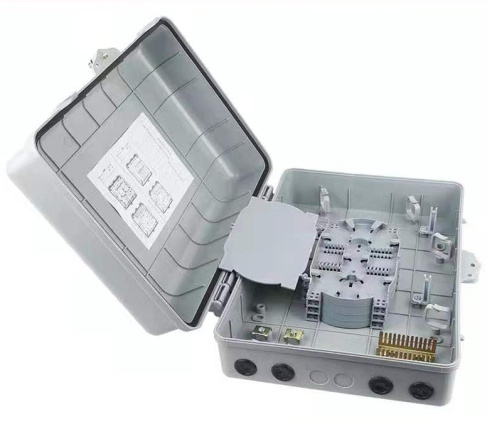
Splice Closures (Fiber Joint Boxes)
These are perhaps the most critical protective accessories in the OSP network. A splice closure houses the fusion splices where two cable sections are joined. In 2026, the demands on these closures are higher than ever.
- Environmental Sealing: Closures must be rated for direct burial or aerial use, preventing water ingress and ice damage. The integrity of the seal is paramount; failure here leads to fluctuating attenuation and eventual communication failure .
- Management of Slack Fiber: Inside the closure, spare cable (slack) must be neatly coiled. The bending radius of this slack must be strictly maintained—typically 30-40mm for single-mode fiber—to prevent macrobending losses. Over-tight binding or too small a radius can cause gradual signal degradation visible on an OTDR .
Fiber Optic Distribution Frames and Panels
In data centers and headends, organization is king. High-density panels allow for the termination of hundreds of fibers in a single rack unit. Features like sliding drawers and built-in slack management spools are standard. The trend toward pre-terminated MPO/MTP trunks has accelerated, reducing installation time and the risk of on-site termination errors .
2.4 Specialized Assemblies for Industrial and Medical Use
While telecommunications drives volume, specialized applications demand high-performance accessories. Bundled assemblies, for instance, are used in medical laser delivery, spectroscopy, and aerospace. These assemblies might combine multiple fiber types (e.g., pure silica core for high-power transmission and plastic-clad fiber for sensing) into a single, heavy-duty jacket, terminated with custom-machined ferrules capable of withstanding vacuum or extreme temperatures ranging from -269°C to +750°C .
3. The Critical Role of Installation Accessories and Techniques
Even the highest-quality cable and connectors will fail if installed improperly. The tools and methodologies used during deployment are just as important as the components themselves.
3.1 The Shift to Cable Blowing
For large-scale FTTH and campus deployments in 2026, cable blowing has become the preferred method over traditional pulling. This technique uses a high-volume compressor to push a specialized “blowing” unit that floats the fiber cable through a micro-duct using air pressure. This method drastically reduces physical stress on the cable, allowing for longer continuous installation lengths and minimizing the risk of fiber damage .
3.2 The Golden Rules: Bend Radius and Pulling Tension
Mechanical damage is a leading cause of hidden network faults. Two rules are non-negotiable:
- Respect the Bend Radius: Fiber can be bent, but only so far. The minimum bend radius under tension during installation is typically 20 times the cable diameter; once installed and not under tension, it’s 10 times. Modern bend-insensitive fiber (G.657.A2) allows for tighter radii (as low as 7.5-10mm), but installers should never force a sharp 90-degree turn .
- Monitor Tension: During pulling, tension must be constantly monitored to ensure it never exceeds the cable’s rating. Using swivels prevents the cable from twisting, which can induce stress on the internal fibers .
3.3 Termination: Fusion Splicing vs. Mechanical Splicing
The choice of termination method impacts long-term reliability and signal loss.
- Fusion Splicing: Using an electric arc to weld the glass fibers together, fusion splicing offers the lowest insertion loss (typically <0.1 dB) and the highest reliability. It is the standard for OSP and backbone links. Precision cleavers and splicers are essential accessories here .
- Field-Installable Connectors: For direct termination at the wall outlet or Optical Network Terminal (ONT), field-installable connectors offer speed. These require specific crimping tools and epoxy or mechanical splice mechanisms inside the connector body.
Table 3: Common Installation Pitfalls and Prevention Strategies
4. Future Trends: Where Are Fiber Accessories Headed?
As we move toward 2030, several technological and market trends are shaping the development of fiber optic accessories.
4.1 The Rise of AI and Hyperscale Data Centers
Artificial Intelligence workloads require massive parallel processing, driving demand for 800G and 1.6T transceivers. This, in turn, demands accessories that can handle higher densities and thermal loads. We are seeing the development of immersive cooling-resistant components (as per new IEC test procedures for immersion cooling environments) and co-packaged optics where the optical engine sits closer to the switch ASIC, reducing power loss .
4.2 Smarter, IoT-Enabled Infrastructure
The passive network is getting smarter. Future splice closures and patch panels may include embedded RFID tags or sensors that can monitor seal integrity, water ingress, or even fiber continuity. This aligns with the trend of IoT-enabled fiber monitoring solutions, allowing operators to move from reactive maintenance to predictive diagnostics .
4.3 Tariffs and Supply Chain Localization
Recent trade policies and tariffs have impacted the cost of imported glass preforms, amplifiers, and semiconductor components. This is pushing the industry toward regional production and localized sourcing strategies to build supply chain resilience. For procurement managers, understanding the origin and supply chain of accessories is becoming as important as the technical specifications .
4.4 Sustainability and Material Science
There is a growing push for halogen-free, low-smoke zero-halogen (LSZH) cable jackets and more recyclable packaging for accessories. In installation hardware, stainless steel remains the king for corrosion resistance, ensuring a 20+ year lifespan that outlasts multiple generations of active electronics, contributing to a more sustainable infrastructure lifecycle .
5. Frequently Asked Questions (FAQs)
Q1: What is the difference between a fiber optic connector and a fiber optic adapter?
A connector is the termination on the end of a fiber cable (e.g., an LC connector). An adapter (also called a coupler) is a component used to align and connect two connectors together, allowing light to pass from one fiber to another. Adapters can be simplex, duplex, or quad, and are often used to connect patch cords or connect a patch cord to a piece of equipment.
Q2: Why is connector cleaning and inspection so important in 2026?
With higher data rates (400G/800G), the margin for error is minuscule. A speck of dust on a fiber end-face can cause significant back-reflection, overheating, and failure of the optical link. The standard IEC 61300-3-35 provides specific pass/fail criteria for end-face images. Many network operators now mandate inspection and cleaning of every connection before it is mated, as contamination is the number one cause of network faults .
Q3: How do I choose the right fiber type for my installation?
It depends on distance and bandwidth needs.
- OM3/OM4/OM5 Multimode: Best for short distances (less than 100-150 meters) in data centers. OM4 supports 100G up to 150m. OM5 is designed for short wavelength division multiplexing (SWDM) to increase capacity over multimode.
- OS2 Single-mode: Best for all distances over 150 meters, including building backbones, campus networks, and FTTH. It supports virtually unlimited bandwidth potential and is future-proof for higher speeds. For FTTH, OS2 G.657.A2 (bend-insensitive) fiber is highly recommended for the tight corners found in homes and MDUs .
Q4: What is the typical lifespan of outdoor fiber optic accessories?
High-quality accessories designed for outside plant (OSP) use are built to last. Stainless steel hardware like clamps and brackets can last 20 years or more if properly installed. Sealed splice closures are also designed for long-term deployment, though their gaskets and seals should be inspected during network maintenance. The fiber itself has a lifespan often exceeding 30 years, which is why the mechanical protection provided by accessories is so critical .
Q5: What is a “pre-terminated” fiber solution and when should I use it?
Pre-terminated solutions involve cables that are cut, terminated with connectors (like MPO/MTP), and tested in a factory before being shipped to the site. This is extremely popular in data centers because it eliminates the need for field termination, reduces installation time by up to 70-80%, and guarantees performance. It is ideal for structured cabling environments where pathways and distances are known in advance .
Conclusion
Fiber optic accessories are the silent partners in the global communications revolution. From the ruggedized clamps that secure aerial cables against gale-force winds to the ultra-precise connectors that guide light pulses into silicon photonic circuits, these components ensure that the promise of fiber optic technology—unlimited bandwidth and flawless signal integrity—is actually delivered.
As we progress through 2026, the market is responding to the demands of AI, 5G, and FTTH with smarter, more durable, and higher-density solutions. For network planners and installers, success lies not just in selecting the right cable, but in meticulously choosing and installing the entire ecosystem of accessories that support it. By adhering to stringent international standards (IEC, TIA) and respecting the mechanical limits of the glass fiber, we can build networks that are not only fast, but truly future-proof.