
Product Description
What This Cable Is Built For
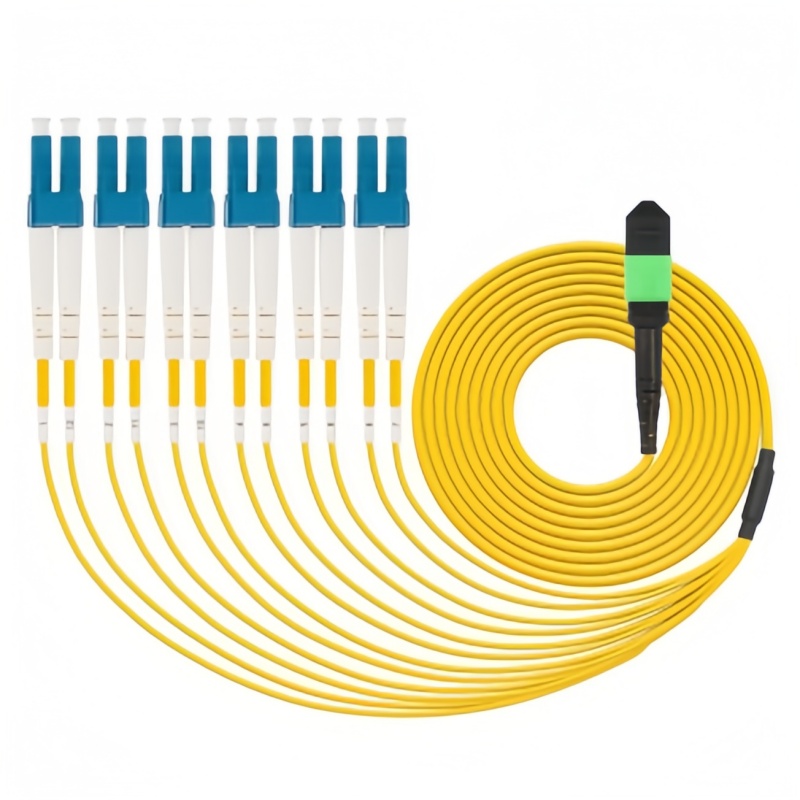
The MPO-LC-3M-12Core is not just about fiber count — it’s about efficient optical routing in crowded environments:
-
3-meter optimized length
Long enough for rack-to-rack or shelf-to-switch connections, short enough to avoid cable slack and airflow blockage. -
High-density backbone to equipment transition
One MPO trunk feeds twelve LC ports, reducing patch panel clutter. -
Fast deployment
Factory-terminated and tested, so no field polishing or splicing is needed. -
Stable optical performance
Designed to maintain low insertion loss across all twelve channels.
Core Technical Details
| Item | MPO-LC-3M-12Core |
|---|---|
| Cable Length | 3 meters |
| Fiber Count | 12 |
| Connector A | MPO / MTP (12-fiber) |
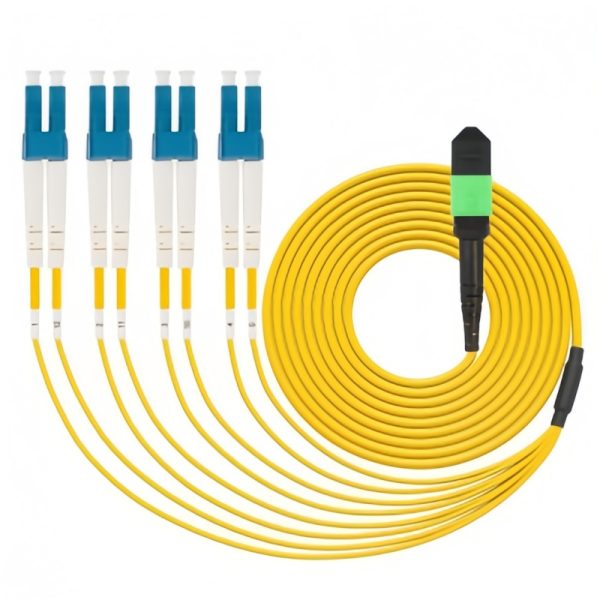
| Connector B | 12 × LC |
| Fiber Type | Multimode OM3 / OM4 or Single-mode OS2 (optional) |
| Insertion Loss | MPO ≤ 0.35 dB, LC ≤ 0.30 dB |
| Jacket | LSZH or PVC |
| Operating Temp. | −10 °C to +70 °C |
| Compliance | IEC, TIA, RoHS, REACH |
Where It Fits Best
This cable is widely used in:
-
Data center racks and cabinets
-
MPO backbone to switch ports
-
40G / 100G / 400G breakout links
-
Cross-connect and patch-panel systems
-
Cloud and AI infrastructure
Designed for High-Density Networks
High-speed networks don’t just need fast optics — they need orderly fiber routing. The MPO-LC-3M-12Core keeps installations compact, minimizes congestion, and allows technicians to quickly identify and service individual channels without touching the MPO backbone.
Professional Q&A
Q1: Is 3 meters suitable for data center use?
Yes. 3 m is one of the most common patching lengths, ideal for rack-to-rack and cabinet-to-cabinet connections.
Q2: Can this cable support 100G and 400G links?
Yes. When paired with the correct MPO and LC-based transceivers, it supports parallel-optic 100G and 400G networks.
Q3: Does it work with both OM4 and single-mode fiber?
Yes. The MPO-LC-3M-12Core can be supplied in OM3, OM4, or OS2 single-mode, depending on your application.
Q4: Do I need to worry about MPO polarity?
Yes. Polarity (Type A, B, or C) must be selected to ensure the transmit and receive fibers align correctly.


Reviews
There are no reviews yet.