
Beschreibung
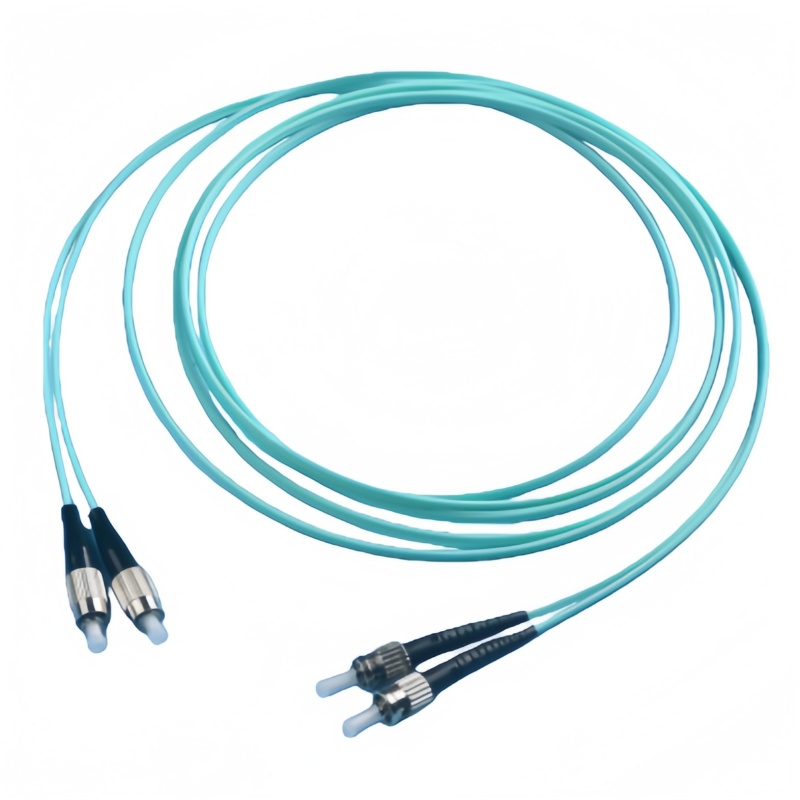
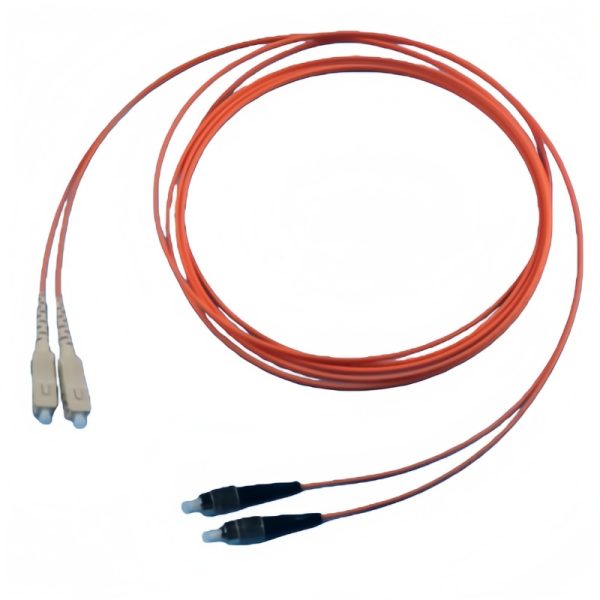
Why FC-to-ST on OM3 Fiber?
FC connectors provide threaded, vibration-resistant locking, making them ideal for measurement equipment and critical links.
ST connectors offer quick bayonet coupling, allowing fast installation in patch panels and wall outlets.
Combining these two on OM3-Faser gives you industrial-grade stability with data-center-grade bandwidth.
Technische Daten
| Parameter | FC/UPC-ST/UPC-OM3-DX |
|---|---|
| Faser-Typ | OM3 Multimode 50/125 μm |
| Konfiguration | Duplex (DX) |
| Anschluss A | FC / UPC |
| Anschluss B | ST / UPC |
| Betriebswellenlänge | 850 nm / 1300 nm |
| Einfügedämpfung | ≤ 0,30 dB |
| Rückflussdämpfung | ≥ 30 dB |
| 10G Ethernet Reach | bis zu 300 m |
| 40G / 100G Reach | bis zu 100 m |
| Kabelmantel | LSZH oder PVC |
| Betriebstemperatur | -10 °C bis +70 °C |
| Normen | IEC, TIA-568, RoHS, REACH |
Real-World Performance
OM3 fiber supports 2000 MHz-km-Bandbreite bei 850 nm, which enables:
-
10G Ethernet up to 300 meters
-
40G and 100G up to 100 meters
This makes the FC–ST OM3 jumper suitable for:
-
High-speed industrial Ethernet
-
Optische Prüf- und Messsysteme
-
Telecom and metro edge networks
-
Querverbindungen in Rechenzentren
-
Automation and control systems
Manufactured for Signal Integrity
Each cable is assembled using precision ceramic ferrules, UPC polishing, and automated interferometer inspection. Both fiber channels are 100% tested for insertion loss and return loss, ensuring stable transmission even in high-vibration or high-temperature environments.
Die Option LSZH-Jacke meets modern Brandsicherheitsstandards for data centers and commercial buildings.
Fachliche Fragen und Antworten
Q1: How is OM3 different from 62.5/125 fiber?
OM3 has much higher bandwidth and supports 10G–100G, while 62.5/125 is limited to 1G.
Q2: Why use FC connectors in high-speed links?
FC's Metallgewindekupplung prevents micro-movement that can cause signal fluctuations in sensitive optical systems.
Q3: Is this cable suitable for data centers?
Yes. OM3 supports 10G, 40G und 100G Kurzstreckenverbindungen, die häufig in Rechenzentren und Cloud-Infrastrukturen verwendet werden.

Bewertungen
Es sind noch keine Bewertungen vorhanden.