
A quotation for a campus or access build can double for one quiet reason: the patch cords were priced as duplex assemblies, while the optics at each end carry both directions over a single strand. BiDi — bidirectional — transceivers separate transmit and receive by wavelength instead of by fiber, turning a two-strand channel into a one-strand channel. The passive layer around those modules has to be ordered to match, or the savings evaporate in rework. This guide sets out how the wavelength pairing works, what it changes in the patch field, and where single-fiber links are worth the trouble.
How One Strand Carries Two Directions
Inside every BiDi module sits a diplexer: a thin-film filter that couples the locally generated transmit wavelength onto the fiber while splitting the incoming receive wavelength off to the photodiode. The two functions share one ferrule, which is why a BiDi module has a single optical port where a duplex module has two. Filter isolation between the two wavelengths typically exceeds 30 dB, which keeps the two directions from interfering — provided the wavelengths are far enough apart.
The modules only work in matched pairs. Side A transmits at one wavelength and receives at the other; side B does the exact reverse. Fit two side-A modules back to back and both ends transmit on the same wavelength with nothing tuned to hear it — the link stays dark. This is the single most common installation fault with single-fiber optics, and it is a warehouse problem before it is a field problem: A and B modules should be labelled, banded and stocked together so a technician cannot pull two identical units from one tray.
| Interfaz | Wavelength pair (A / B) | Typical reach | Referencia |
|---|---|---|---|
| 1000BASE-BX10 | 1310 / 1490 nm | 10 km over OS2 | IEEE 802.3, Clause 58 |
| GPON Class B+/C+ | 1490 nm down / 1310 nm up | 20–40 km split budget | ITU-T G.984.2 |
| 10GBASE-BX10 / BX20 | 1270 / 1330 nm | 10–20 km | IEEE 802.3 |
| 25G BiDi SFP28 | 1270 / 1330 nm | 10–40 km | 5G transport builds |
| 100G single-fiber QSFP28 | CWDM grid, 1271–1331 nm | short reach | ITU-T G.694.2 grid |
The point-to-point Gigabit and 10G pairs descend from the Ethernet in the First Mile work in the IEEE 802.3 standard, while GPON fixes its 1310/1490 relationship in the ITU-T G.984.2 specification — though note that a PON allocates wavelengths by design and does not use pluggable BiDi pairs at all. At 100G, single-fiber modules combine wavelengths taken from the UIT-T G.694.2 CWDM grid.
The Passive Channel Is Graded the Same Way
Nothing about BiDi relaxes the loss budget; if anything it tightens it. A BiDi module gives up roughly 1 dB of margin to its internal filter compared with an equivalent duplex module, so the passive channel between the two ports has to be clean. The arithmetic is the one used in our cálculo del presupuesto de pérdida de inserción guide: count fiber attenuation over the route, add every mated pair and every splice, and compare the total against the module budget. Channel allowances are set by TIA-568 in North America — 0.75 dB per mated pair is the ceiling most designs still quote.
| Parámetro | Value to work to | Why it matters on one strand |
|---|---|---|
| Return loss, APC mated pair | ≥60 dB | Reflections land in a receiver that shares the strand with the transmitter |
| Return loss, UPC mated pair | ≥50 dB | Usable only where the module budget has clear margin |
| Insertion loss per mated pair | ≤0.75 dB max, 0.3 dB typical | BiDi modules already give ~1 dB to the internal filter |
| Certification test | At both wavelengths of the pair | Attenuation differs between 1310 and 1490/1550 nm |
That last row is the one crews miss. A link certified only at 1310 nm says nothing about how it behaves at 1550 nm, where bend and micro-bend losses run higher. Certify each single-fiber link at both wavelengths with a light source and power meter, and keep the loss limits from the presupuesto de pérdidas en fibra óptica reference on the test sheet.
APC Polish Belongs on Most Single-Fiber Links
On a duplex link, a connector reflection travels back down the fiber it came from, toward the transmitter that emitted it. On a single-fiber link, every reflection and every bit of Rayleigh backscatter travels the full strand toward the far end, where the receive path sits in the same fiber — and an imperfect WDM filter lets a slice of it into the receiver band. The noise floor rises exactly where the link can least afford it, which is why transceiver vendors recommend APC connectors for single-fiber optics almost without exception.
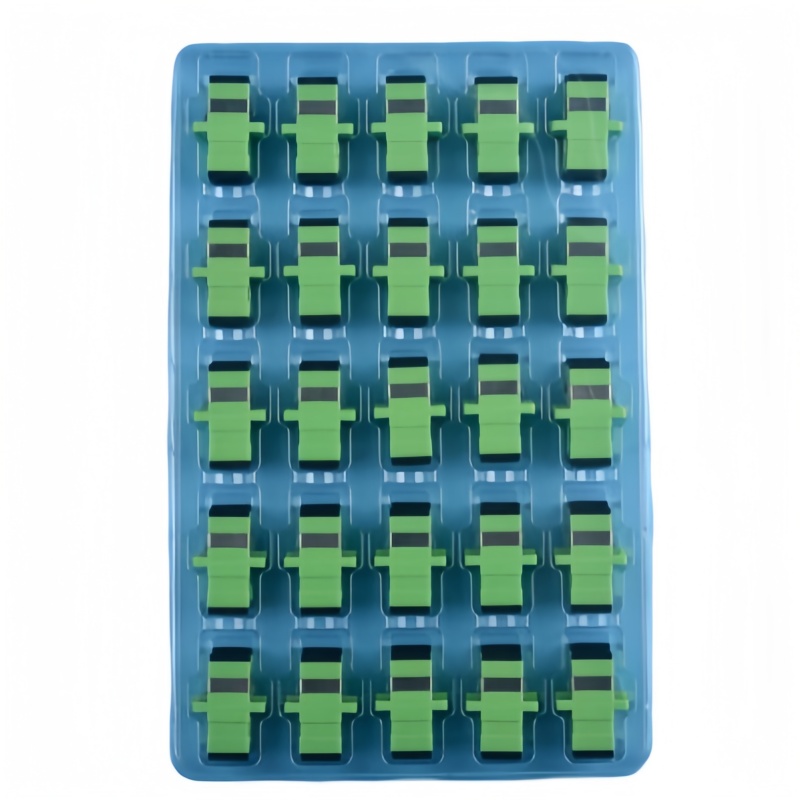
APC means the green 8° angled ferrule, with mated-pair return loss at or above 60 dB where a UPC pair tops out near 50 dB. That 10 dB of extra reflection rejection is the margin that keeps a BiDi receiver quiet. It also carries a hard rule that applies to the whole adaptador de fibra óptica range: a green APC ferrule must never mate with a blue UPC one. The angled and perpendicular surfaces touch off-axis, insertion loss jumps, and the return loss benefit disappears entirely. On single-mode single-fiber builds, order APC end to end — cords, adapters, ODF panels — and say so on the purchase order.
What Changes on the Purchase Order
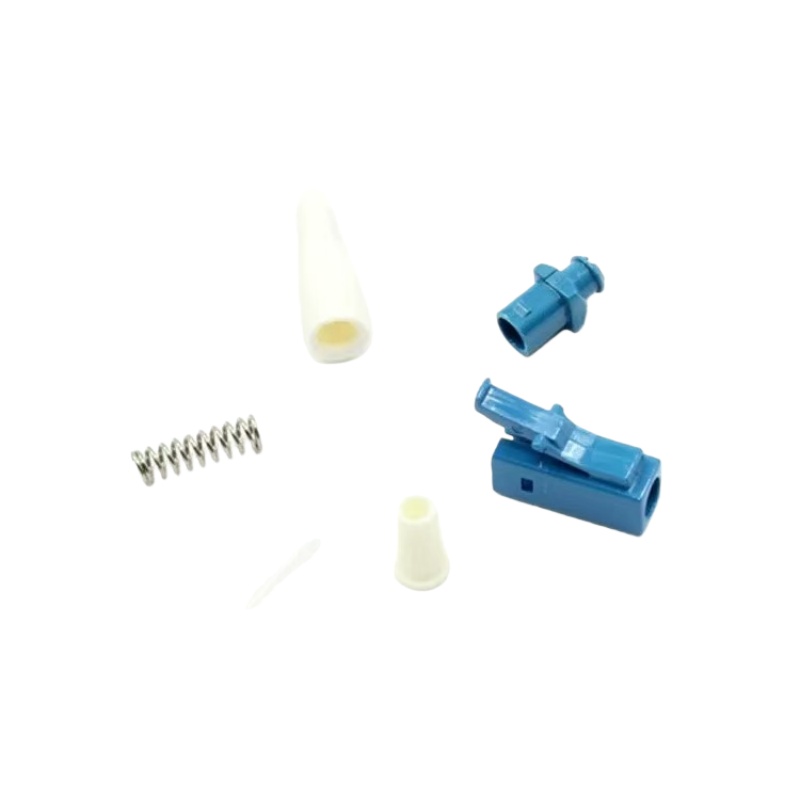
The cord order is the first thing to change. A duplex assembly has two ferrules per end and a zip or round duplex jacket; a single-fiber link wants a single-mode patch cord in simplex format — one ferrule per end, one jacket, typically LC or SC. Ordering duplex cords for a BiDi port leaves a dangling leg that can pick up dust or get patched into the wrong port two months later.
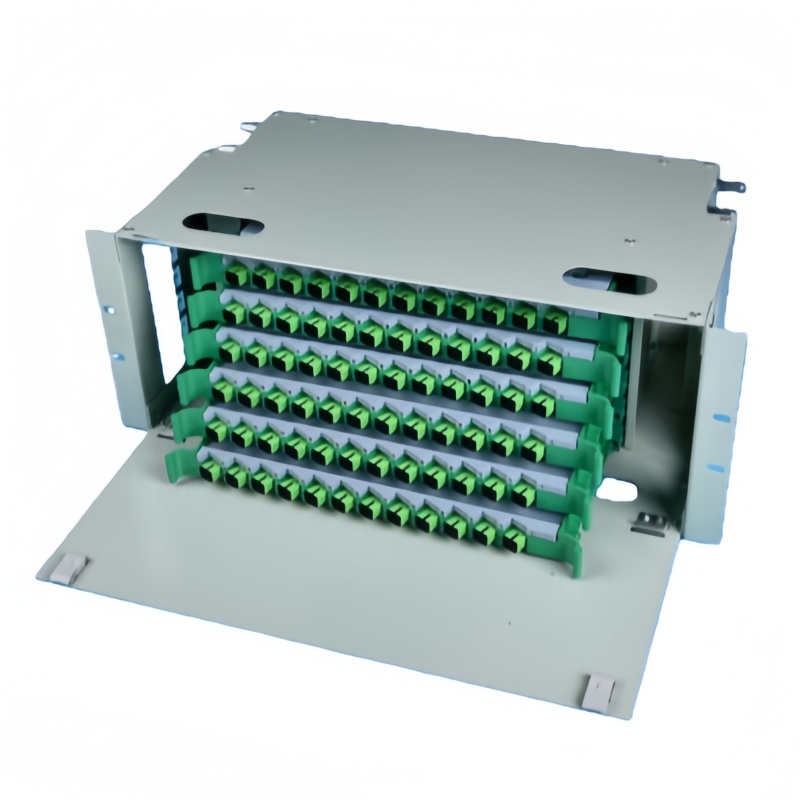
Polarity, which dominates duplex planning, mostly disappears: with one fiber there is no A/B swap to get wrong in the cable. What replaces it is module pairing — A/B labelling on the optics, as covered above. Density, meanwhile, improves. Every mated pair occupies one adapter position instead of two, so a panel that held 48 duplex LC ports holds 96 simplex ones, and a 24-fiber trunk that served 12 duplex links serves 24 single-fiber links. Plan the Armario de distribución de fibra óptica ODF around one port per link, stock conector LC and SC/APC simplex variants as standard, and keep the dust caps on every unused simplex port.
Where Single-Fiber Pays — and Where It Does Not
BiDi earns its keep where strands are scarce or expensive: tower backhaul where the duct is already full, point-to-point FTTH where every subscriber wants a dedicated fiber, campus links across leased routes, and DCI over rented fiber where the monthly bill is quoted per strand. In each case the cabling, splicing and port savings accrue on both ends of every link.
There is also a retrofit play that costs nothing in civil works. A route laid with two strands for one duplex link can be re-cut into two independent single-fiber links with paired BiDi modules, doubling capacity on cable that is already in the ground. The same trick applies in reverse when auditing an installed plant: many duplex links carry far less traffic than their strand count suggests, and converting the quiet ones releases strands for growth elsewhere.
It earns less where fiber is abundant. The modules carry a price premium — typically 10–30% over duplex equivalents — and on short in-building runs where cable costs almost nothing, duplex optics with duplex cords remain the simpler and cheaper answer. PON access networks are a special case: GPON and XGS-PON already manage their wavelength plan inside the standard, so there is nothing for a BiDi module to add. The break-even question is always strand price against module premium, which the table below makes explicit.
Total Cost of Ownership: Duplex vs Single-Fiber
Taken over a 48-link build, the comparison looks like this. Figures are indicative; strand cost and labour rates decide the outcome on any given project.
| Line item | Duplex build | Single-fiber BiDi build |
|---|---|---|
| Strands in cable | 2 per link — 96 total | 1 per link — 48 total |
| Patch cords ordered | 48 duplex LC | 48 simplex LC or SC/APC |
| ODF ports occupied | 96 | 48 |
| Fusion splices | 96 | 48 |
| Transceiver cost | Referencia | +10–30% premium, paired A/B stock |
| Where the money lands | Cable, splice labour and port count dominate on long routes | Module premium vs half the passive bill; wins on leased or congested routes |
Fenxi supplies simplex LC and SC/APC single-mode patch cords, green APC adapters and ODF panels matched to single-fiber BiDi deployments, each shipment with per-mated-pair test data at both working wavelengths. Send your link count, route lengths and module wavelength pairs, and our engineers will confirm the cord, polish and panel specification before the order is cut.