
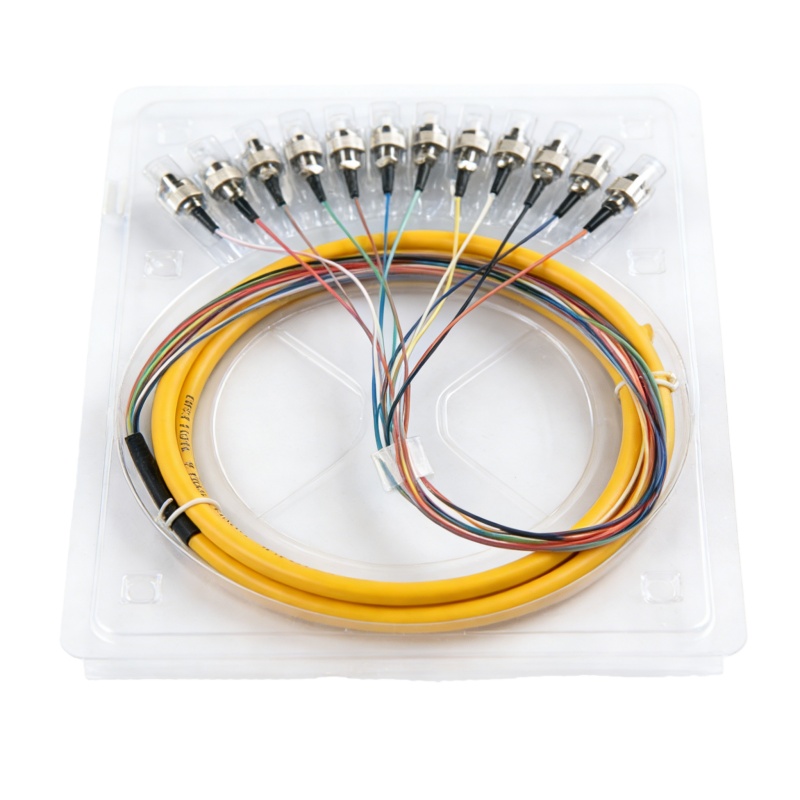
Description
Caractéristiques principales
1. Cohérence supérieure de la fabrication
-
Construit avec des matériaux avancés, durables et résistants aux facteurs environnementaux et au stress physique.
-
Les processus de fabrication automatisés garantissent la précision des dimensions et la répétabilité des performances.
-
La réduction des manipulations manuelles minimise la contamination et les variations de qualité.
2. Amélioration des performances optiques
-
Le polissage UPC de précision permet une faible perte d'insertion et une transmission stable du signal.
-
Les bagues en céramique de haute qualité garantissent un alignement précis et des connexions fiables.
-
Performances constantes sur les 12 canaux pour les applications parallèles
3. Performance monomode de première qualité
-
Fabriqué avec une fibre monomode conforme à la norme G.652.D pour des performances optimales sur plusieurs longueurs d'onde.
-
Chaque queue de cochon fait l'objet d'un test optique complet avant d'être expédiée.
-
Fiabilité éprouvée dans des installations commerciales et de niveau opérateur dans le monde entier
Spécifications techniques
| Paramètres | Spécifications |
|---|---|
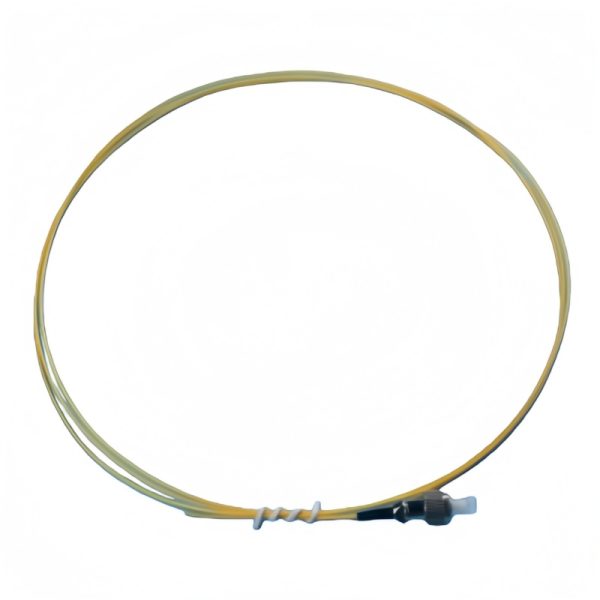
| Nom du produit | Câble de fibre à 12 fils (FC/UPC) |
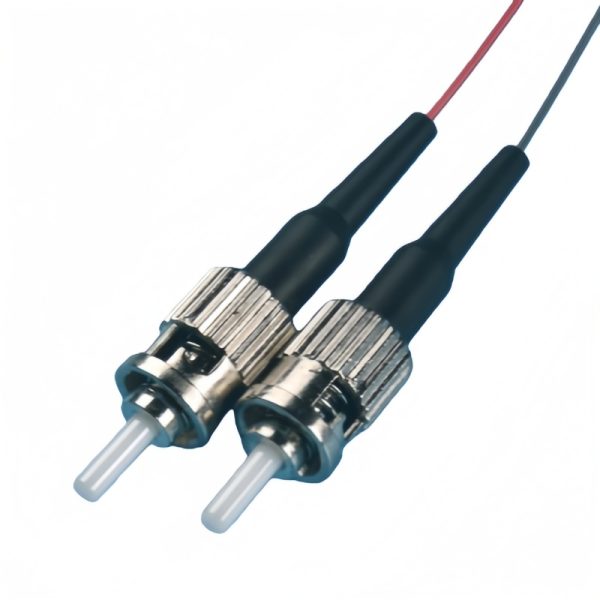
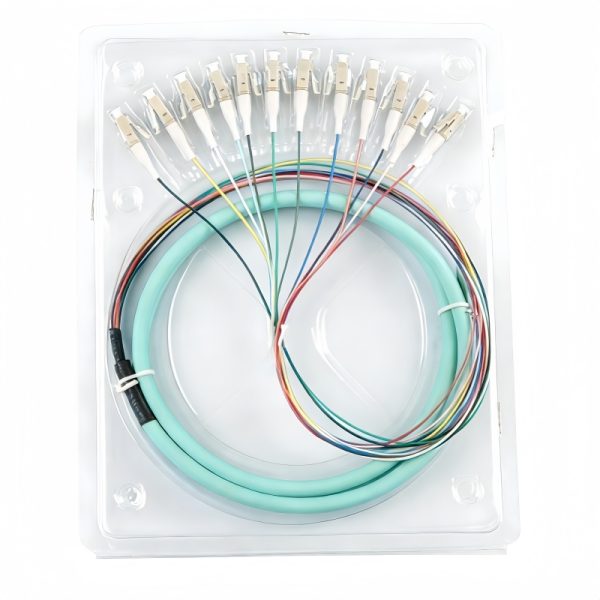
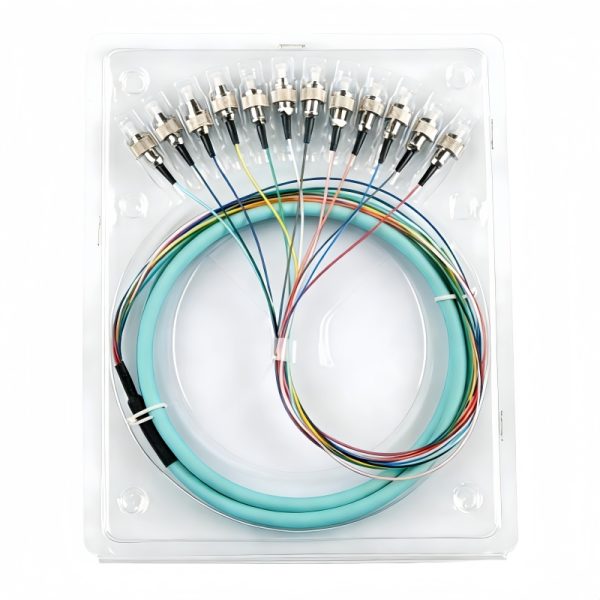
| Type de connecteur | FC/UPC (également disponible en SC/UPC, SC/APC, FC/APC, LC/UPC, LC/APC, ST/UPC) |
| Type de fibre | monomode (SM), G.652.D |
| Couleur | Jaune |
| Longueur d'onde de fonctionnement | 1310 nm, 1490 nm, 1550 nm |
| Perte d'insertion | < 0,2 dB (typique), < 0,3 dB (maximum) |
| Perte de retour | > 50 dB |
| Durabilité | ≥ 1000 cycles d'accouplement |
| Matériau du câble | LSZH (Low Smoke Zero Halogen) |
| Résistance à la traction | > 100 N |
| Température de fonctionnement | -40°C à +85°C |
Applications
-
Interconnexions de centres de données et câblage structuré
-
Équipement de bureau central de télécommunications
-
Points de distribution et nœuds d'agrégation FTTx
-
Réseaux fédérateurs d'entreprises
-
Interfaces des équipements d'essai et de mesure
-
Systèmes de radiodiffusion numérique et de transmission des médias
Questions et réponses professionnelles
Q1 : Quels sont les principaux avantages des connecteurs FC/UPC par rapport aux connecteurs FC/APC dans des applications spécifiques ?
A : Les connecteurs FC/UPC offrent des performances supérieures dans les systèmes de communication numérique où une faible perte d'insertion est prioritaire par rapport à une réflexion minimale. Avec une perte de retour typique >50 dB et une perte d'insertion <0,2 dB, ils sont idéaux pour les liaisons de données Gigabit Ethernet, 10G-40G-100G, et la transmission vidéo numérique où l'atténuation du signal est plus critique que le contrôle de la réflexion.
Q2 : Quels sont les avantages de la configuration à 12 cœurs pour les déploiements de réseaux modernes ?
A : La conception à 12 fils permet des installations à haute densité, réduisant l'espace physique requis d'environ 60% par rapport aux pigtails individuels. Cette configuration est particulièrement utile dans les centres de données, les répartiteurs de fibres et les installations GPON OLT où la densité des ports et la gestion des câbles sont des considérations importantes.
Q3 : Quels sont les protocoles de test qui garantissent la qualité de ces connecteurs UPC ?
A : Chaque connecteur est soumis à un test d'interférométrie 3D pour vérifier la rugosité de la surface (<20 nm) et le rayon de courbure (10-25 mm). Les tests optiques comprennent la vérification de la perte d'insertion TIA-455-107 et la mesure de la perte de retour IEC 61300-3-6. En outre, des essais environnementaux conformes à la norme CEI 61300-2-22 permettent de valider les performances en fonction des variations de température et des conditions de contrainte mécanique.
Q4 : Ces pigtails peuvent-ils être utilisés en extérieur ou dans des environnements difficiles ?
A : Oui, avec des panneaux de raccordement ou des boîtiers appropriés pour l'extérieur. La gaine LSZH offre une résistance à la flamme et une faible toxicité, tandis que la température nominale (-40°C à +85°C) permet un déploiement en extérieur. Pour l'enfouissement direct ou les installations aériennes, il est recommandé d'utiliser une gaine de protection supplémentaire ou des variantes blindées.
Q5 : Quelles sont les dernières normes industrielles applicables à ces composants ?
A : Ces pigtails sont conformes aux normes IEC 61754-15 (connecteurs FC), TIA-604-5 (FOCIS 5) et ISO/IEC 11801-1 Ed 3.0 pour la compatibilité OM5. Ils sont conformes à la norme GR-326-CORE Issue 4 pour la fiabilité et sont compatibles avec les spécifications ITU-T G.657.A2 pour les fibres insensibles à la courbure pour les installations à haute densité.

Commentaires
Il n'y a pas encore de commentaires.