
描述
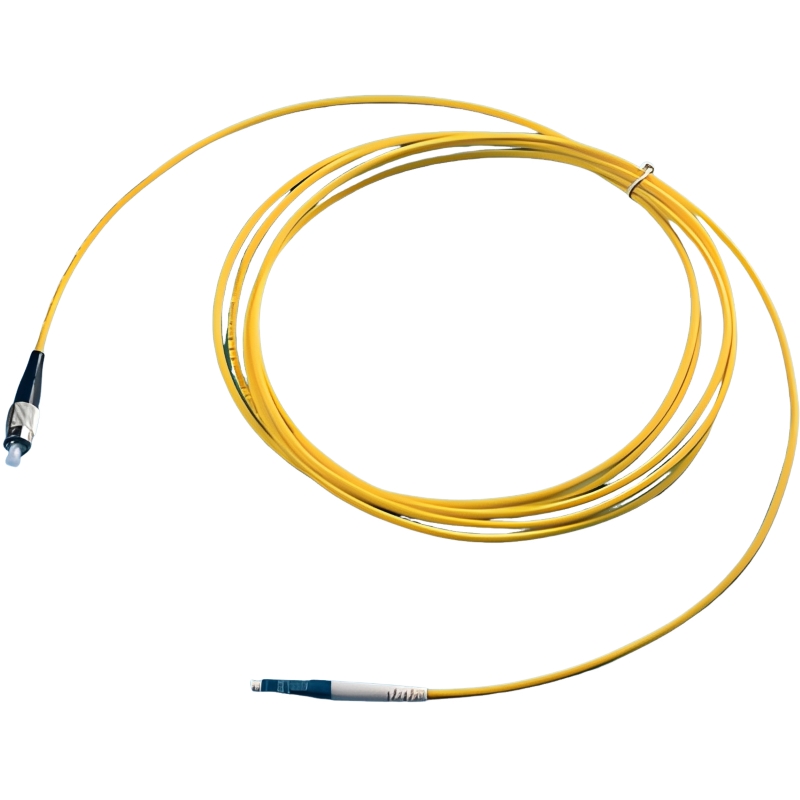
Whether you’re working with legacy OTDR testing equipment or heavy-duty telecommunication switches, this hybrid jumper ensures that different generations of tech talk to each other without dropping a single packet.
Why This Hybrid Configuration Works
The beauty of the FC/UPC to LC/UPC lies in its “best of both worlds” approach:
-
The FC End (The Tank): The FC (Ferrule Connector) is built for stability. Its threaded, metallic body screws into place, making it practically immune to vibrations or accidental tugs.
-
The LC End (The Precision): The LC (Lucent Connector) is the king of the modern data center. Its small form factor allows for high-density patching, and its “snap-in” latch gives you that satisfying click of a secure connection.
-
The UPC Polish (The Standard): By using Ultra Physical Contact (Blue) on both ends, you get a highly polished finish that keeps return loss low (typically $\geq 50\text{ dB}$) without the complexity of angled connectors.
Technical Performance Breakdown
Let’s look at the numbers that actually matter for your link budget:
| Feature | Performance Specification | The “Real World” Benefit |
| Fiber Type | Single Mode (OS2) 9/125μm | Zero distance anxiety for long-haul links. |
| Insertion Loss | $\leq 0.3 \text{ dB}$ | Practically invisible to your light source. |
| Return Loss | $\geq 50 \text{ dB}$ | Keeps back-reflection from messing with your data. |
| Jacket Material | LSZH (Yellow) | Building-code compliant and safe for the rack. |
| Durability | $1000+$ Matings | It’s built to be plugged, unplugged, and re-plugged. |
Pro-Tips for the Field
1. Cleanliness is Next to… Uptime
Because you have two different ferrule sizes (2.5mm for the FC and 1.25mm for the LC), don’t try to use the same cleaning tool for both. Use a dedicated “One-Click” cleaner for each end to avoid cross-contamination.
2. Don’t Over-Tighten the FC
It’s tempting to crank down on the FC screw-type connector. Don’t. Finger-tight is enough to seat the ceramic ferrule. Over-tightening can put unnecessary stress on the internal spring mechanism.
3. Mind the Blue
Remember, this is a UPC (Blue) cable. If you try to plug that LC/UPC end into a Green LC/APC transceiver, you’re going to see a massive spike in signal loss. Keep your colors matched.
Quick-Fire Q&A
Q: Why use FC at all in 2026?
A: Vibration. In industrial settings, maritime applications, or labs where equipment is moved frequently, the screw-on FC connector is far more reliable than a plastic snap-in latch.
Q: Can I use this for 10G or 40G?
A: Absolutely. Single-mode OS2 fiber is effectively “speed-blind.” As long as your transceivers match the 1310/1550nm wavelengths, the cable won’t be your bottleneck.
Q: Is “Simplex” (SX) outdated?
A: Not at all. With the rise of BiDi (Bi-directional) transceivers, a single fiber strand (Simplex) is often all you need to handle full-duplex communication, effectively doubling your fiber capacity.

Reviews
There are no reviews yet.