
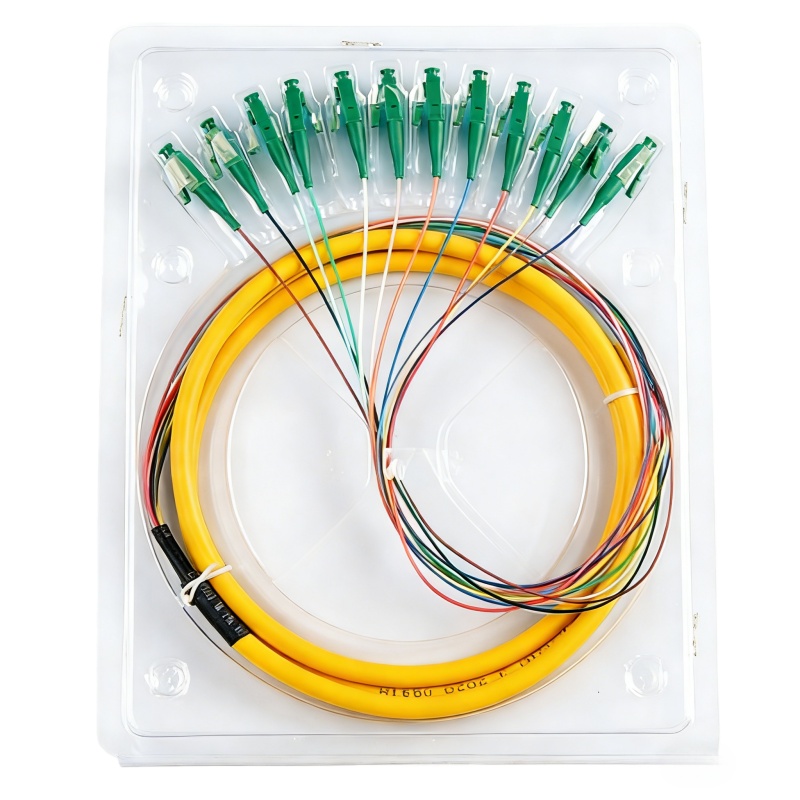
Descrição
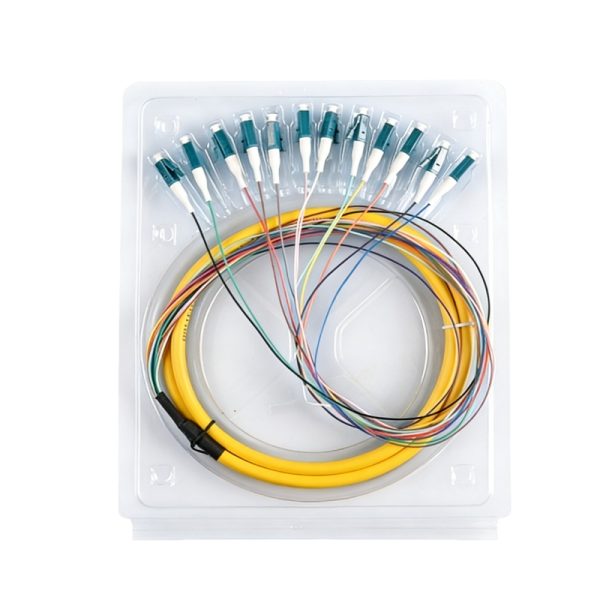
Principais vantagens do pigtail de fibra SM de 12 núcleos LC/APC
1. Repetibilidade e estabilidade ambiental inigualáveis
Fabricado com novos materiais resistentes a altas temperaturas e ecologicamente corretos, Com o pigtail de fibra de 12 núcleos, nosso pigtail de fibra de 12 núcleos foi projetado para resistir à deformação, à quebra e ao desprendimento, mesmo em ambientes externos adversos ou de alta temperatura. O processo de produção padronizado e totalmente automático minimiza a intervenção manual, garantindo qualidade consistente em todas as unidades e desempenho confiável para implantações de rede de longo prazo.
2. Baixa perda de inserção e perda de retorno líder do setor
Apresentando um Ponteira de alta qualidade com polimento em ângulo de 8°, Com o conector LC/APC, o reflexo do sinal é eliminado ao direcionar a luz dispersa para longe do núcleo da fibra, proporcionando uma perda de retorno de ≥40 dB, superando em muito o desempenho do conector UPC. Esse design também garante uma concentricidade rígida e uma precisão dimensional precisa, mantendo a perda de inserção ≤0,3 dB e a integridade do sinal para sinais CATV analógicos e tráfego PON bidirecional.
3. Núcleo de fibra monomodo de alto desempenho
Em sua essência, esse pigtail usa um fibra monomodo importada de alta qualidade que passa por rigorosos testes 100% antes da entrega. Reconhecido por engenheiros de rede em todo o mundo, esse núcleo de fibra oferece baixa atenuação e transmissão estável, o que o torna a escolha ideal para aplicações PON, CATV e FTTH em que a fidelidade do sinal não é negociável.
Especificações técnicas
| Parâmetro | Detalhes |
|---|---|
| Nome do produto | Pigtail de fibra de 12 núcleos (LC/APC-12core-SM) |
| Tipo de conector | LC/APC (compatível com SC/UPC, SC/APC, FC/UPC, FC/APC, LC/UPC, ST/UPC) |
| Tipo de fibra | Modo único (SM) |
| Codificação de cores | SM: Amarelo; MM-OM3: Aqua; MM-OM4: Magenta |
| Resistência à tensão | ≥ 1000N |
| Durabilidade | ≥ 1000 vezes de acasalamento |
| Perda de inserção | ≤ 0,3dB |
| Perda de retorno | APC≥40dB; UPC≥30dB |
| Largura de banda | ±40nm |
| Comprimento de onda operacional | 1310nm-1490nm, 1550nm-850nm |
| Material | LSZH (baixa fumaça e zero halogênio) |
Aplicações ideais
O pigtail de fibra monomodo LC/APC de 12 núcleos é otimizado para cenários de alta demanda e sensíveis à reflexão:
- Redes ópticas passivas (PON): Oferece suporte a implementações GPON/EPON minimizando a reflexão do sinal na transmissão bidirecional.
- Sistemas de TV a cabo (CATV): Garante a transmissão clara de sinais analógicos com interferência mínima para serviços de vídeo e dados de alta velocidade.
- Fibra para casa (FTTH): Oferece conectividade confiável de última milha para usuários residenciais e comerciais que precisam de acesso estável e de alta largura de banda.
- Redes metropolitanas e de longa distância: Apoia a infraestrutura de telecomunicações para provedores de serviços que implementam links de alta frequência e baixa reflexão.
Perguntas frequentes (FAQ)
P1: O que torna os conectores LC/APC melhores do que os LC/UPC para redes CATV e PON?
R: Os conectores LC/APC apresentam um polimento angular de 8° que direciona a luz refletida para longe do núcleo da fibra, obtendo uma perda de retorno de ≥40 dB - essencial para minimizar a interferência de sinal em sistemas CATV analógicos e PON bidirecionais. Por outro lado, os conectores LC/UPC (perda de retorno ≥30 dB) são mais adequados para redes de dados digitais em que a sensibilidade à reflexão é menor.
P2: Como o design de 12 núcleos simplifica as implementações de PON?
R: O design de 12 núcleos consolida 12 fios de fibra em um único pigtail compacto, reduzindo a confusão de cabos e permitindo conexões de várias fibras em uma única etapa de instalação. Isso reduz os custos de mão de obra e o tempo de implementação, tornando-o ideal para pontos de distribuição PON de alta densidade.
P3: Quais são os padrões do setor com os quais os pigtails LC/APC estão em conformidade?
R: Todas as unidades seguem os padrões IEC 61753-1 (para desempenho) e Telcordia GR-326 (para confiabilidade), garantindo a conformidade com os requisitos globais de telecomunicações e data centers. Também seguimos as diretivas RoHS para segurança ambiental.
P4: Por que o material LSZH é essencial para os pigtails de fibra em espaços fechados?
R: O material LSZH (Low Smoke Zero Halogen) emite o mínimo de fumaça e gases tóxicos quando exposto ao fogo, aumentando a segurança em ambientes fechados, como data centers e prédios de apartamentos. Isso faz com que nossos pigtails estejam em conformidade com as rigorosas normas de segurança contra incêndio na UE, na América do Norte e na Ásia.

Comentários
Ainda não há comentários.