
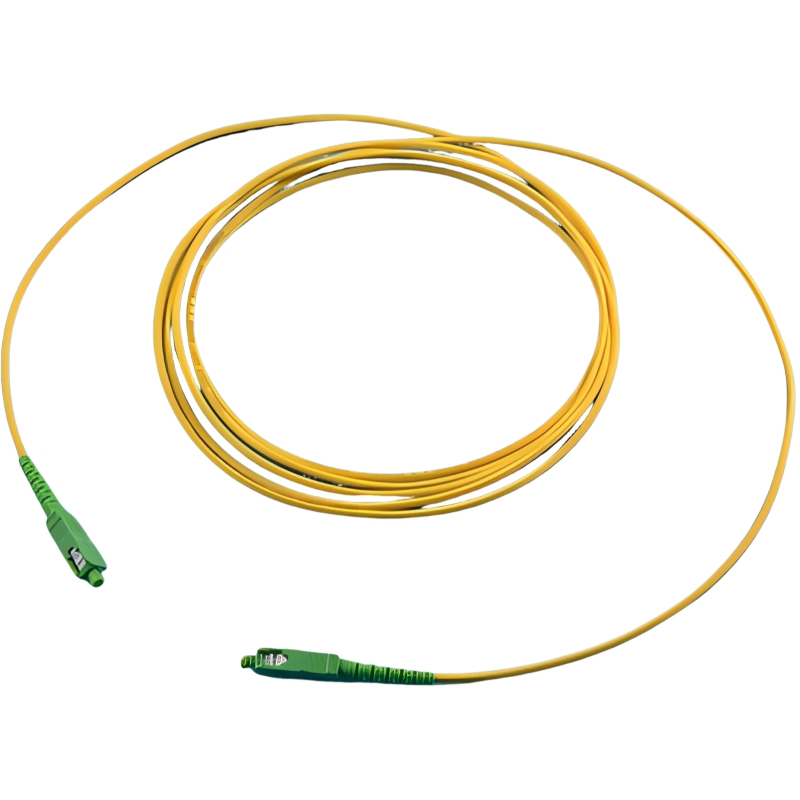
Descrição
Technical Specifications: The 2026 Benchmark
Our SC/APC jumpers are built using high-performance G.657.A1 or G.652.D fiber, ensuring they meet the stringent requirements of modern high-speed infrastructure.
| Parâmetro | 2026 Industry Standard | Benefício |
| Tipo de conector | SC/APC para SC/APC | Universal compatibility for ODFs & ONTs |
| Fiber Grade | Single Mode (OS2) 9/125μm | Long-distance signal stability |
| Perda de inserção | Típico $\leq 0.2 \text{ dB}$ | Maximum power efficiency |
| Perda de retorno | $\geq 65 \text{ dB}$ | Essential for video and PON stability |
| Jacket Diameter | 2.0mm / 3.0mm | Rugged protection for indoor routing |
| Temperatura de operação | $-40\text{°C to } +85\text{°C}$ | Reliable in extreme environments |
| Conformidade com os padrões | Telcordia GR-326-CORE | Guaranteed intermateability |
In 2026, the SC/APC para SC/APC Simplex monomodo (SM SX) patch cord remains the undisputed king of broadband and telecommunications. Often referred to as the “Subscriber Connector,” this cable is the backbone of global FTTH (Fiber to the Home) and CATV deployments.
If you are looking for a reliable, cost-effective link for a GPON or XGS-PON network, this is the industry-standard “green-to-green” jumper.
Technical Specifications: The 2026 Benchmark
Our SC/APC jumpers are built using high-performance G.657.A1 or G.652.D fiber, ensuring they meet the stringent requirements of modern high-speed infrastructure.
| Parâmetro | 2026 Industry Standard | Benefício |
| Tipo de conector | SC/APC para SC/APC | Universal compatibility for ODFs & ONTs |
| Fiber Grade | Single Mode (OS2) 9/125μm | Long-distance signal stability |
| Perda de inserção | Típico $\leq 0.2 \text{ dB}$ | Maximum power efficiency |
| Perda de retorno | $\geq 65 \text{ dB}$ | Essential for video and PON stability |
| Jacket Diameter | 2.0mm / 3.0mm | Rugged protection for indoor routing |
| Temperatura de operação | $-40\text{°C to } +85\text{°C}$ | Reliable in extreme environments |
| Conformidade com os padrões | Telcordia GR-326-CORE | Guaranteed intermateability |
Why SC/APC is the Global Standard for FTTH
1. The “Push-Pull” Convenience
The SC connector’s square, plastic housing features a simple push-pull latching mechanism. Unlike the screw-on FC connector, the SC is designed for quick, audible engagement. This makes it the preferred choice for field technicians and consumers alike.
2. High Return Loss for Video & Data
In 2026, with the rollout of 50G-PON and higher-frequency CATV signals, back-reflection is a critical enemy. The 8-degree APC (Contato Físico Angular) polish ensures that reflected light is directed into the fiber cladding, keeping the return loss at a superior $\geq 65\text{dB}$.
3. Cost-Effective Durability
The SC connector’s larger 2.5mm ceramic ferrule provides a robust mating surface that is less sensitive to microscopic dust than smaller connectors. It is the most cost-effective solution for high-volume subscriber deployments without sacrificing performance.
4. Safety First with LSZH
Our SC/APC-SC/APC-SM-SX cables are jacketed with LSZH (baixa fumaça e zero halogênio) materials. This ensures that in the event of a fire, the cable will not emit the toxic gases or heavy smoke found in standard PVC jackets—a mandatory requirement for modern residential and office buildings.
Professional Q&A: Field FAQ
Q1: Why can’t I use a Blue (SC/UPC) patch cord instead of this Green (SC/APC) one?
A: In a PON or CATV network, using a UPC connector will cause significant “noise” due to back-reflection. This can lead to pixelation in video signals or increased bit-error rates (BER) in high-speed data. Furthermore, physical contact between a flat UPC and an angled APC can permanently damage the fiber faces.
Q2: Is “Simplex” (SX) sufficient for my Gigabit internet connection?
A: Yes. Most FTTH systems use a single fiber strand to both send and receive data (using WDM technology like 1310nm/1490nm). Therefore, a Simplex (SX) cable is exactly what is needed for the final link to your ONT or router.
Q3: How do I know if I need a 2.0mm or 3.0mm jacket?
A: For routing inside tight patch panels or desktop settings, 2,0 mm is more flexible. If the cable is exposed or hanging in an open rack, the 3,0 mm jacket offers better tensile strength and protection against physical stress.
Q4: Can this cable support 10G or 25G speeds?
A: Absolutely. The OS2 single-mode fiber core has a bandwidth capacity far exceeding current 10G/25G/50G standards. As long as your transceivers are compatible, this cable is future-proof.

Comentários
Ainda não há comentários.