
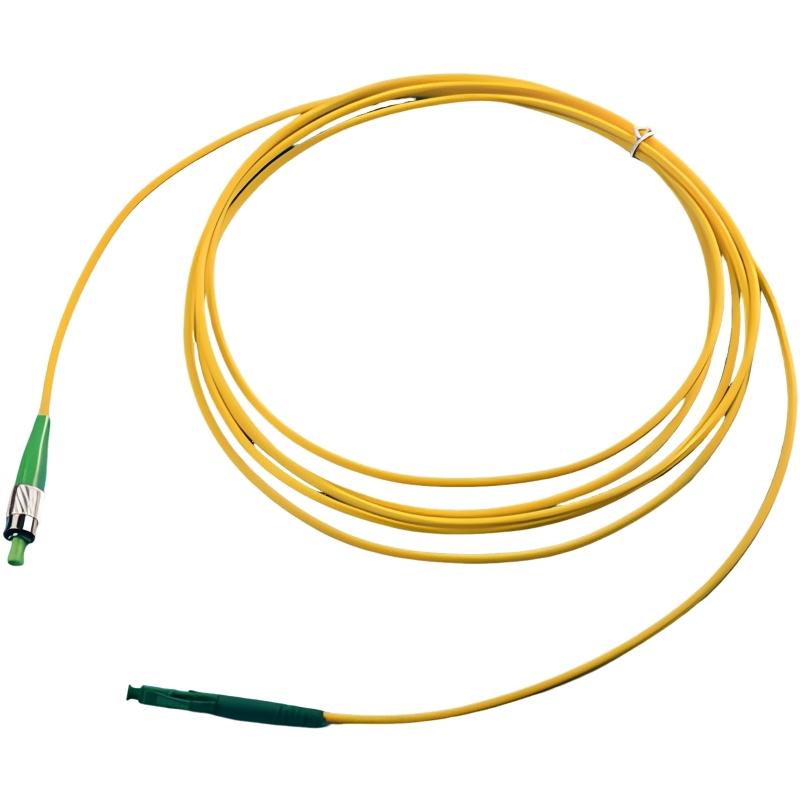
In the hyper-evolving landscape of telecommunications, the Fiber Optic Patch Cord—often dismissed as a simple “plug-and-play” accessory—has become the single most critical link in the signal chain. As we cross the threshold into 800G Ethernet and Terabit-scale AI clusters, the physical layer faces unprecedented scrutiny.
In 2026, a patch cord is no longer just a piece of glass; it is a high-precision optical instrument. A single fingerprint or a sub-micron misalignment in the connector ferrule can now lead to catastrophic packet loss in a multi-million dollar data center environment. This guide explores the engineering, physics, and strategic selection of fiber patch cords for modern infrastructure.
1. The Physics of the “Last Meter”: Material Science in 2026
The performance of a patch cord is dictated by the interaction between the optical fiber core, the cladding, and the mechanical housing.
Bend-Insensitive Fiber (BIF): The New Standard
Historically, standard G.652.D fiber was prone to “leakage” if bent too sharply. In 2026, the industry has almost entirely transitioned to G.657.A2 for single-mode and OM4/OM5 for multi-mode. These fibers utilize a “trench” of lower-refractive-index material that reflects light back into the core even during extreme bends. This is vital for high-density 1U panels where cables are frequently tucked into tight corners.
Ferrule Precision and Zirconia Quality
The heart of the connector is the Zirconia Ceramic Ferrule. Lower-tier manufacturers often use composite materials, but 2026 premium standards demand high-purity zirconia to ensure that the “Center-to-Core” alignment remains within a tolerance of $\leq 0.5 \mu\text{m}$. Any deviation beyond this results in Lateral Offset Loss, which becomes exponential as data rates increase.
2. Advanced Categorization and Performance Metrics
When sourcing patch cords for enterprise or carrier-grade networks, technical specifications must be evaluated against the Optical Power Budget.
Table 1: Detailed Optical Performance Matrix (2026 Standards)
| Parameter | Ultra-Low Loss (ULL) | Standard Grade | Economy Grade |
| Fiber Type | G.657.A2 / OM5 | G.652.D / OM4 | G.652 / OM3 |
| Insertion Loss (Typical) | $\leq 0.07\text{ dB}$ | $\leq 0.25\text{ dB}$ | $\geq 0.35\text{ dB}$ |
| Return Loss (APC) | $\geq 70\text{ dB}$ | $\geq 60\text{ dB}$ | $\geq 50\text{ dB}$ |
| Eccentricity | $< 0.2 \mu\text{m}$ | $< 0.5 \mu\text{m}$ | $< 1.0 \mu\text{m}$ |
| Jacket Material | LSZH-Plenum | LSZH | PVC |
| Ideal Use Case | 800G AI Backend | Enterprise Core | Legacy 1G/10G |
3. The Evolution of Connectors: From LC to VSFF
As port density increases, the physical space available for connectors has shrunk. We are currently witnessing a transition from traditional connectors to Very Small Form Factor (VSFF) solutions.
The MTP/MPO Revolution
For backbone links, MTP (Media Termination Patch) connectors are essential. In 2026, we see a heavy shift toward MTP-16 and MTP-32 to support parallel optics. Unlike standard LC connectors, MPO connectors require precise Polarity Management (Method A, B, or C) to ensure the transmitter at one end hits the receiver at the other.
VSFF: SN, MDC, and CS Connectors
To maximize the capacity of a single QSFP-DD or OSFP transceiver, new connectors like the SN (Senko) and MDC (US Conec) allow for individual duplex pairs to be broken out directly at the transceiver face. This eliminates the need for bulky breakout cables and allows for up to 432 fibers in a single 1U rack space.
Table 2: Connector Capacity & Application Mapping
| Connector Type | Fiber Count | Density (per 1U) | Primary Application |
| Standard LC Duplex | 2 | 144 Fibers | General Purpose Networking |
| LC Uniboot | 2 | 192 Fibers | High-Density Patching |
| MTP/MPO-12 | 12 | 864 Fibers | 40G/100G Trunks |
| MTP/MPO-24 | 24 | 1,728 Fibers | 400G/800G Parallel Optics |
| MDC / SN | 2 | 432 Fibers | 800G Breakout Architecture |
4. The LSZH vs. OFNP Debate: Safety and Compliance
In 2026, regulatory compliance is no longer optional.
- LSZH (Low Smoke Zero Halogen): The standard for Europe and many parts of Asia. In the event of a fire, it emits no toxic halogen gases and very little smoke.
- OFNP (Plenum Rated): The highest fire rating in North America. These cables are designed for use in “plenum” spaces (air ducts) and are coated with flame-retardant materials like Teflon.
- Armored Patch Cords: For industrial environments, a spiral stainless steel tape is added under the jacket. This provides Crush Resistance of over $3000\text{N}/100\text{mm}$, protecting the glass from being pinched by heavy equipment or foot traffic.
5. Maintenance 2.0: The “Zero-Contamination” Mandate
With the move to higher frequencies, the “Inspect, Clean, Connect” mantra has become an automated reality. Modern transceivers use PAM4 modulation, which is significantly more sensitive to noise than older NRZ systems.
- Automated Inspection: Technicians now use AI-integrated scopes that provide a “Pass/Fail” result based on the IEC 61300-3-35 standard.
- Dry vs. Wet Cleaning: In 2026, “Click-cleaners” (Dry) are preferred for routine maintenance, while “Wet-to-Dry” cleaning with specialized solvents is reserved for stubborn oils or residues.
- End-face Geometry: Beyond just being clean, the shape of the connector tip (Apex offset, Radius of curvature) is now audited during high-tier installations to ensure perfect physical contact.
6. Future-Proofing with OM5 and Singlemode
Is Multimode dead? Not yet. While Singlemode (OS2) is the king of distance, OM5 (Wideband Multimode) is gaining ground in the data center. OM5 allows for Shortwave Wavelength Division Multiplexing (SWDM), enabling 100G to be transmitted over a single pair of fibers by using four different wavelengths (850nm, 880nm, 910nm, and 940nm).
Industry Expert Q&A: Deep Dive
Q1: Why is Return Loss (RL) more critical than Insertion Loss in 2026?
A: As we reach 800G speeds, laser sources become extremely sensitive to “back-reflection.” High back-reflection (low RL) causes laser instability and increases the Bit Error Rate (BER). While $0.3\text{dB}$ of loss (IL) is manageable, a bad return loss can effectively “blind” the transceiver, causing the link to drop entirely.
Q2: Can I use G.657.B3 fibers in a standard data center?
A: G.657.B3 is “Ultra-Bend-Insensitive” (5mm bend radius). While excellent for FTTH (Fiber to the Home) installations where cables go around sharp corners in molding, it can sometimes have a higher splice loss when joined with standard G.652.D core fiber. For data centers, G.657.A2 is the optimal balance of performance and compatibility.
Q3: What is the impact of “Polarity Flip” in MPO systems?
A: In an MPO system, if the polarity is wrong, your light is hitting a “dark” pin rather than a receiver. In 2026, we use Universal Polarity components that allow technicians to flip the polarity in the field without replacing the entire cable, saving thousands in emergency shipping and downtime.
Q4: How does temperature affect patch cord performance in outdoor cabinets?
A: Extreme heat can cause the plastic buffer to expand at a different rate than the glass (Coefficient of Thermal Expansion mismatch). This leads to micro-bending. Always ensure that patch cords used in non-climate-controlled environments are rated for $-40^{\circ}\text{C}$ to $+85^{\circ}\text{C}$ and utilize an “Aramid Yarn” (Kevlar) strength member.