
A splice crew working a 288-fiber feeder does not count fibers; they read colors. The same discipline reaches all the way back to the purchase order: when a cord, pigtail or adapter arrives in the wrong color, the mistake is caught at the receiving dock or, worse, during commissioning. This guide sets out the TIA-598 twelve-color sequence, the jacket and connector colors that identify fiber grade at a glance, and the ordering details that keep a color-coded plant consistent from one reel to the next.
The Master Twelve-Color Sequence
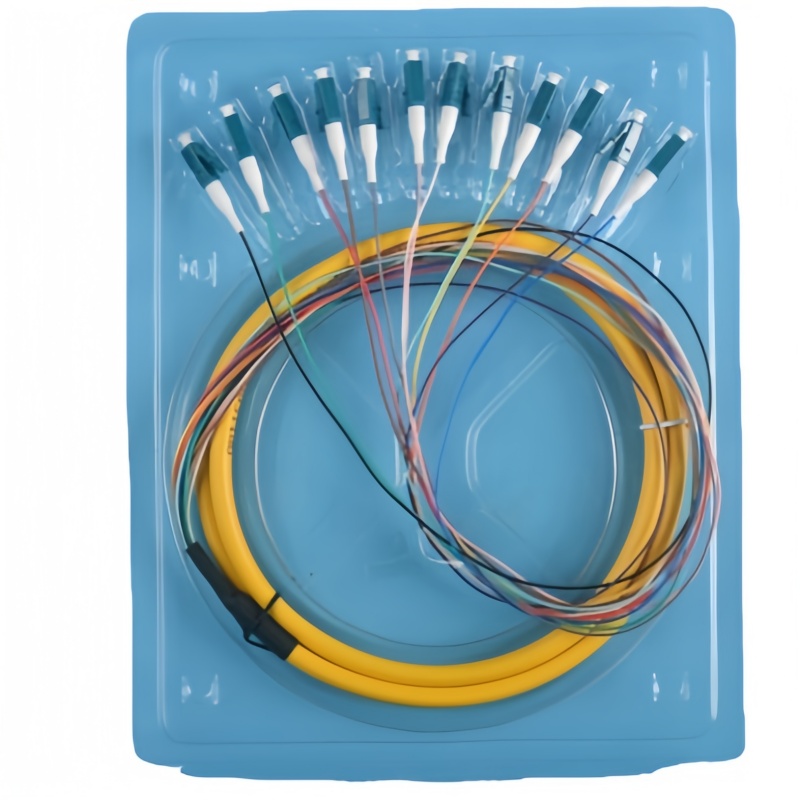
TIA-598, maintained by the Telecommunications Industry Association, assigns every fiber and buffer tube position in a cable one of twelve fixed colors. Position 1 is always blue, and the sequence runs through aqua at position 12. In a loose-tube cable the buffer tubes carry the same colors as the fibers inside them, which is what lets a crew open a cable, find the blue tube, and know exactly which fiber they are holding without a meter.
The twelve colors are chosen to survive both factory and field: no two positions share a similar hue, and the set avoids shades that fade or blur under sodium and LED street lighting. The same logic extends to hardware. An ODF labeled in position order, a splice tray numbered the same way and a pigtail fan-out in boot-color order all reference one sequence, so a fiber identified as position 4 at the cable sheath is position 4 in the tray and port 4 on the panel. Buyers benefit most when several vendors supply one link — a cable from one mill, pigtails from another, adapters from a third — because the standard, not any single vendor, carries the identification.
| المنصب | اللون | المنصب | اللون |
|---|---|---|---|
| 1 | أزرق | 7 | أحمر |
| 2 | برتقالي | 8 | أسود |
| 3 | أخضر | 9 | أصفر |
| 4 | براون | 10 | فيوليت |
| 5 | Slate (grey) | 11 | Rose (pink) |
| 6 | أبيض | 12 | أكوا |
Above twelve units the colors repeat with a contrasting tracer, and this is where regional practice splits. Under TIA-598 the second group is commonly striped black — position 20, nominally black itself, gets a yellow stripe instead because a black ring on a black fiber is invisible. Some IEC-aligned makers leave that fiber natural and uncolored. Two crews splicing a TIA-striped cable to an IEC-striped one can therefore produce a “missing fiber” panic that is pure labeling artifact. Manufacturer color code guides publish the exact convention per design, so request the color sheet with every reel of high-count cable and file it with the splice plan; an independent TIA-598 identification sheet shows how the two conventions sit side by side. The جمعية الألياف الضوئية keeps a reference table of connector identifiers worth printing for the toolbox.
Jacket and Connector Colors Identify the Grade
The outer jacket answers the first question a buyer is asked at goods-in: what grade of glass is on this reel? TIA-598 fixes jacket color for premises cables — yellow for single-mode, orange for legacy multimode, aqua for laser-optimized 50 µm grades, lime for OM5 — and the connector housing on each end repeats the same information, because that is what remains visible after the cable is dressed in a rack.
| لون السترة | Fiber grade | Typical connector housing |
|---|---|---|
| أصفر | OS1 / OS2 single-mode | Blue (UPC) or green (APC) |
| برتقالي | OM1 / OM2 62.5 or 50 µm | بيج |
| أكوا | OM3 / OM4 laser-optimized | Aqua; violet on some OM4 builds |
| أخضر ليموني | OM5 wideband 50 µm | Lime |
| أسود | Outside plant, any grade | Read the printed sheath legend |
Two exceptions matter on real orders. Outdoor cables are black regardless of grade because the jacket compound is colour-restricted, so the printed legend — fiber count, grade, manufacture date — carries the identification instead. And hybrid or fire-rated premises cables may substitute a printed legend for jacket color when the flame-rated compound limits the palette. When ordering cords, state the fiber grade explicitly rather than naming a color: violet and aqua both appear on OM4 cords depending on the maker, and a goods-in clerk cannot be expected to adjudicate. Our سلك تصحيح الألياف البصرية متعدد الأنماط و single-mode fiber optic patch cord ranges are built to the jacket and housing colors above as standard.
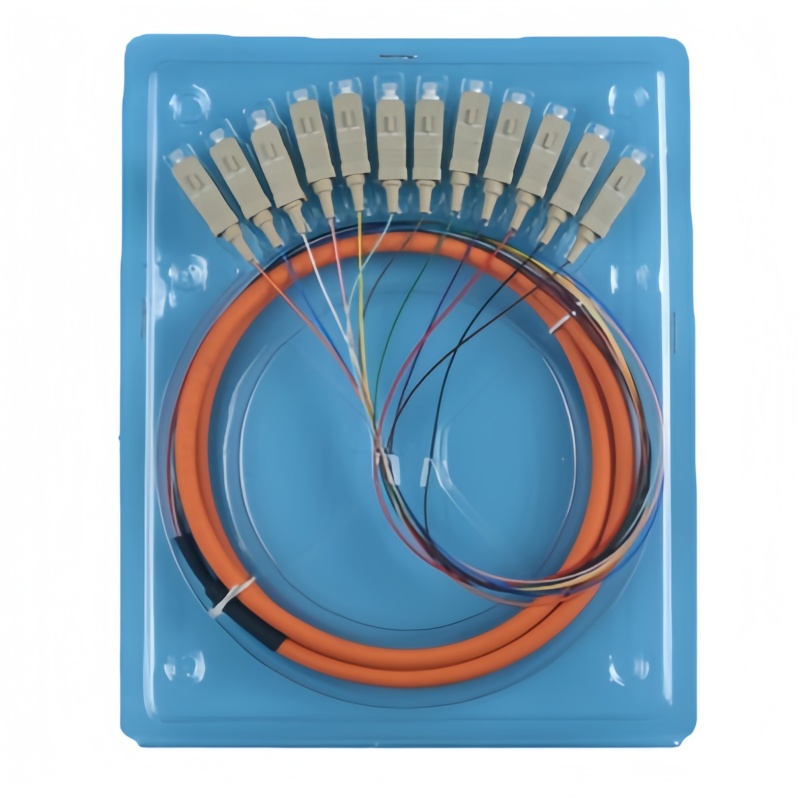
Jacket aging is worth a word for buyers planning long dwell times in outdoor cabinets. Yellow single-mode jackets chalk and drift toward cream after years of UV exposure, and aqua OM3 fades measurably in direct sun, which is why identification on outdoor-rated cordage should never rest on color alone — the printed sheath legend, the dust cap marking and the worksheet all carry the position number. Indoors the colors stay stable for the life of the installation, which is exactly what makes the discipline worthwhile there.
Adapter Panels and Boots Repeat the Code
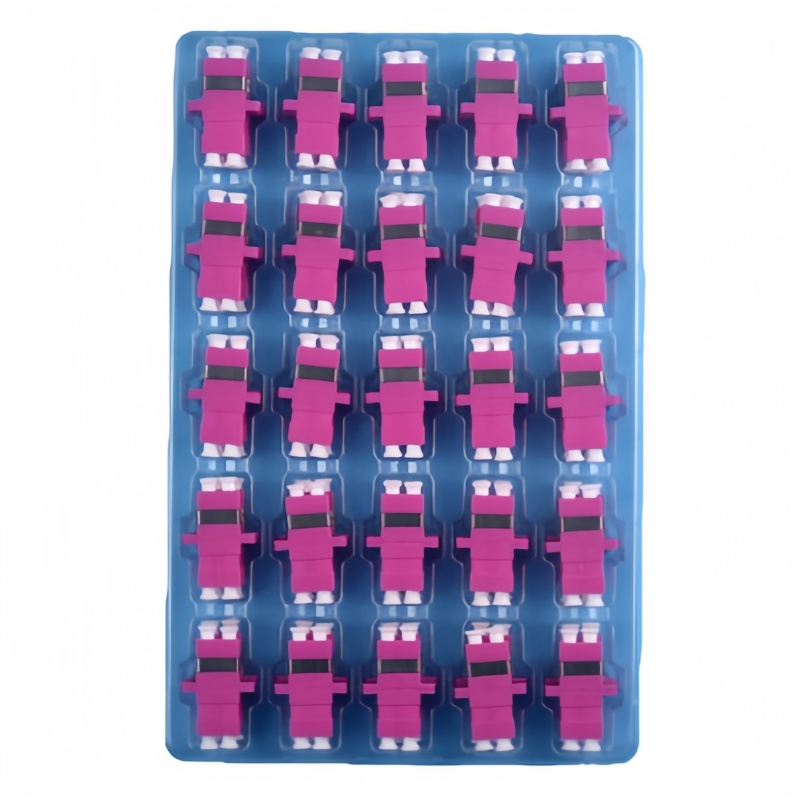
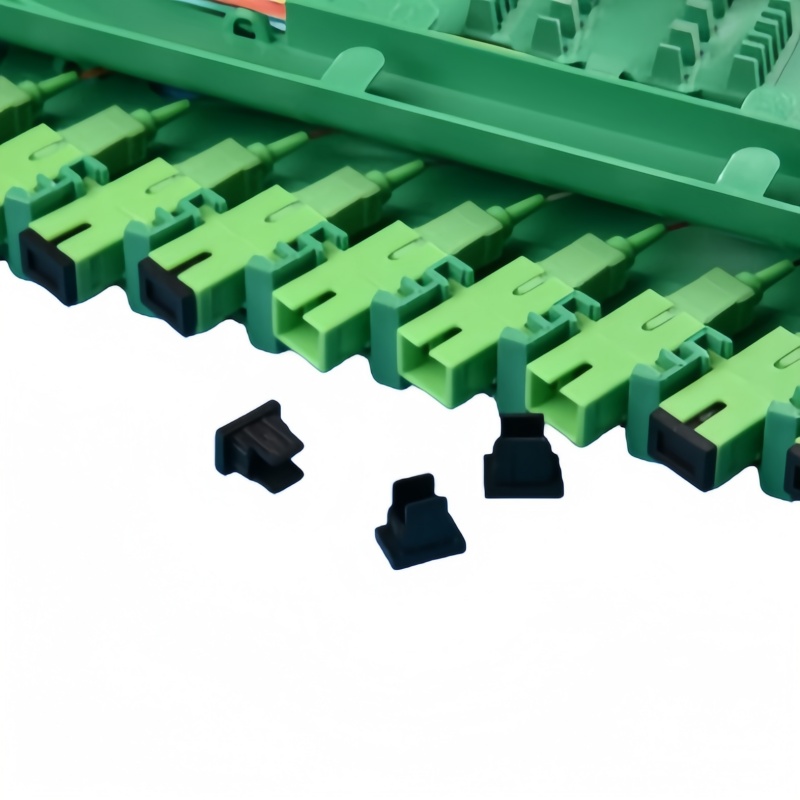
Color discipline does not stop at the cord. Adapter housings follow the same table — blue single-mode UPC, green single-mode APC, aqua and violet multimode — which is why a panel of green adapters behind blue-patched ports is visible evidence of a polish mismatch before a single meter is tested. Specifying the محول الألياف البصرية color to match the cord polish turns the panel itself into a permanent label, one that survives repatching and new technicians.
On 0.9mm fan-out pigtails the 900 µm boots take the twelve-color sequence, so a 12-core pigtail enters the tray blue-first and the crew can fan the legs straight onto the tray in position order without a second identification pass. The polish rule still dominates: an APC pigtail is green-housed whatever its boot color, so the boot never overrides the housing when the two are read together.
There is a maintenance dividend too. A technician troubleshooting a dark port checks the adapter color first: green housing confirms APC at a glance, blue confirms UPC, and a mismatch — the classic green adapter behind a blue cord — is found before the meter is unpacked. Panels ordered with mixed colors, one block per service, let a single wall of adapters carry single-mode and multimode traffic without a paper label, and keep the two from being cross-patched when a new hire dresses the rack at speed.
Position Discipline in Trays and ODFs
The sequence earns its money during termination. In a splice tray, fibers are laid in position order starting with blue at port 1 and proceeding clockwise or counterclockwise per the tray’s printed numbering — the direction matters less than agreeing it once and never varying. A 12-core 12-core fiber pigtail fanned onto an ODF should land with boot 1 at adapter 1; when the fan-out order drifts, the labeling on the front panel no longer matches the glass behind it, and every future fault call starts with a polarity hunt.
Higher-count builds need the same habit scaled up. A 24-core cable terminated through two 12-core pigtails should be split so that fibers 1–12 land on the first group and 13–24 on the second, with the ring-marked fibers mapped on the splice worksheet before fusion starts. Crews who keep a صينية لصق الألياف البصرية layout drawing beside the tray close out jobs in half the time of those who re-derive the order every visit.
Documentation closes the loop. The splice worksheet should record the color, the position and the reel number of the cable section each fiber came from, because that combination is what an OTDR operator needs to locate a break in the middle of the night. Legacy plants that predate disciplined color use — early OM1 runs in all-orange cords, hand-written panel labels — are worth auditing during the next upgrade window: re-patching those links into color-coded cords and re-labeling the panels typically takes a shift per rack and removes a permanent source of misidentification.
Pitfalls Matrix: Where Color Coding Goes Wrong
The recurring failures cluster into a short list. Each one is cheap to prevent at the purchase order and expensive to discover in the field.
| Pitfall | What happens | الوقاية |
|---|---|---|
| Ordering “blue connectors” without polish | UPC arrives where APC was designed in | State polish type on the PO; green is the only APC housing |
| Naming a color instead of a fiber grade | Violet vs aqua OM4 dispute at goods-in | Specify grade (OM4, OS2) and let color follow the standard |
| Splicing TIA-striped to IEC-striped cable | Position 20 appears uncolored or mis-striped | Request the manufacturer color sheet per reel; map before fusion |
| Fan-out order drifting from panel numbering | Front labels no longer match the glass | Boot 1 blue at port 1; lock direction on the worksheet |
| Counting ring-marked tubes as solid colors | Tubes 13–24 read as duplicates of 1–12 | Confirm tracer convention before the crew opens the cable |
Fenxi builds patch cords, pigtails and adapter panels to the TIA-598 sequence with grade-correct jacket and housing colors on every order, and ships the color sheet with each reel on request. Send your fiber counts, polish types and panel layouts, and our engineers will confirm the color-coding specification before production starts.