
Most buyers meet the duplex LC uniboot patch cord for the first time in a rack that has run out of room: a 1U switch face, 48 ports, and a thumb-thick bundle of zipcord that blocks airflow and buries the latches. Uniboot construction puts both fibres of the duplex channel into one slim round jacket terminated in a single integrated housing, which roughly halves the cable bulk and turns polarity into a field decision instead of a warehouse decision. This guide sets out what actually changes with uniboot, which values belong in the purchase order, and where the price premium pays back — and where it does not.
What a Uniboot Cord Changes Inside the Rack
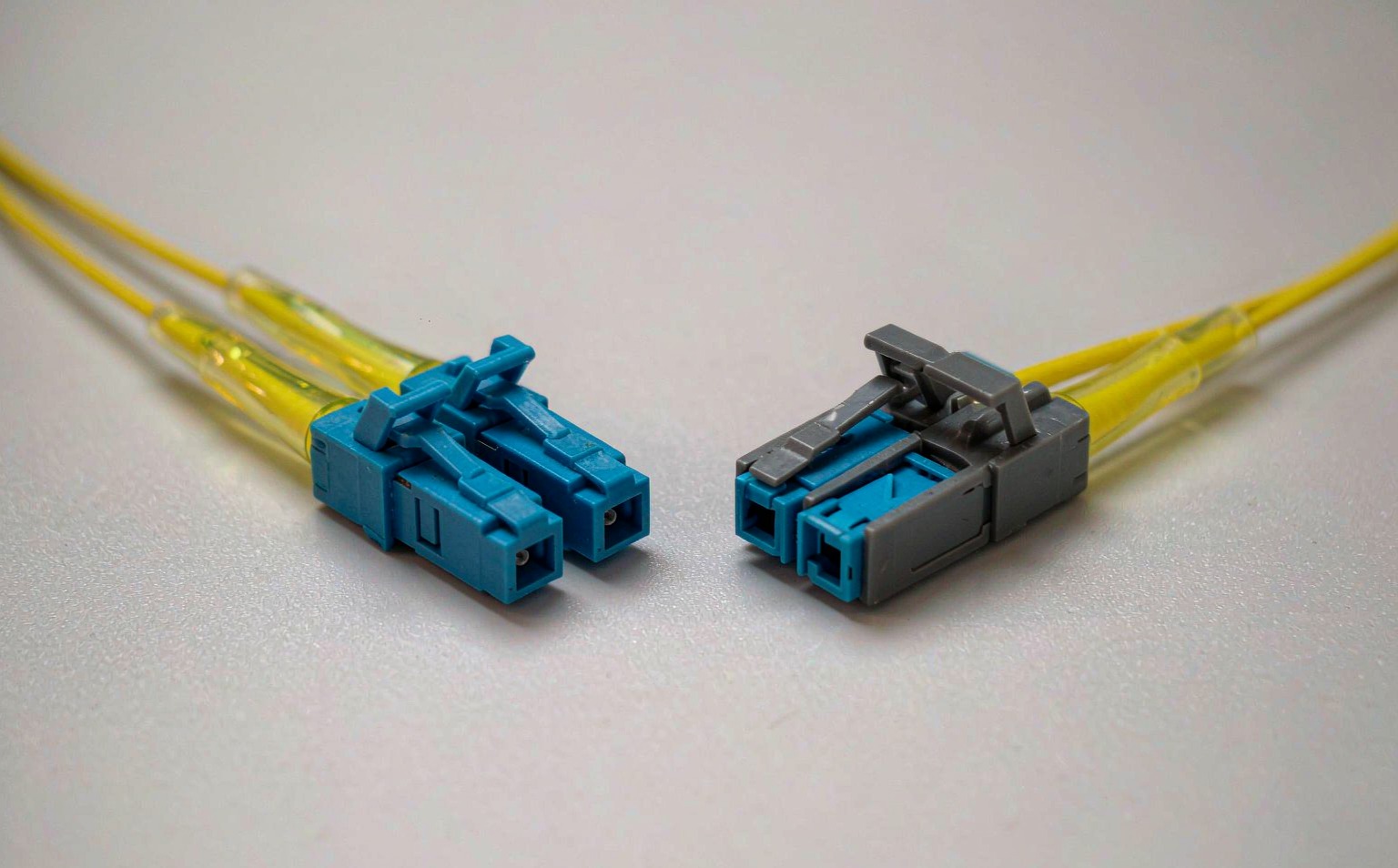
A standard duplex LC cord is two simplex cables joined by a plastic clip: each fibre has its own jacketed leg, and the two connectors hang together through a duplex clip at both ends. A uniboot cord routes both fibres through a single round jacket and terminates them in one connector body with a single boot. Electrically and optically nothing moves — the same two ceramic ferrules mate into ordinary LC adapters, so panels, cassettes and transceivers do not change. The FOA connector identification guide treats both as LC under the same interface family, and suppliers build both to the same ferrule dimensions.
What changes is the material around the fibre. Halving the jacket count lowers the cable fill in trays and vertical managers, opens airflow paths through the rack, and leaves room for a latch you can actually reach. Most uniboot designs also carry an extended push-pull tab, so a cord can be released from a packed panel without fitting a finger between neighbouring connectors — the daily reality on a fully populated 48-port switch face. See the LC connector family for the interface options and our Glasfaser-Patchkabel for the standard-duplex equivalents.
Uniboot vs Standard LC Duplex: the Field-by-Field Comparison
| Attribut | Standard LC duplex | LC uniboot | What it means for the PO |
|---|---|---|---|
| Cable body | Two jacketed legs plus clip | One round jacket, one boot | Quote the jacket OD of the finished cord, not the leg OD |
| Cable volume | Basislinie | Up to about 50% less | More ports per tray and manager |
| Polarity change | Swap legs or re-terminate | Field-reversible on switchable models | One SKU covers both polarities |
| Removal in dense rows | Standard latch, needs finger access | Push-pull tab | Specify tab length for packed panels |
| Insertion loss, UPC, typical | 0.3 dB max | 0.3 dB max | No optical penalty from the format |
| Purchase price | Unter | Roughly 1.5 to 2 times higher | Justify through labour and spares, not unit price |
The interface itself is unchanged: the LC duplex format is standardised under IEC 61754-20 and TIA-604 FOCIS 10, and the cabling-side polarity language lives in TIA-568.3-D, published by the TIA. Because the optical interface is identical, uniboot is a mechanical and workflow decision, not a transmission decision — which is also why it needs to be justified on cost and density rather than on datasheet loss figures.
Switchable Polarity: One SKU Carries Both A and B
A duplex channel is Tx-to-Rx in both directions. If that A-to-B relationship is flipped anywhere in the path, the link stays dark, and the fault looks like a dead transceiver. On a standard duplex cord the fix is physical: unclip, swap the two connectors, or pull a reversed SKU from the spares bin. On a switchable uniboot the fix is a mechanism inside the housing.
The field procedure is short and repeatable: release the connector with the push-pull tab, slide the boot housing back so the two ferrules come free, swap the ferrule positions A-to-B, re-seat the housing until it clicks, then re-mate and verify with a visual fault locator or link test. No fibre is cut and no connector is re-polished, so the reversal can be repeated across the life of the cord. The practical result is that one part number covers both polarities, which collapses the spares shelf and removes the most common cause of a polarity mismatch discovered during commissioning. Ask the supplier to state, in writing, whether the polarity mechanism is rated for repeated switching and whether the swap is tool-free on the exact model quoted — designs differ between flat-clip and push-pull families.
Diameter and Jacket: 1.6 mm, 2.0 mm and 3.0 mm
Uniboot comes in jacket diameters, and the density benefit is realised through how slim the chosen diameter is. The trade-off is handling: slimmer cords pack tighter but want more care in strain relief.
| Jacke | Typical position | Bend behaviour | Watch-outs |
|---|---|---|---|
| 1.6 mm uniboot | Highest-density switch faces and congested trays | Tightest minimum bend radius | Confirm tensile load and strain-relief boots; do not exceed rated pull force |
| 2.0 mm uniboot | Default for data-centre patching and cross-connects | Comfortable routing in trays | The most common quoting base; check fire rating per building code |
| 2.0/3.0 mm duplex zipcord | Low-density telecom rooms, industrial and long runs | Larger radius, easier handling | Lower unit cost; bulk grows fast above about 100 cords per rack |
Jacket material is a separate decision from diameter. LSZH suits enclosed rooms and transport applications, OFNR and OFNP riser and plenum ratings follow the building code, and the same rules apply to uniboot as to any other patch cord construction. Colour codes still signal the fibre: yellow for single-mode OS2, aqua for OM3/OM4, lime for OM5.
Fibre Grade, Polish and the Loss Limits to Write Down
The uniboot format carries any glass, so the fibre choice follows the optics exactly as on a standard cord. For single-mode, OS2 matched to ITU-T G.652.D is the general default, while bend-insensitive G.657.A1 earns its keep behind dense panels and inside slim trays where routing radii are short; both options are listed under our Single-Mode-Patchkabel. For multimode, OM3 and OM4 cover 10G to 100G-SR runs inside the data centre and OM5 adds shortwave wavelength-division headroom, all available in the multimode range.
Polish determines return loss and must match the panel: UPC with roughly 50 dB minimum return loss for general single-mode and multimode, APC at 60 dB and above where radio or DWDM hardware demands it — the same discipline used behind MPO/MTP trunk and breakout assemblies, where uniboot LC often terminates the cassette side. Write numeric acceptance limits into the order: insertion loss per mated pair and return loss per end, each with a per-cord test report. Optical loss budgeting is covered step by step by the FOA, end-face acceptance belongs to IEC 61300-3-35 zone inspection as documented by Fluke Networks, and connector performance is specified against IEC 61753-1 and GR-326; the IEC-Webshop confirms the current edition numbers before they enter a contract.
Where Uniboot Fits — and Where Standard Duplex Still Wins
Uniboot earns its premium in specific places: top-of-rack patching on dense switch faces, cross-connect fields above a few hundred cords, cabinets where cable bulk measurably restricts airflow, and any operation with frequent moves, adds and changes where polarity flips are routine. It also pairs naturally with cassette front ends, where eight or twelve uniboot cords leave the cassette face in the space that six standard duplex cords would occupy.
Standard duplex remains the right answer elsewhere. A telecom room with forty cords spread across five racks has no density problem to solve, an industrial line wants the durability and price of 3.0 mm construction, and a spares pool built around price will always be cheaper in standard format. Buying uniboot for a low-density application converts a workflow tool into an unused line item.
Total Cost of Ownership: Uniboot vs Standard Duplex per Port
| Cost line | Standard duplex | LC uniboot | Driver |
|---|---|---|---|
| Purchase price, 3 m cord | 1.0x baseline | About 1.5 to 2.0x | Integrated boot and switchable mechanism |
| Labour per polarity fix | 15 to 30 min, re-termination or SKU swap | 1 to 2 min, tool-free ferrule swap | Field reversal replaces re-termination |
| Spare SKUs per fibre type | 2 (A and B) | 1 (reversible) | Single polarity-safe part number |
| Tray fill per 48-port rack unit | Basislinie | About 50% less | One jacket instead of two legs |
| Airflow impact | Higher bundle blockage | Reduced obstruction | Slimmer round profile |
| Inspection effort at receipt | Unchanged | Unchanged | Same ferrule, same IEC 61300-3-35 zones |
The breakeven is arithmetic worth doing before the order. A cord that costs twice as much but removes one 20-minute polarity rework pays for itself after roughly two interventions, and every rack above a few dozen cords gains tray space back. A static low-density install never reaches that point and should stay on standard duplex. Count your expected moves, adds and changes per quarter, price the labour honestly, and let that number — not the catalogue price — make the decision. Send your panel schedule and fibre counts to Fenxi and we will return a uniboot and standard duplex bill of materials with test limits written into the quote.