
A fiber panel that will not bolt into the rack is not a design problem, it is a two-week schedule problem, and crews discover it on the day the truck is already standing outside. The purchase order said “19-inch rack mount” and the exchange has ETSI frames. Or the panel is 465 mm deep and the cabinet is 600 mm, so the trunk has nowhere to turn. Or the cage nuts are M6 and the screws in the bag are 10-32. None of these are exotic failures. They all come from specifying a distribution frame by port count alone and leaving the rack interface to the installer.
Rack space is getting more contested, not less. Reporting from OFC 2026 carried by the Fiber Broadband Association describes the shift to eXtra-dense Pluggable liquid cooled optics: 16 modules each carrying 64 channels at 200G fit into a single 1U Open Rack unit for 204.8 Tbps, and the switch racks needed to serve 512 accelerators drop from eight to two (Fiber Broadband Association, 2026). Optical hardware that once had a rack to itself now competes with power shelves, busbars and manifolds. A central office can hold 19-inch cabinets, ETSI 535 mm frames and 23-inch Western Electric iron in the same aisle.
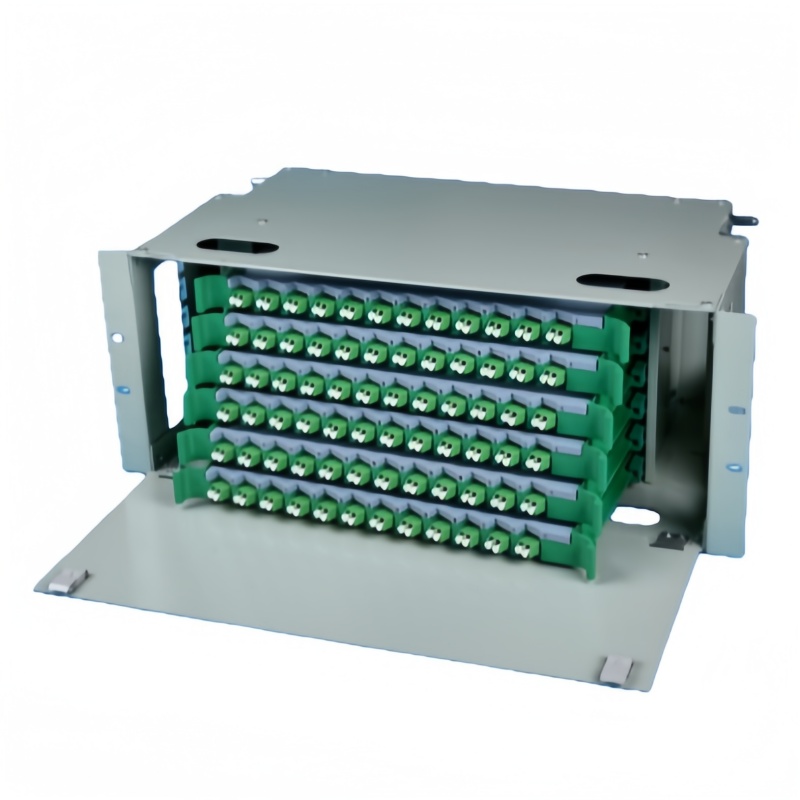
This guide sets out the numbers that decide whether an Quadro de distribuição ODF fits: rail hole centres, vertical pitch, unit height, usable depth, bend radius clearance, loaded weight and the hardware that has to be in the box. All four mounting systems in service are covered, and the acceptance plan at the end catches a mismatch while it is still a cheap fix.
Which Rack Standards Does an ODF Actually Have to Fit?
Four mounting systems are in service, and only two of them share a hole pattern.
The 19-inch frame is governed by EIA-310 (revision D, 1992), mirrored internationally by the IEC 60297 series. The name refers to the equipment panel width, 482.6 mm, not to the cabinet. What actually matters to a fitter is the horizontal distance between the vertical rows of holes on the two mounting flanges: 465.1 mm, commonly held to ±1.6 mm, with a rack opening at least 450 mm wide. Vertical pitch is the rack unit, 1U = 44.45 mm, and a real 1U panel is cut roughly 0.8 mm short of that so adjacent units do not bind.
ETSI frames follow the ETS 300 119 / EN 300 119 series, which is metric from end to end. The distance from the right edge of the right mounting rail to the left edge of the left rail is 535 mm, the gap between the posts is 500 mm, and hole spacing is a flat 25 mm. ETSI also fixes the cabinet envelope: widths of 150, 300, 600 and 900 mm and depths of 300 and 600 mm.
The 23-inch frame is the Western Electric inheritance still found in North American and some legacy exchanges. Rail centres sit at 566.7 mm with a 580 mm faceplate, and the vertical pitch is the same 44.45 mm rack unit — but the hole pitch is either one inch (25.4 mm) on Western Electric frames or the EIA 5/8-inch pattern, and the two do not interchange.
The fourth system is the Open Compute Project Open Rack v3. Outwardly it is 600 mm wide, 1068 mm deep and 2286 mm tall, but internally it carries 21-inch equipment on a 48 mm Open Unit rather than a 44.45 mm rack unit. A 44 OU frame is quoted by rack makers as holding 44 OU of OCP gear or 48 RU of conventional 19-inch equipment, which tells you the two units are close enough to confuse and far enough apart to matter.
| System | Governing document | Panel width / rail centres | Vertical pitch | Hole pattern | Typical cabinet envelope |
|---|---|---|---|---|---|
| 19-inch | EIA-310-D; IEC 60297 series | 482.6 mm panel; 465.1 ±1.6 mm hole centres; ≥450 mm opening | 1U = 44.45 mm | 3 holes per U: 15.875 / 15.875 / 12.7 mm | 600, 800, 1000, 1200 mm deep |
| ETSI 21-inch | ETS 300 119 / EN 300 119 series | 535 mm rail edge to rail edge; 500 mm between posts | 1 su = 25 mm | 25 mm metric pitch | 150 / 300 / 600 / 900 mm wide; 300 or 600 mm deep |
| 23-inch (WECO) | Western Electric practice | 580 mm faceplate; 566.7 mm rail centres | 1U = 44.45 mm | 1-inch pitch, or EIA 5/8-inch pattern | Telecom frames, deep |
| OCP Open Rack v3 | OCP ORV3 base specification | 21-inch internal width, 600 mm outer | 1 OU = 48 mm; 44 OU per frame | OCP IT shelf interface; 19-inch via adapter rails | 600 × 1068 mm, 2286 mm tall |
ETSI frames dominate European telecom, 23-inch iron survives in incumbent exchanges, 19-inch is the enterprise and data center default, and ORV3 is what hyperscale AI halls are built from. A supplier shipping to all four needs the bracket set specified at order time, not discovered on site.
Can One Panel Serve 19-Inch, ETSI and OCP Racks?
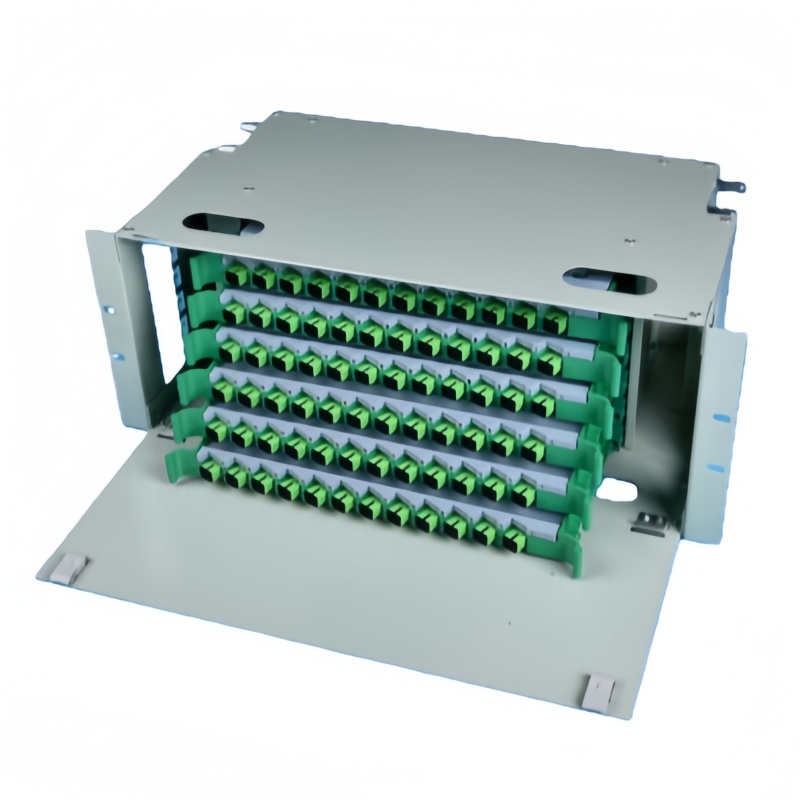
Yes, if the bracket set is on the order; no, if the depth or the ear position is wrong. Brackets and rails convert width, but nothing converts a panel that is too deep for the cabinet.
Width conversion is the easy half. A 19-inch panel is at most 438.15 mm across the body, which drops inside the 500 mm ETSI post gap, so an ETSI adapter bracket or adapter plate carries it. Open Rack v3 frames are built to take 21-inch OCP equipment directly and to accept conventional 19-inch EIA gear on adapter rails; rack makers publish this explicitly, quoting both a 44 OU and a 48 RU capacity for the same frame. The 1-inch Western Electric pitch is the awkward one, because a panel with fixed 19-inch ears will not line up with it at all — that install needs slotted or convertible ear brackets.
Hardware is where most site calls start, and it is worth spelling out on the PO:
- Hole form. Modern cabinets use square holes with snap-in cage nuts; telco frames often have round tapped holes; OCP shelves use their own toolless interface. Cage nuts are the forgiving option because the thread is chosen at install time.
- Thread. M6 is the metric default and what ETSI frames and most current cabinets use. 10-32 UNF is the North American convention. 12-24 UNC is the legacy telco thread that has been in service since the 1930s. A 10-32 screw driven into an M6 cage nut feels tight and then strips, which is how panels end up hanging on two screws.
- Screw length. Engagement through the rail and cage nut should be 12 mm or more, but a screw that is too long bottoms out against the chassis and bends the mounting ear. A screw gauge check on the first panel catches both.
- Ear position. Adjustable-depth ears let a panel be recessed or brought forward, typically across a 0–100 mm range, which is what reconciles a deep panel with a shallow front door. Fixed ears have no such margin.
- Rear support. Any panel deeper than roughly 350 mm, or loaded past about 10 kg, wants four-post mounting or a rear support bracket. Two ears on the front flange will let a loaded drawer sag, and a sagging drawer is how adapter plates stop seating squarely.
Two order lines solve the whole category: state the rack system and the hole form on the PO, and ask for the matching bracket and screw set to ship in the same carton. Brackets ordered separately are a two-to-three week delay on a job that is already on site.
How Much Rack Space Does the Fiber Layer Need?
Budget one rack unit of horizontal management for every two to three units of panel, and hold 20–30% of the rack empty for growth.
Density depends entirely on which panel family you buy. A conventional splice-and-termination drawer ODF gives 12 to 24 SC ports in 1U, or 24 to 48 LC ports, in 300–400 mm of depth. A high-density cassette panel is a different animal: 1U holding twelve 12-fiber MPO-to-LC cassettes gives 144 fibers, 2U gives 288 and 4U gives 576, all in roughly 430–470 mm of depth. At the extreme end, twelve 72-fiber MPO cassettes in a 1U chassis reach 864 fibers in one rack unit, which is a real product figure rather than a marketing number, and it is why data center buyers now plan fiber in cassettes rather than in ports.
Density buys nothing if the management space is not reserved alongside it: a 1U panel with 144 LC ports presents 72 duplex cords that need a managed path before they turn. Rules that hold up on site — one 1U horizontal manager for every two to three panel units, vertical management on both rack sides once port counts pass a few hundred, and slack storage inside the panel or an adjacent unit, because 2 m of stored 0.9 mm pigtail per 12 fibers adds up quickly.
| Panel format | Fibers per rack unit | Typical depth | Typical loaded weight | Melhor ajuste |
|---|---|---|---|---|
| Splice/termination drawer ODF, 1U | 12–24 SC or 24–48 LC | 300–400 mm | 4–8 kg | FTTH head ends, building risers, small exchanges |
| High-density cassette panel, 1U | 144 (12 × 12F MPO-LC) | 430–470 mm | 6–9 kg | Data center MDA/HDA, 40G–400G breakout |
| High-density cassette panel, 2U | 288 | 430–470 mm | 12–18 kg | Aggregation rows |
| High-density cassette panel, 4U | 576 | 430–470 mm | 20–30 kg | Core and campus backbone |
| MPO-to-MPO chassis, 1U | up to 864 (12 × 72F cassettes) | 440–470 mm | 8–12 kg | Hyperscale trunk cross-connect |
A 144-core steel panel is a known weight: one published 1U 144-core specification lists a 482.6 × 428.9 × 44.2 mm chassis shipping at 8.6 kg per carton, and comparable 1U 144-fiber panels are quoted at 482.6 × 44 × 465 mm. Those two depth figures, 429 mm and 465 mm, are the range that decides which cabinet you can order.
Does the Rack Depth Leave Room for the Bend Radius?
Depth is the dimension that gets value-engineered away, and it is the one that decides whether the trunk survives commissioning.
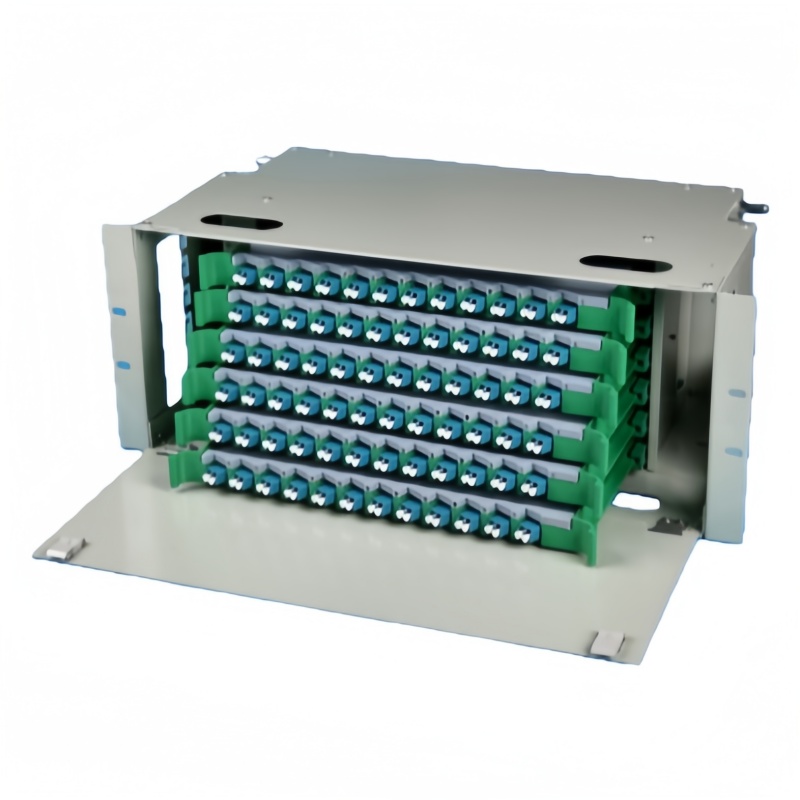
Nominal cabinet depth is not usable depth. A 600 mm cabinet loses the front door and its frame, the rear door, and the rail adjustment range before a single screw is turned. Take a 465 mm deep panel: in a 600 mm cabinet there is roughly 135 mm left to cover the front patch field, the rear trunk routing and both bend radii. That is not enough, and the symptom is a row of patch cords pressed flat against the rear door.
The arithmetic is simple. A 12-fiber MPO trunk sits around 4.5–5.4 mm in outer diameter depending on construction. At the 20× dynamic limit that is a 90–110 mm radius while the cable is being handled, and at the 10× static limit 45–54 mm once dressed. Turning a trunk back on itself inside the cabinet needs depth of about twice the radius, so plan 180–220 mm behind the panel for a 12-fiber trunk and more for 24-fiber. A 3.0 mm duplex patch cord is easier at 60 mm dynamic and 30 mm static, which is why cords bend where trunks cannot.
Drawer panels add a second constraint in the other direction. A sliding drawer needs clear space in front equal to its travel, commonly 250–400 mm, plus working room for the technician. A rack with a front door sitting 50 mm off the rail will mount the panel and then will not let anyone service it. If the site has shallow front clearance, specify a fixed panel rather than a drawer, or move the frame to a deep-front cabinet.
| Cabinet depth | Realistic usable depth | What fits | What does not |
|---|---|---|---|
| 600 mm | ≈430–480 mm | Fixed 300–400 mm termination panels, shallow switches | 465 mm cassette panels with trunk routing behind; drawer panels with any real travel |
| 800 mm | ≈630–680 mm | 1U–2U cassette panels with 150–200 mm rear routing; most drawers | Deep 4U chassis with a full trunk bundle |
| 1000 mm | ≈830–880 mm | Mixed panels and servers; vertical management plus trunk slack | Very deep enterprise chassis sharing the same rails |
| 1200 mm | ≈1030–1080 mm | Cable-heavy fiber rows; the depth AI-era guidance assumes | Nothing common; cost and floor space are the trade-off |
Industry guidance for AI-dense halls now starts at 1200 mm depth with a width beyond the standard 600 mm, and it is worth noting for any fiber row planned next to accelerated compute: if the compute is going into 1068 mm deep ORV3 frames, the fiber frames in the same row should match, or the row will not line up with the overhead containment and traywork.
What Does a Loaded Fiber Rack Weigh, and Will the Floor Carry It?
Fiber is light per port and heavy per rack; forty units of loaded panels plus patch cords is a three-figure kilogram problem that nobody budgets for.
An empty 1U steel panel is 2–4 kg. Loaded with twelve cassettes, pigtails and adapters it is 6–9 kg, and the published shipping weight for a 1U 144-core chassis is 8.6 kg per carton. A 4U 576-fiber chassis lands in the 20–30 kg band once populated. Patch cords are the hidden mass: a fully dressed 42U rack with several hundred 2–3 m cords carries 5–15 kg of copper-free weight hanging on the managers and the panel ears, and that load is applied at the front of the rack where the moment is worst. Treat those as planning values and weigh a sample panel from the first shipment.
Rack ratings are generous on paper and uneven in practice. Standard 19-inch cabinets are commonly rated between 450 kg and 1400 kg static, roughly 1000 to 3000 lb, with cheaper frames below the bottom of that band. OCP ORV3 frames are quoted at 1400 kg static and 1400 kg dynamic, and at least one ORV3 rack is UL 2416 listed for 3000 lb dynamic and 3500 lb static. Guidance built on Schneider Electric white paper 110 and relayed through 2026 data center design writing recommends racks at least 750 mm wide and 1200 mm deep for high-density work, with floor slabs validated for loads above 3000 kg — a check that matters as much for a full fiber frame as for a GPU rack.
Two habits prevent most of the trouble: load heavy panels in the lower third of the rack so the centre of mass stays low, and confirm the raised-floor tile and pedestal rating before a fully populated frame is rolled onto it. Where the rack ships populated, ask the supplier for a packed weight and a centre-of-gravity note.
Which Mounting and Bonding Details Fail on Site?
Almost every “the panel does not fit” call is one of five hardware mismatches, and only one of them is about dimensions.
Thread mismatch is first: M6 cage nuts with 10-32 screws, or the reverse, which either will not start or strips under load. Hole form is second, with round tapped telco holes rejecting cage-nut hardware entirely. Ear position is third, where a fixed ear cannot be recessed far enough for a shallow door or brought forward far enough for a rear-post cabinet. Rear support is fourth, and it shows up months later as a sagging drawer and adapters that no longer seat squarely. The fifth is the ground path: powder-coated rails and painted mounting ears are insulators, so a panel screwed into a painted rail is not bonded. Penetrate the finish at the contact point with a star washer or a dedicated bonding screw, and tie the frame into the site common bonding network per ANSI/TIA-607 practice.
Two more items belong in the same conversation because they cost nothing at install and a great deal later. Blanking panels: an empty U left open in a hot or cold aisle is a hole in the airflow plan, and they are a one-line item on the order. Labelling: agree the U numbering direction and the port numbering scheme before the first panel is mounted, because renumbering 576 ports after handover is a full day of work and a source of every subsequent mis-patch.

Fit and Installation Acceptance Plan
Run these checks in three passes and the rack interface stops being a discovery on install day: measure before you order, verify at goods receipt, and audit after mounting.
| Verificar | Quando | Método | Pass criterion |
|---|---|---|---|
| Rail geometry | Before ordering | Measure horizontal hole centres and vertical pitch on the destination rack | 465.1 ±1.6 mm and 44.45 mm pitch for 19-inch; 535 / 500 mm and 25 mm pitch for ETSI; 566.7 mm and 1-inch pitch for WECO |
| Bracket and thread set | Goods receipt | Dry-fit one panel with the supplied brackets, cage nuts and screws | Bracket matches the rack system; ≥12 mm thread engagement; screw does not bottom out |
| Depth clearance | Design and pre-install | Panel depth + rear trunk radius + front drawer travel against usable cabinet depth | ≥180 mm behind a cassette panel for 12-fiber trunk; drawer travel unobstructed with the door closed |
| Load budget | Design | Sum loaded panel weights, managers and patch cords; compare with rack rating | Total at or below 80% of the rack static rating; heavy units in the lower third |
| Bonding and earthing | At install | Continuity between the panel ear and the rack ground point, with finish penetrated | Continuity confirmed; panel bonded to the rack and rack to the site bonding network |
| Bend radius audit | After mounting | Visual check against 10× cable OD at rest, 20× while handled | No trunk or cord dressed below its limit; no cord pressed against doors |
| Optical verification | After termination | Tier 1 insertion loss at 1310/1550 nm (850/1300 nm multimode) and end-face inspection to IEC 61300-3-35 | Mated connector ≤0.75 dB per TIA-568.3-D; end faces pass the zone criteria |
| As-built record | Handover | U map, port numbering, photographs, bracket and screw list | Record matches the approved elevation drawing |
The mechanical fit and the optical result are the same purchase. A panel forced into a rack it was not bracketed for ends up with cords at half their permitted radius, and the loss shows at 1550 nm on the acceptance trace rather than in the install report. The Programa de normas da TIA lists the cabling documents referenced here, the IEC Webstore carries the 60297 mechanical series and IEC 61300-3-35, the IEEE 802.3 working group publishes the physical-layer rates behind the port counts, and the Referência ao orçamento de perdas da FOA com o Fluke Networks inspection guide cover the acceptance side.
Fenxi builds rack-mount ODF frames, drawer and fixed panels, adapter panels, splice trays and factory-terminated patch cords and pigtails to whatever rack system your sites run. Send the rack standard, hole form, usable depth, fiber count and connector mix, and we will return a panel schedule with the bracket set, screw thread, depth clearance and loaded weight per unit before you place the order. Port count planning for the same frames is covered in our ODF capacity planning guide.
Can a 19-inch ODF be mounted in a 21-inch ETSI rack?
Yes. A 19-inch equipment body is at most 438.15 mm wide, which fits inside the 500 mm ETSI post gap, so an ETSI adapter bracket or adapter plate carries it. Order the bracket with the panel: it is a separate part, and it is the single most common cause of a stalled install in European exchanges.
What is the difference between an Open Unit and a rack unit?
An Open Unit (OU) in OCP Open Rack v3 is 48 mm; a rack unit (RU) under EIA-310 is 44.45 mm. The 3.55 mm difference per unit is why a rack maker will quote the same ORV3 frame as 44 OU of OCP equipment or 48 RU of conventional 19-inch gear, and why hardware sized for one does not simply stack into the other without rails.
How much clearance does a 12-fiber MPO trunk need behind the panel?
Plan on 180–220 mm. A 12-fiber trunk is about 4.5–5.4 mm in outer diameter, so the 20× dynamic limit is a 90–110 mm radius while it is being routed, and turning it back on itself needs roughly twice that in depth. That is the number that rules out 600 mm cabinets for 465 mm cassette panels.
How many rack units should be reserved for cable management?
One 1U horizontal manager for every two to three units of panel, plus vertical management on both rack sides once the frame carries more than a few hundred fibers. Hold 20–30% of the rack empty. A 1U panel with 144 LC ports presents 72 duplex cords, and they need a managed path before they turn.