
1. Introduction
Choosing between SC APC and SC UPC connectors is one of the most important design decisions in modern fiber optic networks. The wrong choice can lead to:
- Higher insertion loss and back reflection
- Unstable optics and throughput issues
- Costly truck rolls and customer complaints
This in‑depth guide compares SC APC and SC UPC connectors from practical, engineering, and business perspectives. You’ll learn:
- What APC and UPC actually mean
- How SC APC vs SC UPC differ in performance and use cases
- When to choose one over the other for FTTx, PON, data centers, CATV, and enterprise networks
- How connector choice impacts return loss, insertion loss, and long‑term reliability
The article is written for:
- Network engineers and planners
- FTTH and ISP deployment teams
- System integrators and installers
- Technical buyers and product managers
2. Quick Definitions: SC, APC, and UPC
Before comparing SC APC vs SC UPC, it’s essential to unpack the terms:
2.1 What is SC?
SC (Subscriber Connector / Standard Connector) is:
- A square, push‑pull fiber optic connector
- 2.5 mm zirconia ceramic ferrule
- Widely used in telecom, FTTx, and patch panels
- Known for:
- Simple push‑pull mechanism
- Good repeatability
- Robust construction
2.2 What is APC (Angled Physical Contact)?
APC (Angled Physical Contact) describes the polishing style of the connector ferrule:
- Ferrule end‑face is polished at an angle (typically 8°)
- Reflected light is directed into the cladding, not back toward the light source
- Results in:
- Very low back reflection (high return loss)
- Ideal for analog and high‑sensitivity systems (e.g., RF overlay, PON)
APC connectors are almost always green in industry color coding.
2.3 What is UPC (Ultra Physical Contact)?
UPC (Ultra Physical Contact) is another polishing style:
- Ferrule end‑face is polished flat but highly refined
- Improved surface finish vs. older PC (Physical Contact) connectors
- Results in:
- Low insertion loss
- Good, but not as high, return loss compared to APC
UPC connectors are typically blue in industry color coding.
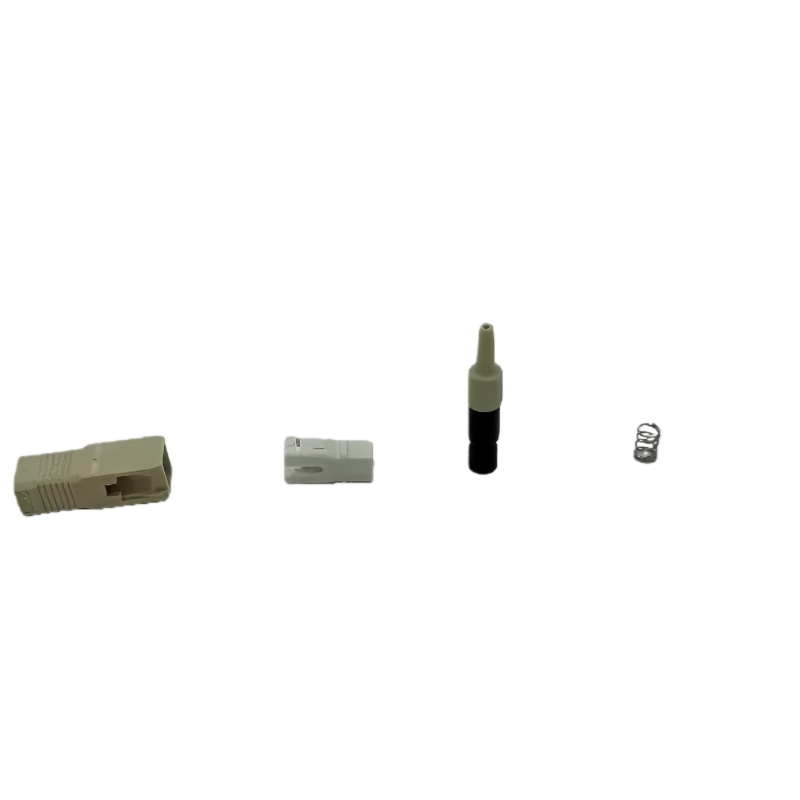
3. Fundamental Differences: SC APC vs SC UPC
The real difference between SC APC vs SC UPC is not the SC housing itself, but the end‑face polish and optical performance.
3.1 Visual and Mechanical Differences
- SC APC
- Green housing
- Angled 8° ferrule
- Mates with APC adapters (usually green)
- SC UPC
- Blue housing
- Flat (radius‑polished) ferrule
- Mates with UPC adapters (usually blue)
3.2 Optical Performance Differences
At a high level:
- SC APC offers better return loss (lower back reflection)
- SC UPC offers slightly simpler geometry and is widely used in data networks
Table 1: High-Level Comparison – SC APC vs SC UPC
| Feature / Parameter | SC APC Connector | SC UPC Connector |
|---|---|---|
| Connector type | SC (square, push-pull) | SC (square, push-pull) |
| Polish type | APC (Angled Physical Contact) | UPC (Ultra Physical Contact) |
| End-face angle | Typically 8° | 0° (flat with spherical radius) |
| Housing color (standard) | Green | Blue |
| Typical insertion loss | ~0.2–0.3 dB | ~0.2–0.3 dB |
| Typical return loss | ≤ −60 dB (often −60 to −65 dB) | ≤ −50 dB (often −50 to −55 dB) |
| Best for | FTTx, PON, CATV, RF over fiber, long links | Enterprise LAN, data center, general use |
| Back reflection risk | Very low | Low, but higher than APC |
| Price difference | Slightly higher (often) | Baseline SC cost |
| Color-coded compatibility | Only mates APC to APC | Only mates UPC to UPC |
Values are typical ranges from current (2023–2025) manufacturer datasheets; actual performance depends on specific brand and quality.
4. Why Back Reflection (Return Loss) Matters
4.1 Insertion Loss vs Return Loss
Two key parameters determine connector performance:
- Insertion Loss (IL)
- How much signal power is lost when the connector is inserted into the link
- Measured in dB (lower is better)
- Typical values: 0.2–0.5 dB per connector
- Return Loss (RL)
- How much light is reflected back toward the source
- Expressed as a negative dB value (more negative = less reflection = better)
- APC: typically ≤ −60 dB
- UPC: typically ≤ −50 dB
4.2 When is High Return Loss Critical?
High return loss (i.e., low back reflection) is crucial when:
- The system uses high‑sensitivity lasers (such as in PON OLTs)
- You are transporting analog or RF signals (e.g., CATV, RF over fiber)
- The network employs long distances or high power
- Reflections can cause:
- Laser instability
- Noise and interference
- Bit error rate (BER) increase
This is why SC APC is standard in many FTTx / PON and CATV deployments.
5. Use Cases: Where SC APC vs SC UPC Are Commonly Deployed
Choosing the right connector starts with understanding the application.
5.1 FTTx / FTTH / PON Networks
Most modern GPON, XG‑PON, and XGS‑PON deployments use SC APC connectors for the optical distribution network.
- OLT ports (in CO / headend) often use SC APC or LC APC
- Splitters and distribution frames: SC APC
- ONT / ONUs at customer premises: often SC APC drop connectors
Why APC?
- Better return loss protects OTL / ONT optics
- Reduces interference from reflections in split networks
- Meets strict telco specifications on RL
5.2 CATV & RF over Fiber
For Cable TV (HFC) or RF overlay on PON:
- SC APC is almost always mandatory on the RF portion
- RF is sensitive to reflections, which cause:
- Distortion
- Noise
- Degradation in analog and QAM signals
5.3 Enterprise LAN and Data Centers
In enterprise and data center environments:
- Parallel optics and high‑density structured cabling often use LC UPC or MPO/MTP UPC
- SC UPC may be found in:
- Legacy backbone links
- Certain patch panels, telecom rooms, and ODFs
SC UPC is often sufficient because:
- Links are relatively short
- Systems are primarily digital Ethernet (less sensitive to small reflections)
- Equipment ports historically used UPC-style connectors
5.4 Metro and Long-Haul Transport
For long‑haul or metro networks:
- Modern systems increasingly favor LC APC or SC APC in many regions, especially where high power or DWDM systems are used.
- APC helps maintain stable performance over long spans and high channel counts.
6. Performance Comparison in Detail
6.1 Typical Insertion Loss Values
Both SC APC and SC UPC can achieve similarly low insertion loss:
- Typical IL: 0.2–0.3 dB
- Industry spec: often ≤ 0.5 dB max
Insertion loss depends more on:
- Connector quality and polish
- Fiber alignment
- Cleanliness and proper mating
6.2 Typical Return Loss Values
Here’s where SC APC clearly wins:
- SC APC: ≤ −60 dB, some premium products claim up to −65 dB
- SC UPC: ≤ −50 dB, typical range −50 to −55 dB
A 10 dB improvement in RL means 10× reduction in reflected power.
Table 2: Typical Performance Specs – SC APC vs SC UPC (Single‑Mode)
| Parameter | SC APC (Typical) | SC UPC (Typical) |
|---|---|---|
| Insertion Loss (IL) | 0.2–0.3 dB (≤0.5 dB max) | 0.2–0.3 dB (≤0.5 dB max) |
| Return Loss (1310 nm) | ≤ −60 dB (high-quality: −65 dB) | ≤ −50 dB (sometimes −55 dB) |
| Return Loss (1550 nm) | Similar, often ≤ −60 dB | Similar, typically ≤ −50 dB |
| Repeatability | ±0.1 dB | ±0.1 dB |
| Durability (mating) | ≥ 500–1000 matings | ≥ 500–1000 matings |
Values compiled from widely available manufacturer datasheets as of 2023–2025; check specific vendor specs for exact numbers.
7. Compatibility: Why You Must Not Mix SC APC and SC UPC
7.1 Physical Mating is Possible – But Not Allowed
Mechanically, an SC APC plug can physically fit into an SC UPC adapter (and vice versa). However:
- The angled APC ferrule does not align correctly with the flat UPC ferrule
- Contact area is small and misaligned
- This causes:
- Extreme insertion loss
- Severe back reflection
- Risk of damaging the ferrule end‑faces
7.2 Consequences of Mixing APC and UPC
Mating SC APC with SC UPC can lead to:
- IL of multiple dB (far beyond spec)
- Very poor RL, with large reflections harming transceivers
- Unstable laser output or link flapping
- In worst cases, accelerated laser degradation in sensitive optics
Rule:
Only mate APC to APC and UPC to UPC. Use appropriate adapters and couplers that match the polish type.
7.3 Color Coding as a Safety Mechanism
Industry color coding reduces mistakes:
- Green = APC
- Blue = UPC
Train technicians to never connect green to blue in SC connectors.
8. Design Considerations: How to Decide Between SC APC and SC UPC
8.1 Questions to Ask Before Choosing
- What is the main application?
- FTTx / PON / CATV → Often APC
- Enterprise LAN / data center → Often UPC
- How sensitive is the system to back reflection?
- Analog or RF or high-power → APC
- Short‑reach digital Ethernet → UPC generally okay
- What are the equipment port styles?
- Many OLTs / ONTs: SC APC or LC APC
- Many switches / routers: LC UPC
- What does the operator or standard require?
- Many telcos have strict policies: “ODN shall use SC APC only”
8.2 Pros and Cons – SC APC
Advantages:
- Outstanding return loss (≤ −60 dB)
- Reduced interference and improved system stability
- Preferred in telecom, FTTx, CATV, RF overlay
Disadvantages:
- Slightly higher connector cost (typically small difference)
- Requires APC‑specific polishing and jigs (for field termination)
- Not compatible with UPC panels or equipment without adapters
8.3 Pros and Cons – SC UPC
Advantages:
- Widespread use in legacy and general-purpose networks
- Often cheaper and more available in generic patch cords
- Good performance for most digital applications
Disadvantages:
- Lower return loss performance than APC
- Not ideal for long PON networks, CATV, or systems sensitive to reflections
9. Market Trends (2023–2025 Context)
While I can’t access live market dashboards, general industry trends through 2023–2025 show:
- FTTH / FTTx penetration continues to grow globally; passive optical networks widely use APC connectors in the distribution network.
- XGS‑PON and 10G PON deployments emphasize higher RL and IL performance; operators tend to standardize on SC APC (or LC APC) in outside plant and customer drops.
- Data centers increasingly deploy LC UPC / MPO UPC for high‑density spine‑leaf topologies; SC UPC remains in legacy or lower‑density environments.
- RF over fiber and remote PHY / remote OLT architectures keep APC as the preferred choice due to analog signal sensitivity.
Overall, APC use is rising in telco and FTTx, while UPC maintains a strong base in enterprise and data center environments.
10. Cost and Procurement Considerations
10.1 Price Differences
In many markets:
- SC APC patch cords may be slightly more expensive than SC UPC
- However, the difference is often small (sometimes only a few percent), and overshadowed by:
- Labor cost
- OPEX from truck rolls
- Service quality impact
When evaluating cost:
- Consider total cost of ownership (TCO), not just unit connector price.
10.2 Availability and Standardization
- In FTTx regions, SC APC drop cables and pigtails are usually standard shelf items.
- In enterprise LAN, SC UPC patch cords are more common in existing infrastructure (though many new systems use LC UPC).
Standardizing on one connector type per network layer can simplify:
- Inventory management
- Training and certification
- Maintenance procedures
11. Practical Scenarios and Recommendations
11.1 Scenario 1: New FTTH GPON Deployment (Residential)
- OLT in central office
- 1:32 splitters in cabinets
- ONTs in customer homes
Recommended choice:
SC APC from OLT to ONT:
- OLT panel: SC APC (or LC APC with SC APC in ODN)
- Splitter ports: SC APC
- Drop cables: SC APC
- ONT: SC APC port
11.2 Scenario 2: Enterprise Campus Network
- Several buildings connected via single‑mode fiber
- Most switches have LC UPC SFP/SFP+ ports
- Patch panels: SC or LC
Typical approach:
- Use LC UPC at the active equipment side
- SC UPC or LC UPC at patch panels, depending on design
- SC APC not generally required unless there are special RF/analog services
11.3 Scenario 3: CATV + Broadband over PON (RF Overlay)
- PON network carries data + IPTV + RF overlay
- RF overlay optical links are sensitive to reflections
Recommended choice:
SC APC is strongly recommended:
- SC APC at OLT/EDFA output to RF overlay subsystem
- SC APC on all RF overlay distribution paths
- Ensures best RL performance and stable analog signal delivery
11.4 Scenario 4: Long Metro Single-Mode Link with DWDM
- Long‑distance single‑mode links
- Potential high launch power into fiber
Many operators and system vendors favor APC connectors for:
- Reduced reflections
- Better OSNR performance in certain designs
However, the exact choice depends on vendor specifications and existing infrastructure.
12. Installation, Testing, and Maintenance Implications
12.1 Field Termination: APC vs UPC
- SC UPC
- Easier polishing geometry (flat)
- Widely supported by generic toolkits
- SC APC
- Requires APC‑specific polishing jigs with an 8° angle
- Polishing sequence more sensitive to achieve RL ≤ −60 dB
In practice, many operators:
- Use factory‑terminated pigtails (APC or UPC as needed)
- Splice them to outside plant cables instead of field‑polishing connectors
12.2 Testing
Regardless of APC or UPC, always test:
- Insertion loss using OTDR or LSPM (light source + power meter)
- Return loss if required by specs (especially for APC)
Typical acceptance thresholds:
- IL: ≤ 0.5 dB per connector
- RL:
- APC: typically ≤ −55 to −60 dB
- UPC: typically ≤ −45 to −50 dB for many general‑purpose deployments
12.3 Cleaning and Inspection
Connector type doesn’t change core best practices:
- Inspect before you connect with a fiber microscope or video probe
- Clean using:
- One‑click cleaners
- Lint‑free wipes + IPA (≥99% isopropyl alcohol)
- Always put dust caps on unused connectors
13. Summary Table: When to Choose SC APC vs SC UPC
Table 3: Application-Oriented Recommendation Matrix
| Application / Scenario | Recommended Connector | Reason / Notes |
|---|---|---|
| FTTx / FTTH (GPON, XG‑PON, XGS‑PON) | SC APC | High RL, protects OLT/ONT optics |
| PON splitters and distribution frames | SC APC | Standard for ODN in many operators |
| CATV / RF over fiber / RF overlay | SC APC | Analog signals sensitive to reflections |
| Long-haul / DWDM transport | Often APC (SC or LC) | Better RL in high-power / long-distance systems |
| Enterprise campus single-mode backbone | SC UPC or LC UPC | Digital Ethernet; reflections less critical |
| Data center structured cabling (SM) | Mostly LC UPC / MPO | High density; SC UPC may be legacy |
| Legacy telecom ODF (older installations) | SC UPC | Historical usage; may be mixed with newer APC layers |
| Short indoor SM links with general traffic | SC UPC | Cost-effective, sufficient RL |
14. SEO‑Optimized Conclusion
When comparing SC APC vs SC UPC, the decision boils down to application requirements, especially regarding return loss and equipment sensitivity.
- Choose SC APC when:
- You are designing or upgrading FTTx / PON networks
- You carry CATV or RF overlay services
- Your optical system is sensitive to reflections or uses long distances / high power
- Choose SC UPC when:
- You are working in enterprise LAN or data center environments
- Your links are mostly short‑reach digital Ethernet
- You are integrating with existing UPC‑based infrastructure
Connector cost differences are usually minor compared to the impact on performance, reliability, and OPEX. As fiber networks scale and access speeds climb (e.g., 10G/25G access, 100G+ aggregation), proper connector selection becomes even more critical to avoid performance bottlenecks and service instability.
15. Professional Q&A: SC APC vs SC UPC
Q1: Is SC APC always better than SC UPC?
Answer:
Not necessarily. SC APC has better return loss, making it superior for FTTx, PON, CATV, and RF over fiber applications. However, SC UPC is perfectly adequate—and often more common—in enterprise LAN and data center environments where:
- Links are short
- The system is digital Ethernet
- Equipment ports expect UPC connectors
“Better” depends on the specific use case and equipment requirements.
Q2: What happens if I connect an SC APC connector to an SC UPC adapter?
Answer:
Mechanically, they can fit, but this is not allowed:
- The ferrules do not properly align (angled vs flat)
- You will get:
- Very high insertion loss (several dB or more)
- Very poor return loss (strong reflections)
- There is a risk of damaging the polished end‑faces over time
Always match APC to APC and UPC to UPC—and respect color coding (green vs blue).
Q3: For a new FTTH rollout in 2024+, should I standardize on SC APC?
Answer:
For most modern FTTH / FTTx deployments using GPON, XG‑PON, or XGS‑PON, the industry norm is to standardize on SC APC for the entire optical distribution network (ODN):
- Central office ODF / patch panels: SC APC
- Splitters: SC APC ports
- Distribution / drop cables: SC APC
- ONT/ONU ports: SC APC
This ensures high return loss, protects optics, and aligns with common telco technical guidelines.
Q4: In a data center, does it make sense to use SC APC?
Answer:
In most modern data centers, LC UPC and MPO/MTP UPC are the dominant connector types. SC APC is not typical because:
- APC’s primary advantage (high return loss) is less critical in short digital links
- LC and MPO offer higher port density than SC
- Equipment transceiver ports are usually LC UPC
You might only encounter SC APC in specific interconnects or legacy telecom shelves integrated into data center environments.
Q5: Does SC APC improve insertion loss compared to SC UPC?
Answer:
No. Insertion loss is typically similar between well‑made SC APC and SC UPC connectors (around 0.2–0.3 dB). The main advantage of APC is return loss, not insertion loss. If your system is primarily limited by IL (e.g., very long spans with many connectors), both APC and UPC will perform similarly—as long as they’re high‑quality and properly installed.
Q6: Can I mix SC APC and SC UPC in the same network?
Answer:
You can mix them in different segments (e.g., backbone APC, equipment UPC) as long as you do not mate APC and UPC connectors directly. For example:
- ODN using SC APC
- Equipment using LC UPC or SC UPC
Interface segments might use:
- Hybrid patch cords (e.g., SC APC to LC UPC)
- Carefully designed topologies ensuring APC connectors mate only with APC, and UPC with UPC
Always design the network with clear boundaries and labels to avoid accidental mismating.
Q7: How do industry standards influence APC vs UPC choice?
Answer:
Different standards and operator guidelines influence connector selection:
- Many telecom operators’ internal technical specifications mandate APC for access/ODN due to strict return loss requirements.
- ITU‑T GPON / XG‑PON recommendations emphasize controlling reflection, which supports APC adoption.
- Enterprise standards (like structured cabling guidelines) often focus on LC UPC or SC UPC, especially for OM3/OM4 multimode and OS2 single‑mode inside buildings.
Always check:
- Operator technical policies
- Equipment vendor recommendations
- Regional best practices
before locking in your connector strategy.