
Connector contamination is the quietest cost center in a fiber network, because it stays invisible until it turns into a truck roll. A single micrometre of dust sitting on a nine-micrometre single-mode core adds insertion loss and multiplies reflectance, and it usually arrives through an adapter port that everyone on site assumed was sealed. Adapter cleaning and dust cap discipline cost almost nothing during construction and are painful to retrofit into a live PON.
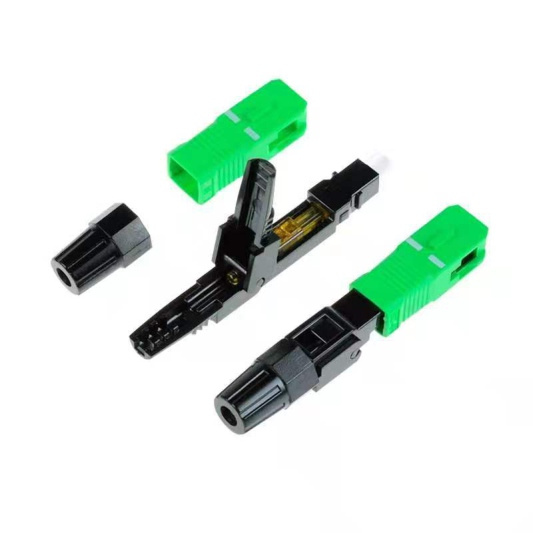
Where Contamination Actually Enters the Link
Every adapter is an open door. A SC or LC port that sits unmated for a week in an unfinished building collects airborne dust, cardboard fibers and, on industrial sites, fine grit, and the ceramic alignment sleeve holds that debris exactly where the next ferrule will press it into the core. The ferrule end face is only 2.5 mm or 1.25 mm across, with a single-mode core of roughly 9 µm, so contamination that covers a fraction of a square millimetre can sit directly in the light path.
Two field patterns explain most loss calls. Panels mounted with ports facing upward collect several times more dust than the same panel mounted with ports facing sideways or down, because gravity loads the sleeve for you. Adapters with retractable dust shutters stay cleaner than open ports fitted with loose caps, because the shutter closes the moment a patch cord is withdrawn. Shuttered adapters cost a fraction of a euro per port.
What Each Contaminant Does to a Link
Contamination does not behave uniformly, and the removal method follows the contaminant rather than the connector brand. The table below maps the contamination classes seen most often at commissioning.
| Contaminant | Typical source | Effect on the link | Correct removal |
|---|---|---|---|
| Airborne dust and lint | Open adapter ports, packaging, site traffic | 0.2–1.5 dB insertion loss; blocked core zone | Dry one-click cleaner, then re-inspect |
| Skin oils and sebum | Touching ferrules or end faces by hand | 0.5–2 dB loss; refractive-index film at the interface | Wet-to-dry with fiber-grade fluid and a lint-free wipe |
| Polishing residue or slurry | Connector manufacture or field re-polish | Scattered loss and raised reflectance | Wet-to-dry; re-terminate if the feature persists |
| Alcohol and water residue | Wet-only cleaning with 70–91% alcohol | Ring-shaped haze; permanent staining inside the sleeve | Fiber-grade fluid followed by a dry finish |
| Sleeve debris from swabs | Worn, oversized or reused cleaning swabs | Intermittent loss on every cord mated to that port | Replace the adapter; use the correct swab size |
The last row is the one buyers underestimate: a worn swab in a 2.5 mm sleeve leaves fibers that migrate to every connector mated to that port, so one careless session can contaminate a whole panel. Adapter condition belongs in the inspection scope alongside cable condition.
Inspect, Clean, Inspect — and Do Not Clean What Is Already Clean
A cleaning pass without inspection is a guess. Portable scopes and digital probes resolve an end face at 200x to 400x, which is the only practical way to judge the core zone of a 9 µm single-mode fiber. IEC 61300-3-35 sets the zone boundaries and the defect sizes that matter, and a connector that already passes those criteria should be mated promptly instead of wiped again. Repeated dry cleaning of a clean ferrule builds static charge and pulls fresh dust onto the surface, which is how a good connector becomes a dirty one on the bench.
The working sequence is inspect, dry clean only if contamination is visible, re-inspect, and stop after three passes. A defect that survives three correct cleaning cycles is a scratch, a pit or a damaged ferrule, and more tape will not remove it — that connector is a re-termination. Before writing a cleaning procedure into an acceptance plan, the fiber inspection method described by Fluke Networks is a useful field reference. The pass criteria themselves are covered in more depth in our end face inspection guide.
Match the Cleaner to the Ferrule, Not the Brand
Cleaning tools divide by ferrule diameter: 1.25 mm for LC and MU, 2.5 mm for SC, FC and ST, and dedicated multi-fiber tools for MPO/MTP. Forcing a 2.5 mm cleaner into an LC port damages the sleeve, and an LC cleaner on a SC ferrule cleans nothing at all. Ferrule size is the first thing to confirm on any connector, and the FOA connector identification charts settle mixed panels quickly.
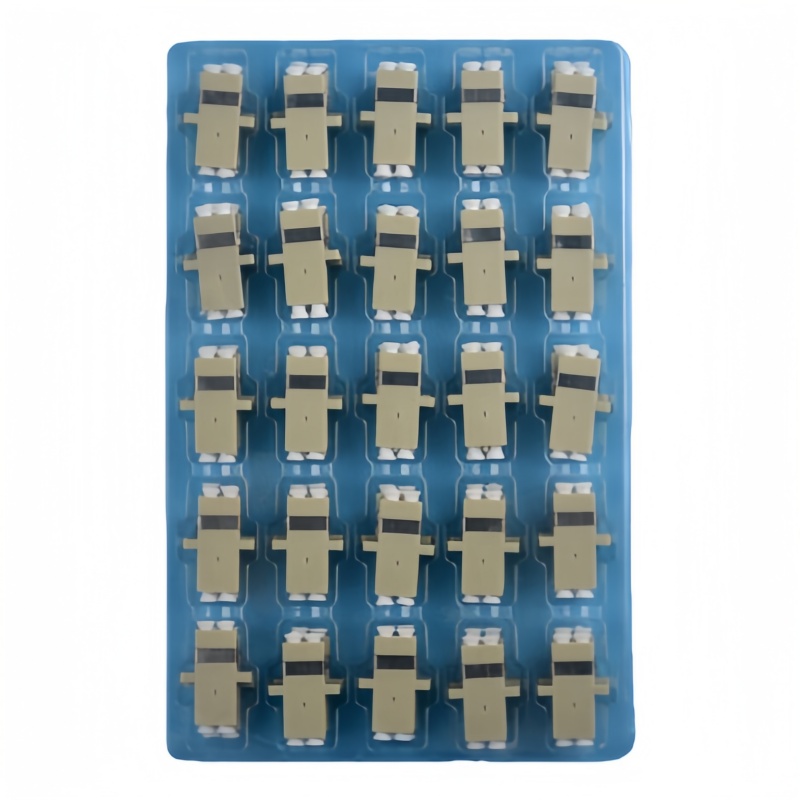
| Tool | Interface | Best used for | Main limitation |
|---|---|---|---|
| 1.25 mm one-click cleaner | LC, MU | Adapter ports, transceiver cages, high-density panels | Cannot remove oily films |
| 2.5 mm one-click cleaner | SC, FC, ST | Field ports, ODF bulkheads, closure pigtails | Wrong size scratches the sleeve |
| MPO/MTP cleaner | 12/24-fiber MT ferrule | Trunks, cassettes, breakout modules | Needs full-face inspection including guide pin holes |
| Cleaning cassette | 2.5 mm and 1.25 mm exposed ends | Bench work and rack-side patch cords | Cannot reach recessed ports |
| Lint-free wipes with fluid | All, manual | Oils, fingerprints, dried residue | Technique dependent; single use only |
Consumable life belongs in the procurement conversation. A one-click cleaner rated at 500 cycles will run out mid-commissioning if it is the only tool on site, and a partially used cartridge can redeposit debris once the tape is exhausted. The tool lines documented by US Conec are built around that duty cycle, and the practical rule is to treat cartridges as tracked consumables with a replacement schedule rather than a one-off purchase.
Wet-to-Dry Technique, Stroke Direction and APC Geometry
Dry cleaning lifts dust and lint. Oils, sebum and polishing residue need the wet-to-dry method: a small amount of fiber-grade fluid on a lint-free wipe or a pre-wetted swab, one straight stroke from the wet area into the dry area, and a dry finish with a fresh section of wipe. Wet-only cleaning leaves a residue ring that bakes onto the ferrule and can deposit inside the alignment sleeve where no wipe reaches. Household alcohol is the usual culprit, because the 70% and 91% grades carry water and additives that stain an end face permanently.
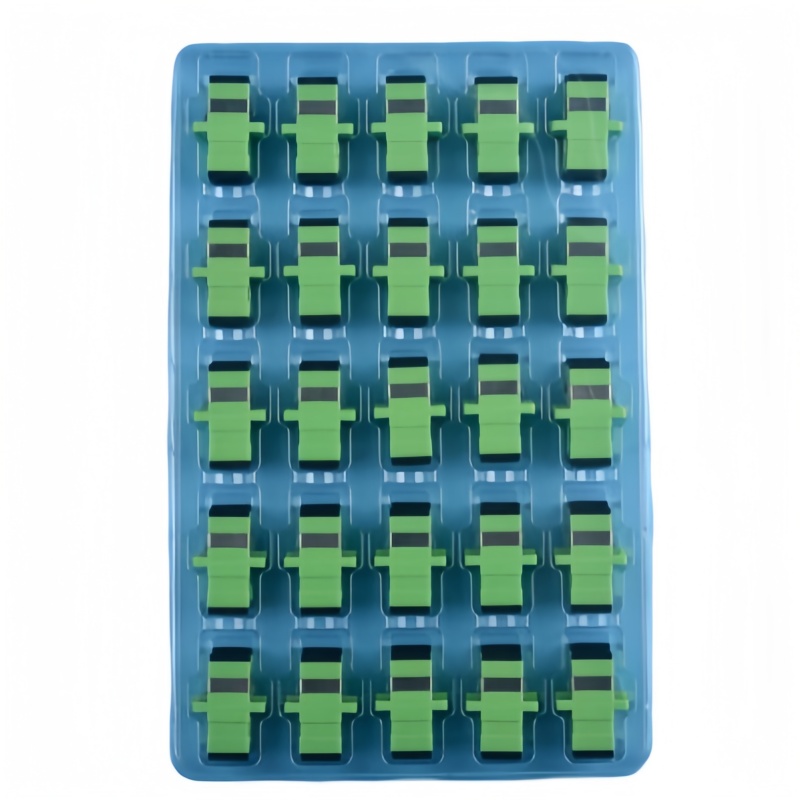
Angle-polished connectors add one rule. An APC ferrule carries an 8° face, so the stroke must travel across the angle without dragging debris back over the core; circular wiping redistributes particles across the whole face instead of removing them. Keyed APC adapters make it physically difficult to mate the wrong polish, but the green-on-green rule still belongs in the work instruction: an APC mated to a UPC leaves an air gap, destroys return loss and can crack both ferrules. Adapters and patch cords in a PON plant should stay APC end to end.
Dust Caps Are the Cheapest Component in the Bill of Materials
The cap that arrives loose in a plastic bag costs a few cents and goes in the bin with the packaging. The cap that is captive on the adapter, or the shutter built into it, is the one still doing its job in month eighteen. Cap selection is a specification decision rather than an accessory afterthought, and the difference shows up as return loss on any mature network. Panel suppliers publish sealing and shutter options for each mounting position, and the adapter and panel options are a useful starting point for a mixed indoor and outdoor schedule.
| Cap or shutter type | Typical application | What it protects against |
|---|---|---|
| Loose push-on cap (PP or PE) | Patch cords and pigtails in storage | Impact and coarse dust; poor seal, easily lost |
| Captive or screw-on cap | ODF adapters, wall boxes | Dust and handling damage; stays attached |
| Shuttered adapter (internal shutter) | Rack bulkheads, high-density panels | Dust ingress between patch changes; no loose parts |
| Waterproof connector cap | FTTA RRU runs, outdoor closures | Moisture, mud and wash-down spray |
| Anti-static cap | Cleaned connectors waiting to be mated | Particle attraction from static charge |
Cleaning Adapters Inside Live ODFs and Terminal Boxes
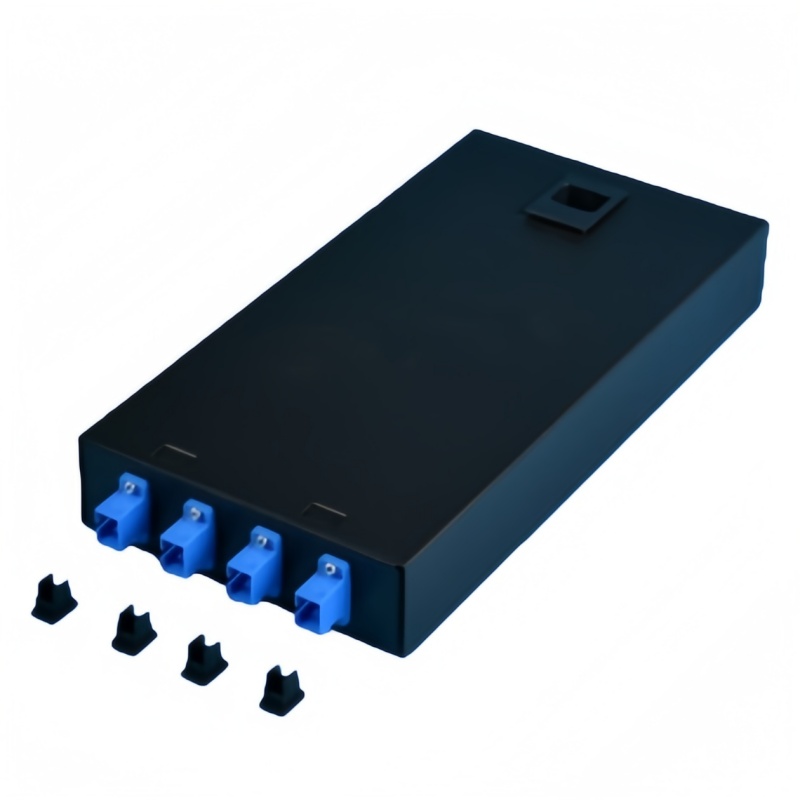
Cleaning in a working optical distribution frame is an access problem before it is a contamination problem. Ports in a 1U panel sit a few millimetres apart, so a cleaner needing 30 mm of straight clearance cannot be used at all; slim 1.25 mm and 2.5 mm tools with narrow tips exist for that geometry. Cleaning should be scheduled before each mating rather than on a calendar, and any port left open on a rack face should be treated as dirty until it is inspected. Where the plant includes exposed fiber termination boxes on a pole or wall, grit and moisture protection depends entirely on the caps staying fitted between visits. In desert and coastal deployments, caps and shuttered adapters belong on the consumables list next to patch cords, because UV exposure and salt air degrade seals long before the ceramics wear.
Procurement Checklist: What to Write into the Order
Adapter cleaning fails for commercial reasons more often than technical ones, because the tools get treated as sundries instead of specified parts. Put these eight lines into the purchase order and the program stops depending on individual crew habits.
- Cleaner size mix: 1.25 mm and 2.5 mm tools in one kit, matched to the connector families on site.
- MPO/MTP tooling wherever a multi-fiber trunk or cassette is installed, including guide pin hole access.
- Consumable quantity: cleaner cycles per 100 ports, with spare cartridges rather than one tool per crew.
- Fluid and wipes: fiber-grade fluid and lint-free wipes specified by part number, never generic alcohol.
- Inspection: one scope or digital probe per splice crew, with IEC 61300-3-35 zone criteria in the plan.
- Cap or shutter type per location: shutter for ODF bulkheads, waterproof caps for outdoor boxes.
- Adapter quality: ceramic alignment sleeves with a stated insertion loss and mating durability figure.
- Records: port-level cleaning and inspection logs tied to the ODF or box position.
Fenxi supplies the adapter side of that list: fiber optic adapters with zirconia ceramic sleeves in SC, LC, FC and ST footprints, including shuttered and hybrid versions, together with the cleaning accessories and single-mode patch cords that reference them. Send your port count, connector families and enclosure schedule, and our team will quote an adapter, cap and cleaning package against the acceptance criteria you are working to.