
Two patch cords can look identical in a photo and still behave differently on site. The jacket compound decides whether an inspector signs off the run; the cable diameter decides whether the cord survives the bend behind a rack door. Buyers who treat both as one line item meet the mismatch later, as a rejected delivery or an intermittent link months after handover.
Jacket Material and Cable Diameter Are Two Separate Decisions
A jacket compound and a fire listing describe different things, and mixing them up is where most RFQs go wrong. The compound, whether PVC, LSZH, TPU or PE, sets how the cord behaves in a fire, how much smoke it releases and how flexible it stays in the cold. The listing, whether OFNR, OFNP or a regional equivalent, states which installation space the cable may be installed in. A cord can be low-smoke and hold no riser listing, and a PVC cord can hold a plenum listing if the finished construction passed the test. Treating LSZH as a synonym for fire rated skips the part an inspector actually checks.
Diameter sits on a different axis. A 3.0 mm duplex cord is comfortable to handle and forgiving in a cable manager; a 2.0 mm cord delivers the same optical performance in roughly half the cross section, which matters when 48 duplex ports have to leave one rack unit. Neither size is better in the abstract. The right answer follows patch field density, the bend radii the route imposes, and how often the cord will be re-patched.
Fire Rating Codes: Where PVC, LSZH, OFNR and OFNP Fit
The table maps the four markings buyers see most often onto the test data behind them. A single cord can carry two at once, for example an LSZH compound that also holds a riser listing.
| Jacket or marking | What it describes | Test basis | What to verify |
|---|---|---|---|
| PVC | Polymer compound: cost, flexibility, abrasion | Fire class comes from the listing, not the material name | Printed jacket legend plus test report |
| LSZH | Low smoke, zero halogen compound | IEC 60332-1-2, IEC 60754-1 / -2, IEC 61034-2 | Measured smoke and acid gas values |
| OFNR | Riser listing, nonconductive optical cable | UL 1666 | Listing number and space classification |
| OFNP | Plenum listing, highest fire class | UL 910 / NFPA 262 | Written approval for any substitution |
| Armoured / PE | Mechanical and environmental protection only | IEC 60794 series crush and tensile tests | That no fire listing is assumed |
The practical question is not which compound is best but which listing the space requires. In North America the air-handling rule comes from NEC Article 770, and the two tests behind it are UL 910 (NFPA 262) for plenum and UL 1666 for riser, with the cable article itself published by NFPA. A non-plenum cord above a ceiling that returns air is a code violation, normally found at inspection, when replacement means re-pulling the whole run.
In Europe, the Middle East and much of Asia the same decision follows IEC test results rather than a UL file number. A low-smoke zero-halogen cord is specified on smoke density and acid gas grounds: IEC 61034-2 limits the smoke, and IEC 60754-2 limits the acidity of the gases that would otherwise attack equipment in the same room. The IEC webstore lists the test methods; the measured values are what belong in your file. Two cords can both be labelled LSZH while one carries a report showing 60 percent light transmittance and the other carries nothing.
Jacket compound also sets the operating window: standard compounds run near minus 20 to plus 70 degrees Celsius in service, and low-temperature or armoured versions reach toward minus 40, which matters for unheated shelters and northern European cabinets.
2.0 mm, 3.0 mm and 0.9 mm: Diameter Choices for Dense Racks
| Cord or buffer size | Where it belongs | Min bend radius in service | Installation note |
|---|---|---|---|
| 0.9 mm buffered | Pigtails spliced into trays and ODF panels | 10 mm | Never hand-routed; protect inside a tray |
| 1.6 – 1.8 mm | Cassette-based high-density patching | 16 – 18 mm | Confirm boot compatibility first |
| 2.0 mm | Dense racks, LC uniboot, tight managers | 20 mm | Best density-to-handling balance |
| 2.4 mm | Mixed panels and legacy SC duplex | 24 mm | Check panel port pitch |
| 3.0 mm | Standard telecom and FTTH patching | 30 mm | Most forgiving, lowest density |
The radius in the table is the in-service limit, at ten times outer diameter. While the cord is being pulled or dressed it doubles to twenty times: 60 mm for a 3.0 mm cord, 40 mm for a 2.0 mm cord. In a live rack that is often the constraint that decides the purchase, because a 3.0 mm cord may bow into the airflow where a 2.0 mm cord reaches the far port cleanly.
Bend-insensitive fibre changes the optics, not the jacket. ITU-T G.657 A1 and A2 fibre holds its attenuation below the 15 mm and 7.5 mm bend radii the recommendation defines, yet the cable around it keeps a mechanical minimum. A G.657.A2 cord does not license a 15 mm bend behind a tray; what it buys is margin in the last 30 mm at the connector, where stress is highest. Fibre grade and jacket size are separate lines on the PO, and the grade logic is covered in our guide to OS2 and OM4 patch cord selection.
Density is arithmetic. Twelve panels of 24 duplex LC ports place 288 connectors on one rack face. A 3.0 mm duplex cord occupies a 3.0 by 6.0 mm cross section; a 2.0 mm duplex cord occupies 2.0 by 4.0 mm. Across twelve panels that gap decides whether the cable manager still closes. Neither size changes insertion loss or return loss, which are set by the ferrule, the polish and the alignment sleeve.
Bend Radius, Tensile Load and Strain Relief at the Connector
Tight bends are only part of the mechanical budget, and they are the part most often tested at handover. Tensile and side load at the connector cause more field failures, and neither shows up in a loss test on acceptance day.
- Bend radius: ten times outer diameter in service, twenty times while pulling.
- Tensile load: carried by the aramid yarn, not the fibre. Ask for short-term and long-term figures for the exact construction.
- Side load and strain relief: no cinched ties, only hook-and-loop; the boot must seat fully or the ferrule carries the load.
- Mating cycles: GR-326-CORE covers 500 cycles at 0.5 dB insertion loss or better, with return loss of 50 dB for UPC and 60 dB for APC.
- Category: IEC 61753-1 defines controlled, uncontrolled and outdoor categories. Match the category to the cabinet, not to the catalogue page.
Return loss moves first when a connector is side-loaded or a bend sits too close to the boot. The loss limits published by Fluke Networks are a practical figure to write into an acceptance clause.
Outdoor, Armoured and Industrial Jacket Options
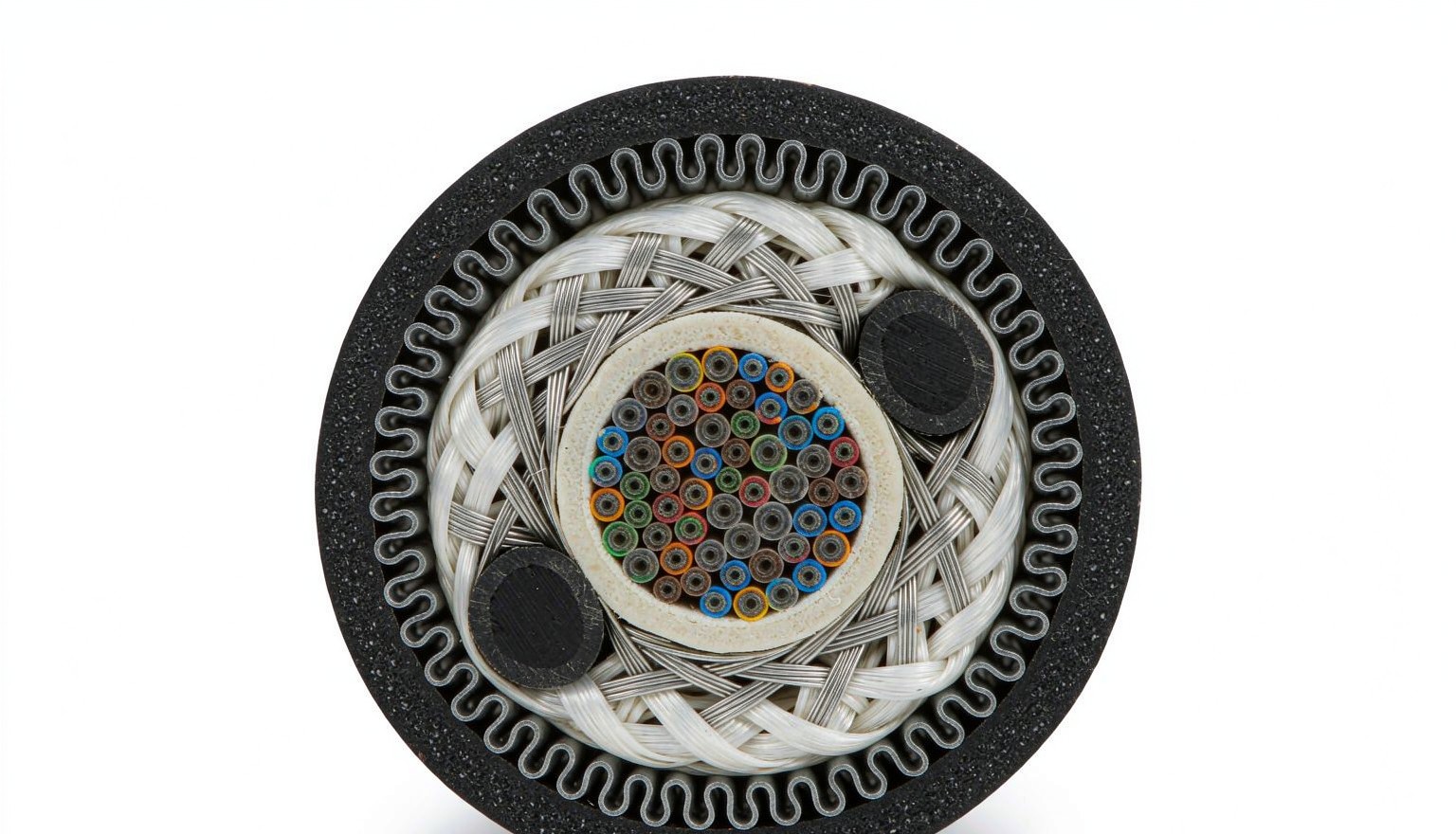
Indoor and outdoor cords are different products, and no fire listing crosses the boundary in either direction. An outdoor cord needs a black polyethylene outer jacket for UV and moisture resistance, plus a construction meeting the crush, impact and tensile requirements of the IEC 60794 series. An indoor LSZH cord run through a duct may pass a first loss test and fail within a season.
Armour is added where the route is exposed: corrugated steel tape for direct burial and industrial cabinets, interlocked armour for rodent-prone ducts. Where the connector sits outdoors, a hardened IP67 interface such as ODVA or FullAXS replaces the duplex port entirely, and the cord becomes a factory-terminated assembly of fixed length.
Matching Connector, Boot and Polish to the Jacket
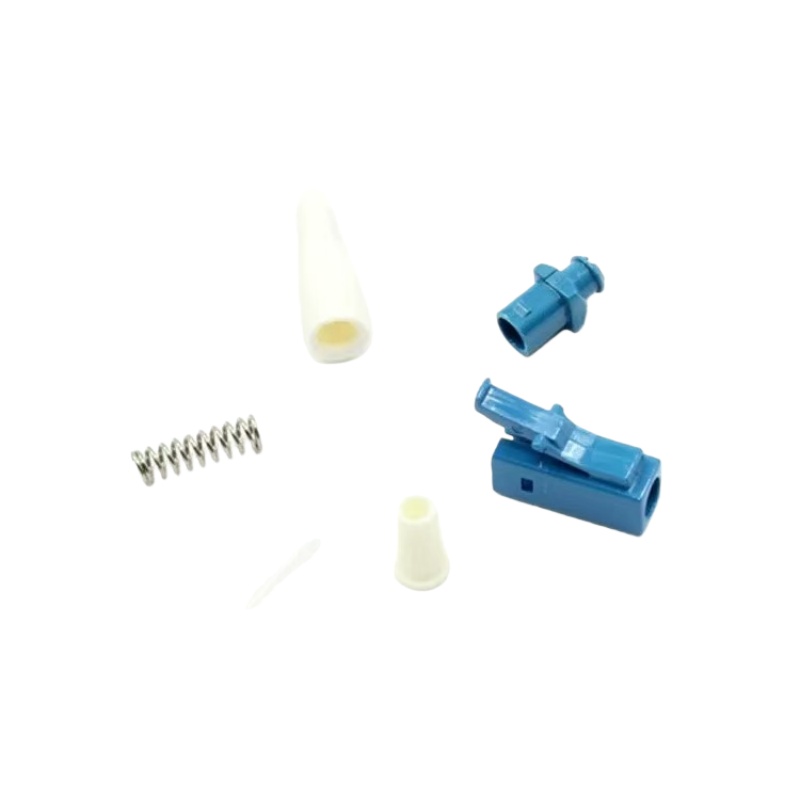
The interface has to agree with the diameter chosen earlier. A 2.0 mm cord pairs naturally with LC uniboot and short boot assemblies, where one round jacket carries both fibres and a single push-pull latch releases the pair. A 3.0 mm duplex cord suits standard SC and LC boots and mixed panels. Boot length must match panel depth, because a long boot inside a shallow cassette stops the door from closing.
Polish must be consistent across the link. LC/UPC and SC/UPC mate with blue housings and hold return loss at 50 dB or better; LC/APC and SC/APC use green housings and reach 60 dB or better, which is why they dominate FTTH splits. An APC ferrule must never be mated to a UPC ferrule, because the angled end face touches only at the edge, the air gap wrecks return loss, and the damage is invisible in a photograph.
- Jacket colour follows fibre grade: yellow for OS2 single-mode, aqua for OM3 and OM4, lime green for OM5, as set out by TIA-568.
- State the length tolerance in the PO, because half a metre of extra slack is easier to accept than a cord that cannot reach the far port.
Single-mode and multimode cords are stocked with the same jacket options, so the single-mode patch cord range and the multimode patch cord range can be ordered against one specification sheet. Keeping the whole patch cord catalogue on one jacket and diameter standard avoids a mixed delivery where half the cords pass inspection and half do not.
Standards Sheet: What to Put in the RFQ
| Standard or test | Scope | What to request from the supplier |
|---|---|---|
| IEC 60332-1-2 | Vertical flame propagation on a single insulated conductor | Report naming the exact cord construction |
| IEC 60754-1 / -2 | Halogen acid gas content and acidity of combustion gases | Compound declaration with measured pH and conductivity |
| IEC 61034-2 | Smoke density under defined combustion | Light transmittance value rather than a claim |
| UL 1666 and UL 910 | Riser and plenum performance for North America | Listing number and printed jacket legend |
| TIA-568.3-D | Cable and connector performance for structured cabling | Attenuation and bandwidth data by fibre grade |
| IEC 61753-1 and GR-326 | Connector performance categories and reliability | Loss limits by category and tested mating cycles |
Send the jacket compound, the fire listing, the cord diameter and the test report reference as four separate lines in the RFQ. A supplier who answers all four with documents will clear inspection; a supplier who answers with a brochure is a risk you carry until the first link test.