
1. Introduction
In modern fiber optic networks, connector performance is critical for ensuring low insertion loss, stable return loss, and long-term optical stability. Among the most commonly used connector types, SC UPC and SC APC stand out as two essential standards for single-mode fiber connections.
However, many technicians, installers, and network designers still wonder:
- What is the real difference between SC UPC and SC APC?
- Why do some networks require APC specifically?
- How does return loss affect transmission quality?
- Which connector type should be used for which application?
This guide answers these questions in detail, offering a complete technical comparison between SC UPC and SC APC connectors, including polishing geometry, return loss performance, insertion loss behavior, and recommended use cases across data centers, FTTH, CATV, and backbone networks.
2. SC Connector Overview
Before comparing UPC and APC, it’s important to understand the basic SC connector design.
2.1 What Is an SC Connector?
SC stands for Subscriber Connector or Standard Connector. It is one of the most widely used fiber optic connector formats globally.
Key characteristics:
- Square-shaped housing
- Push-pull locking mechanism
- 2.5 mm zirconia ceramic ferrule
- Highly reliable, low-cost, and robust
SC connectors are used in:
- Telecom networks
- Data centers
- Fiber-to-the-Home (FTTH)
- Patch panels
- ODF frames
- Backbone cross-connect systems
2.2 Why SC Is Still Widely Used
Despite the popularity of LC connectors in high-density data centers, SC remains dominant in FTTH and telecom environments because:
- It provides stable physical contact
- It is easy to handle in field installations
- It offers strong repeatability
- It is compatible with traditional patch panels
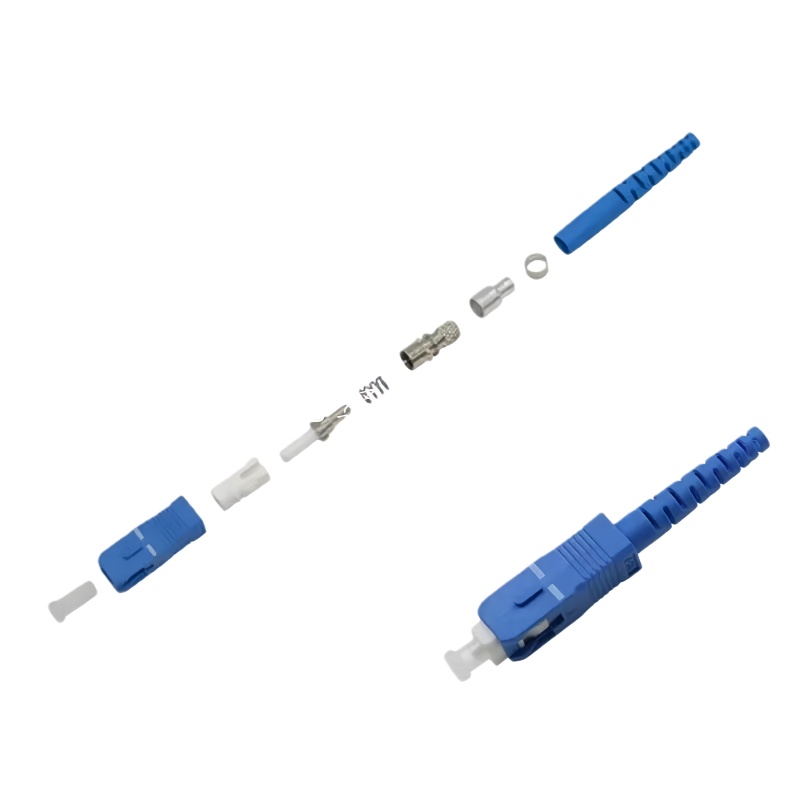
3. What Does UPC and APC Mean?
3.1 UPC – Ultra Physical Contact
UPC connectors feature a highly polished, slightly convex ferrule surface.
Color code: Blue
UPC characteristics:
- Smooth surface finish
- Return loss typically: −50 dB to −55 dB
- Ferrule endface is polished straight (0° angle)
- Ideal for digital signals, short-haul transmission, and data networks
3.2 APC – Angled Physical Contact
APC connectors use an 8° angled ferrule to reduce returning reflections.
Color code: Green
APC characteristics:
- Angled endface → reflected light is diverted into cladding
- Return loss typically: −60 dB to −70 dB
- Required for sensitive analog applications
3.3 Why UPC and APC Are Not Interchangeable
UPC and APC connectors cannot be mated because:
- The ferrule angles are different
- Mating causes air gaps
- Results in extreme signal degradation
- May physically damage the connectors
This is one of the most important rules in fiber termination.
4. SC UPC vs SC APC: End-Face Geometry Comparison
The biggest difference lies in polishing shape.
Table 1 — End-Face Geometry Differences
| Feature | SC UPC | SC APC |
|---|---|---|
| Color | Blue | Green |
| Polishing Angle | 0° (flat convex) | 8° angled |
| Return Loss | −50 to −55 dB | −60 to −70 dB |
| Insertion Loss | 0.2–0.3 dB | 0.2–0.3 dB |
| Surface Finish | Smooth, mirror polish | Smooth, angled polish |
| Fiber Reflection | Back toward source | Redirected into cladding |
| Mating Compatibility | Only UPC | Only APC |
Key Insight:
APC always delivers lower reflection, making it essential for long-distance, analog, and high-power systems.
5. Understanding Return Loss: Why It Matters
5.1 What Is Return Loss?
Return loss (RL) measures how much light is reflected back toward the source.
- Higher absolute value (more negative) = better
- Example: −60 dB is better than −50 dB
5.2 Why Reflection Is Dangerous
Back-reflection can:
- Destabilize laser transmitters
- Reduce signal quality
- Interfere with analog modulation
- Damage high-power optical components
5.3 Why APC Provides Better Return Loss
The 8° angle forces reflected light into the cladding rather than back toward the laser.
This is critical for:
- High-power optical transmitters
- PON splitters
- RF overlay networks
6. SC UPC vs SC APC: Optical Performance Comparison
Table 2 — Optical Performance Metrics
| Metric | SC UPC | SC APC |
|---|---|---|
| Insertion Loss (IL) | 0.2-0.3 dB typical | 0.2-0.3 dB typical |
| Return Loss (RL) | −50 to −55 dB | −60 to −70 dB |
| Back Reflection Level | Medium | Very low |
| Endface Geometry Tolerance | High precision | Higher precision required |
| Stability Under Stress | Good | Excellent |
Important Note:
Contrary to popular belief, insertion loss does not differ much between UPC and APC.
The major difference is in return loss, not insertion loss.
7. SC UPC vs SC APC: Application Comparison
Table 3 — Recommended Application Scenarios
| Application | Recommended Connector | Reason |
|---|---|---|
| FTTH / PON | SC APC | Low reflectance needed for splitters |
| CATV / RF Overlay | SC APC | RF signals are reflection-sensitive |
| ODN (optical distribution networks) | SC APC | Minimizes reflection buildup |
| Data Centers | SC UPC | Digital signals, short distances |
| Telecom Backbone | SC UPC or APC (depends on loading) | UPC for digital, APC for analog |
| Digital Transmission Systems | SC UPC | Reflection is less critical |
| High-power laser systems | SC APC | Protects transmitter |
| Enterprise Networks | SC UPC | Cost-effective and stable |
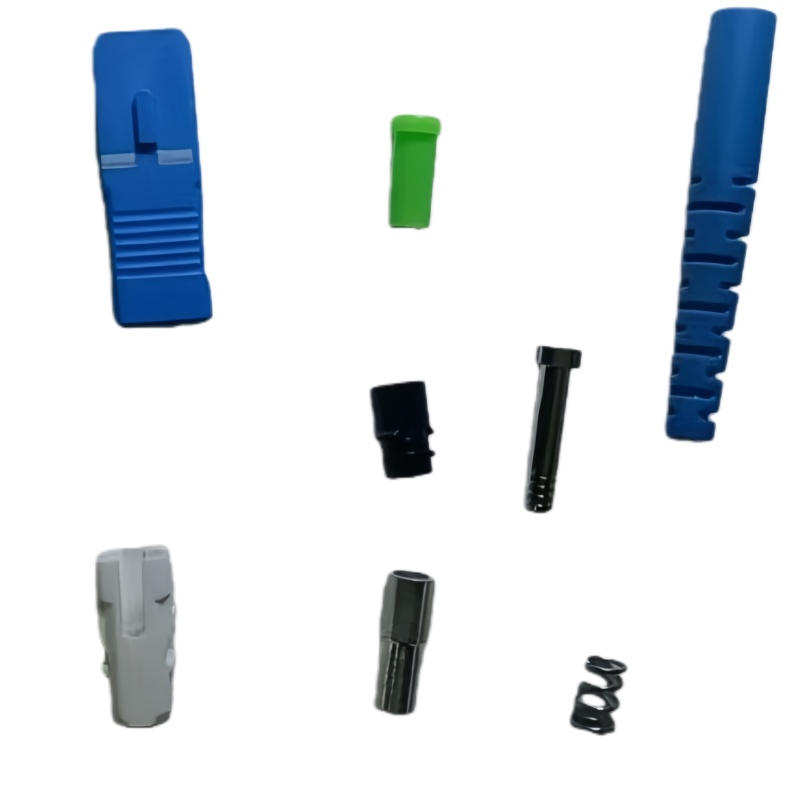
8. When Should You Use SC UPC?
SC UPC is best suited for:
8.1 Data Centers and Enterprise Networks
- Short-distance links
- High-speed digital transmission
- Patch panels and cross-connects
8.2 Ethernet, SDH, and DWDM Digital Signals
Digital modulation schemes (like PAM4, NRZ, QAM) are less sensitive to back-reflection compared to analog signals.
8.3 Low-Cost, High-Density Environments
UPC connectors are cheaper to manufacture.
8.4 Applications Not Sensitive to Reflection
Anywhere where moderate back-reflection is acceptable.
9. When Should You Use SC APC?
SC APC is mandatory for applications where return loss is critical.
9.1 FTTH (Fiber-to-the-Home)
PON networks use splitters (1:8, 1:16, 1:32), making reflection accumulation a real risk.
Most carriers strictly specify SC APC only.
9.2 CATV and RF Overlay
Analog signals cannot tolerate reflection.
APC is the only acceptable connector.
9.3 Long-Distance and High-Power Transmission
Reflection affects:
- Power levels
- DWDM channel stability
- Long-haul system noise
9.4 Sensitive Optical Measurement and Testing
Optical sensors require clean signals without reflection interference.
10. Can SC UPC and SC APC Be Mixed?
The short answer: ABSOLUTELY NOT.
If mated:
- Severe physical damage can occur
- IL increases drastically
- RL becomes unstable
- Data transmission may fail entirely
The different angles prevent proper contact.
Always match UPC with UPC, APC with APC.
11. Polishing Differences: Why APC Requires More Precision
UPC Polishing
- Fewer polishing stages
- Slight convex dome
- Easier mass production
- Lower scrap rate
APC Polishing
- Requires angular polishing ±0.2° tolerance
- Multiple polishing film grits
- Higher production cost
- More complex geometry measurement
This is why APC connectors cost more.
12. Testing Criteria for SC UPC vs SC APC
Both UPC and APC must pass:
- Insertion loss testing
- Return loss testing
- Microscopic inspection
- Interferometer geometry testing
SC UPC Specifications
- IL: 0.2–0.3 dB
- RL: > −50 dB
- End-face: Convex
SC APC Specifications
- IL: 0.2–0.3 dB
- RL: > −60 dB
- End-face: 8° angle ±0.2° tolerance
13. SC UPC vs SC APC in Real-World Installations
13.1 Data Centers
- UPC is most common
- LC UPC is increasingly dominant
- APC used only in niche scenarios
13.2 FTTH (Fiber-to-the-Home)
- APC is mandatory
- Used in ONUs, OLTs, splitters
13.3 Telecom Backbone
- Mix of UPC and APC
- Depends on system architecture
13.4 Cable TV Networks
- 100% APC
- Required for analog video
13.5 PON Networks (GPON, XG-PON, XGS-PON)
- APC only accepted
- Ensures stable optical power levels
14. Price Comparison
Industry average pricing (2024 market):
SC UPC
- Patch cords: Lower cost
- Adapters: Lower cost
- Pigtails: Lower cost
- Easier manufacturing
SC APC
- Higher cost due to polishing precision
- Stronger testing requirements
- Higher scrap rate in production
15. Summary: Which Should You Choose?
Here’s a simplified guideline:
Choose SC UPC if:
- You are building a data center
- You use digital transmission
- Reflection tolerance is moderate
- Low cost is important
- Short-distance communication
Choose SC APC if:
- You deploy FTTH or PON
- You work with CATV or RF signals
- You need lowest reflections
- You operate long-haul networks
- You use high-power optical transmitters
Professional FAQ: SC UPC vs SC APC
Q1: Which is better—SC UPC or SC APC?
Neither is universally “better.”
- UPC is best for data centers and digital systems
- APC is best for FTTH and analog systems
It depends entirely on application requirements.
Q2: Why does SC APC have lower reflection than SC UPC?
Because its 8° angled endface forces reflected light into the cladding instead of back toward the laser.
Q3: Can I use SC UPC for FTTH?
No.
FTTH networks require APC connectors due to PON splitters’ sensitivity to reflection.
Q4: Are SC APC and SC UPC interchangeable?
Absolutely not.
Mating them causes severe reflection issues and potential physical damage.
Q5: Why are UPC connectors cheaper than APC?
UPC connectors use simpler polishing geometry and require less precision manufacturing.
Q6: Is insertion loss lower for APC than UPC?
No.
Insertion loss is similar for both types.
The key difference is return loss, not insertion loss.
Q7: Which connector lasts longer?
Both have similar lifespan, but APC is slightly more stable in long-haul and analog applications due to lower reflection impact.