
Introduction
In the rapidly evolving world of fiber optic communications, the choice of connector can mean the difference between a network that hums along reliably for decades and one plagued by signal degradation, frequent disconnections, and costly troubleshooting. Among the many connector types available, the SC (Subscriber Connector) stands out as one of the most enduring and widely adopted solutions across both single-mode and multimode fiber links. Developed by NTT Japan in the mid-1980s, the SC connector has proven its mettle in telecommunications, data centers, cable television, and industrial networking, earning its reputation as a true workhorse of the fiber optic industry.
The global fiber optic connectors market reflects this widespread adoption. The market was valued at USD 5.61 billion in 2025 and is projected to reach USD 5.98 billion in 2026, with strong growth expected to continue to USD 7.57 billion by 2030. More comprehensive estimates place the market at USD 6.77 billion in 2025, growing to USD 12.07 billion by 2031 at an impressive CAGR of 10.12%. As networks scale to meet 5G, cloud computing, and hyperscale data center demands, the importance of choosing the right connector has never been greater.
This comprehensive guide explores why SC to SC connectors remain a preferred choice for both single-mode and multimode links, delving into their design advantages, optical performance specifications, installation considerations, and the real-world applications that continue to drive their deployment.
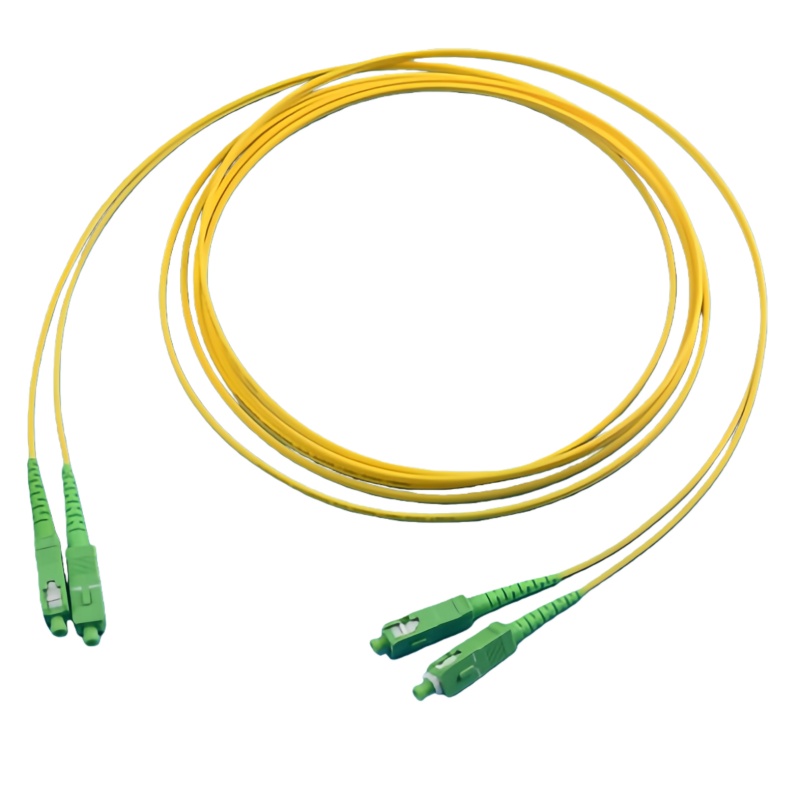
I. Understanding SC Connectors: The Basics
What Does SC Stand For?
The abbreviation “SC” has several meanings in the fiber optic world. The most common interpretation is “Subscriber Connector,” reflecting its widespread use in subscriber-facing network applications. Others refer to it as “Square Connector” (a nod to its distinctive square-shaped housing) or “Standard Connector,” acknowledging its role as an industry benchmark. Whatever you call it, the SC connector’s design has remained remarkably consistent since its introduction, a testament to the soundness of its original engineering.
Design and Mechanical Features
The SC connector is defined by several key design characteristics that contribute to its durability and ease of use:
- Square-shaped housing with a 2.5mm zirconia ceramic ferrule, providing precise fiber alignment.
- Push-pull latching mechanism that allows for quick, one-handed insertion and removal without twisting, significantly reducing installation time compared to threaded designs like FC connectors.
- Spring-loaded ferrule that maintains consistent physical contact even under vibration or cable movement, ensuring stable optical performance.
- UL-rated plastic housing that is corrosion-resistant and available in standardized colors for quick visual identification: blue for single-mode UPC, green for single-mode APC, and beige or aqua for multimode.
- Simplex and duplex configurations, with simplex connectors used for individual fiber connections and duplex configurations for bidirectional links.
SC Variants by Polish Type
SC connectors are available in three primary polish types, each suited to different applications:
| Polish Type | Full Name | Typical Return Loss | Housing Color | Primary Applications |
|---|---|---|---|---|
| PC | Physical Contact | ≥ 40–50 dB | Black or Blue | Legacy systems, general purpose |
| UPC | Ultra Physical Contact | ≥ 55 dB | Blue | Most single-mode applications, enterprise networks |
| APC | Angled Physical Contact | ≥ 65–70 dB | Green | FTTH, PON, CATV, RF-over-fiber, high-bit-rate systems |
The angled end-face of APC connectors (typically 8 degrees) dramatically reduces back reflection, making them indispensable in analog video transmission and passive optical networks where even tiny reflections can degrade signal quality. In 2025, SC APC is widely recognized as the superior choice for the vast majority of new deployments—especially any PON-based FTTH, CATV, or high-bit-rate system.
The key takeaway for network designers is this: SC UPC connectors are perfectly adequate for most digital data transmission, but SC APC is the default choice for any analog or bidirectional system sensitive to back reflection.
| Polish Type | Abbreviation | Return Loss | Housing Color | Best For | Key Consideration |
|---|---|---|---|---|---|
| Physical Contact | PC | ≥ 40–50 dB | Black / Blue | Legacy systems, general | Older standard |
| Ultra Physical Contact | UPC | ≥ 55 dB | Blue | Data, enterprise, most SM | Default for most data |
| Angled Physical Contact | APC | ≥ 65–70 dB | Green | FTTH, PON, CATV, RF | 8° angled tip |
| Polish Type | Abbreviation | Return Loss | Housing Color | Best For | Key Consideration |
|---|---|---|---|---|---|
| Physical Contact | PC | ≥ 40–50 dB | Black / Blue | Legacy systems, general | Older standard |
| Ultra Physical Contact | UPC | ≥ 55 dB | Blue | Data, enterprise, most SM | Default for most data |
| Angled Physical Contact | APC | ≥ 65–70 dB | Green | FTTH, PON, CATV, RF | 8° angled tip |
II. Optical Performance: Why SC Connectors Excel for Both Single-Mode and Multimode
The Universal Ferrule Design
The SC connector’s 2.5mm ceramic ferrule is engineered to accommodate both single-mode (9/125μm) and multimode (50/125μm or 62.5/125μm) fibers without fundamental design changes. The precision alignment achieved by the zirconia ferrule—combined with the push-pull mechanism’s ability to maintain consistent mating pressure—ensures low insertion loss and high return loss across both fiber types.
Single-Mode Performance Specifications
For single-mode fiber links, SC connectors deliver exceptional optical performance. Industry-leading manufacturers report typical insertion loss values as low as 0.05 dB to 0.12 dB for premium-grade connectors, with maximum insertion loss typically not exceeding 0.25 dB to 0.30 dB. Premium SC connectors can achieve insertion loss as low as 0.05 dB typical, 0.15 dB maximum for single-mode applications.
Return loss performance is equally impressive. SC UPC connectors for single-mode fiber achieve return loss values ≥55 dB, meaning less than 0.0003% of the optical power is reflected back toward the source. SC APC connectors, with their angled end-face geometry, push return loss even higher—to ≥65 dB and sometimes exceeding 70 dB for premium variants.
These specifications are not merely marketing numbers; they translate directly into real-world network benefits: longer achievable span lengths, lower bit error rates, and greater system margins for expansion.
Multimode Performance Specifications
For multimode fiber links—commonly OM1 (62.5/125μm), OM2, OM3, and OM4 (50/125μm)—SC connectors deliver comparable reliability. Typical insertion loss values range from 0.15 dB to 0.20 dB, with maximum insertion loss specifications of 0.30 dB. Return loss for multimode SC connectors is generally ≥25 dB, which is adequate given that multimode systems are inherently less sensitive to back reflection than their single-mode counterparts.
It is important to note that multimode SC connectors are generally only available in PC or UPC polish configurations, not APC. APC is primarily a single-mode polish type; while technically possible on multimode, the benefits are marginal and not standardized.
The ability to deploy the exact same connector form factor across both single-mode and multimode links is a significant operational advantage. Technicians trained on SC connectors can work on both fiber types without retraining, reducing the risk of installation errors and simplifying inventory management.
Comparative Performance Table: SC vs. Other Common Connectors
| Parameter | SC Connector | LC Connector | ST Connector | FC Connector |
|---|---|---|---|---|
| Ferrule diameter | 2.5mm | 1.25mm | 2.5mm | 2.5mm |
| Mating mechanism | Push-pull latch | Push-pull latch | Bayonet twist | Threaded screw |
| Typical insertion loss (SM) | 0.12–0.25 dB | 0.10–0.20 dB | 0.25–0.50 dB | 0.20–0.35 dB |
| Typical return loss (SM UPC) | ≥ 55 dB | ≥ 55 dB | ≥ 50 dB | ≥ 55 dB |
| Return loss (SM APC) | ≥ 65 dB | ≥ 65 dB | N/A | N/A |
| Single-mode support | Yes (UPC & APC) | Yes | Yes | Yes |
| Multimode support | Yes | Yes | Yes | Limited |
| Durability (mating cycles) | 1,000+ | 500–1,000 | 1,000+ | 500–1,000 |
| Typical housing color (SM UPC) | Blue | Blue | Silver/Black | Nickel-plated |
| Primary applications | FTTH, data center, telco | Data center, high-density | Legacy, industrial | Telecom, high-vibration |
Data compiled from industry datasheets including Senko, TTI Fiber, and JAE specifications.
III. The Case for SC to SC Links: Why Single-Mode and Multimode Both Benefit
Why SC Is Favored for Single-Mode Links
Single-mode fiber is the backbone of long-haul telecommunications, metro networks, and high-speed data center interconnects. The demands placed on connectors in these environments are severe: they must maintain alignment precision at the sub-micron level across thousands of mating cycles and decades of service life.
The SC connector meets these demands through several key attributes:
First, the 2.5mm ferrule provides a larger mechanical interface than the smaller LC’s 1.25mm ferrule. This may seem like a disadvantage in the era of high-density packaging, but for single-mode applications where fiber alignment is critical, the larger ferrule offers greater mechanical stability and resistance to angular misalignment.
Second, the SC’s push-pull latching mechanism has proven exceptionally reliable over millions of field deployments. Unlike bayonet-style ST connectors that can be incompletely twisted or threaded FC connectors that require careful seating, the SC connector provides an audible click when fully mated—a simple but invaluable confirmation for field technicians.
Third, the SC connector’s robust housing and ceramic ferrule withstand the environmental demands of outside plant installations, including temperature cycling, humidity, and physical handling. Operating temperature ranges from –40°C to +85°C ensure performance in virtually any climate.
Why SC Is Favored for Multimode Links
Multimode fiber dominates short-reach applications such as campus backbones, data center interconnects, and local area networks. In these environments, cost-effectiveness and ease of installation often take precedence over absolute optical performance.
The SC connector’s advantages for multimode links are straightforward:
- Cost efficiency: The SC connector’s design and manufacturing processes are mature and highly optimized, making it one of the most economical connector types available.
- Field termination support: Field-installable SC connectors—including fusion-spliced and mechanical splice variants—allow technicians to terminate cables on-site without expensive polishing equipment. An experienced installer can terminate XP-FIT SC connectors in less than 2 minutes each.
- Interoperability: The SC connector’s compatibility with legacy systems is unmatched. Using hybrid adapters, SC can connect to ST or FC connectors, a valuable capability when maintaining mixed-vendor or mixed-technology networks.
Visual Identification: Color Coding Prevents Costly Mistakes
One of the SC connector’s most valuable features for maintaining single-mode and multimode links is its standardized color coding system. This simple but critical design feature prevents the costly mistake of mismatching fiber types—an error that can cause excessive signal loss or complete network failure.
| Fiber Type | Polish Type | Housing Color | Jacket Color (Cable) |
|---|---|---|---|
| Single-mode | UPC | Blue | Yellow |
| Single-mode | APC | Green | Yellow |
| Single-mode | PC | Black / Blue | Yellow |
| Multimode (OM1/OM2) | UPC | Beige / Cream | Orange |
| Multimode (OM3/OM4) | UPC | Aqua | Aqua |
| Multimode (OM5) | UPC | Lime green | Lime green |
Standardization across manufacturers means that a blue SC connector from one vendor is functionally and visually identical to a blue SC connector from another—a significant operational advantage in multi-vendor environments.
Color-Coding: Quick Visual Check
| Fiber Type | Polish Type | Connector Housing | Cable Jacket |
|---|---|---|---|
| Single‑mode | UPC | Blue | Yellow |
| Single‑mode | APC | Green | Yellow |
| Multimode (OM1/OM2) | UPC | Beige/Cream | Orange |
| Multimode (OM3/OM4) | UPC | Aqua | Aqua |
| Multimode (OM5) | UPC | Lime Green | Lime Green |
IV. The Critical Distinction: UPC vs. APC for Single-Mode Links
Within single-mode SC connectors lies a decision that significantly impacts network performance: UPC (Ultra Physical Contact) versus APC (Angled Physical Contact). Understanding this distinction is essential for any network designer.
UPC Connectors
UPC connectors feature a slightly domed end-face that creates physical contact at the fiber core. They achieve return loss values of ≥55 dB, which is more than adequate for most digital data transmission systems. The primary advantage of UPC is lower manufacturing cost and broader compatibility with standard transceivers.
APC Connectors
APC connectors feature an 8-degree angled end-face that dramatically reduces back reflection by directing reflected light into the cladding rather than back down the fiber core. This design achieves return loss values of ≥65 dB (and ≥70 dB for premium variants), making them essential for systems sensitive to optical reflections.
When to Choose Which
The choice between UPC and APC is not a matter of quality but of application suitability. The table below summarizes the decision criteria.
| Application | Recommended Polish | Reason |
|---|---|---|
| FTTH / PON | APC | PON systems are highly sensitive to back reflection; APC is industry standard |
| CATV / RF-over-fiber | APC | Analog video signals degrade noticeably with any reflection |
| High-bit-rate digital (100G+) | APC | Signal-to-noise ratio margins benefit from reduced reflections |
| Enterprise LAN / general data | UPC | Adequate performance at lower cost; broader transceiver compatibility |
| Data center interconnects (digital) | UPC | Wide compatibility with SFP/SFP+ transceivers |
| Long-haul DWDM | APC | Accumulated reflections over long spans create system penalties |
A Critical Warning: Never Mix UPC and APC
UPC and APC connectors are physically incompatible and should never be mated. Doing so damages both connector end-faces, permanently degrading optical performance. The color-coding system (blue for UPC, green for APC) makes this incompatibility visually obvious—but only if technicians follow the color code. This is one of the most frequent and costly mistakes in fiber optic field work.
As a general rule for 2025: SC APC is the superior choice for the vast majority of new single-mode deployments, especially any PON-based FTTH, CATV, or high-bit-rate system. However, always verify transceiver compatibility—some standard transceivers are designed specifically for UPC and may not seat properly with APC connectors.
V. SC vs. LC: The Data Center Dilemma
No discussion of SC connectors would be complete without addressing the elephant in the room: LC connectors. With their 1.25mm ferrule (half the size of SC’s 2.5mm ferrule), LC connectors have become the de facto standard for high-density data center applications, occupying approximately half the space of SC connectors in patch panels.
However, the LC connector’s growing dominance in data centers does not diminish the SC connector’s value in other domains.
Head-to-Head Comparison: SC vs. LC
| Aspect | SC Connector | LC Connector |
|---|---|---|
| Ferrule diameter | 2.5mm | 1.25mm |
| Relative port density | Baseline | 2x higher density |
| Push-pull latch | Yes | Yes (latch style) |
| Typical IL (SM) | 0.12–0.25 dB | 0.10–0.20 dB |
| UPC return loss | ≥ 55 dB | ≥ 55 dB |
| APC return loss | ≥ 65 dB | ≥ 65 dB |
| Durability in harsh environments | Excellent (robust housing) | Good (smaller latch more delicate) |
| Cost per connection | Lower | Moderate (slightly higher) |
| Field termination ease | Very easy (larger components) | Moderate (smaller parts) |
| Standardization in FTTH | Dominant | Limited |
When to Choose SC Connectors
Despite LC’s advantages in port density, SC connectors remain the preferred choice in several key scenarios:
- FTTH and access networks: SC connectors dominate residential and small-business deployments due to cost-effectiveness and simplicity. SC remains the dominant connector in FTTH, especially drop cables and ONT terminations.
- Telecom central offices: The SC connector’s robust design and proven reliability make it the standard for telecommunications infrastructure.
- Cable TV and RF-over-fiber networks: SC APC’s exceptional return loss performance is essential for analog video transmission.
- Industrial and outdoor environments: The SC’s larger, more rugged housing withstands physical stress and environmental exposure better than the smaller LC.
- Legacy system integration: Existing SC-based infrastructure continues to perform reliably, and hybrid adapters enable seamless connection to LC equipment where needed.
When to Choose LC Connectors
LC connectors are generally the better choice for:
- Hyperscale data centers: Where port density is at a premium and every rack unit must support maximum connections
- High-density patch panels: Where 48 or more ports per 1RU are required
- New enterprise backbone deployments: Where space constraints and future scalability are primary concerns
- Direct-attach SFP/SFP+ connections: Many transceivers ship with LC interfaces by default
The real-world truth is that SC and LC are not direct competitors in the way that VHS and Betamax once were. They coexist because they serve different primary markets. The connector type (LC or SC) has no inherent effect on bandwidth—both can handle 1G, 10G, or even 100G data rates without issue. The choice comes down to physical constraints and application requirements, not technical capability.
For fixed-port applications where simplicity and stability are paramount, the SC’s snap-in design is faster and easier to handle than screw-on types, making it ideal for field deployments where installation speed matters.
VI. Mode Conditioning: Enabling Mixed Single-Mode and Multimode Links
A recurring challenge in fiber optic networking is the need to connect single-mode transceivers to existing multimode fiber plants. While not recommended for new deployments, this situation arises frequently in network upgrades and legacy system integrations.
The Problem
Standard single-mode transceivers use laser sources that launch light into a very small spot at the center of the fiber core. When connected directly to multimode fiber, this concentrated launch creates a phenomenon known as Differential Mode Delay (DMD)—different light modes travel at different speeds, causing signal distortion and limiting effective distance.
Without a mode conditioning patch cord, it is not possible to use a single-mode transceiver with multimode fiber because the laser source does not launch an equal amount of optical power into all modes of the fiber.
The Solution: Mode Conditioning Patch Cords
Mode conditioning patch cords (MCPs) solve this problem through a clever design: they contain a short length of single-mode fiber spliced to graded-index multimode fiber on the transmit side, while the receive side uses standard multimode fiber throughout. This arrangement spreads the laser launch across multiple modes, reducing DMD to acceptable levels.
These patch cords are compliant with the IEEE 802.3z standard and are specially used for single-mode and multimode interconnection, applied over multimode plants in Gigabit Ethernet networks.
Most MCPs are available with SC connectors on both ends, leveraging the SC connector’s widespread deployment and field termination support. For network administrators maintaining mixed fiber plants, stocking a few SC-to-SC mode conditioning patch cords provides a cost-effective solution for interconnecting single-mode equipment to multimode infrastructure.
When MCPs Are Required
| Application | MCP Required? | Notes |
|---|---|---|
| 1000BASE-LX over OM1/OM2 (62.5μm) | Yes | Standard requirement per IEEE 802.3z |
| 1000BASE-LX over OM3/OM4 (50μm) | No | Laser-optimized fiber reduces DMD |
| 10GBASE-LRM over multimode | Sometimes | Depends on fiber type and link length |
| Long-wavelength transceivers over multimode | Typically yes | Check manufacturer specifications |
The key recommendation is simple: for any new deployment, use matching fiber types to avoid MCP complexity altogether. But when legacy integration is unavoidable, SC-based mode conditioning patch cords provide a reliable solution.
VII. Real-World Applications: Where SC Connectors Dominate
Fiber to the Home (FTTH) and Passive Optical Networks (PON)
The most significant single application for SC connectors is FTTH deployment. Global fiber broadband expansion—driven by 5G backhaul requirements, work-from-home trends, and government broadband initiatives—has created unprecedented demand for reliable, cost-effective connectivity. SC APC has become the industry standard for PON-based FTTH, including GPON, EPON, XGS-PON, and NG-PON2 architectures.
FTTH networks use SC connectors at multiple points:
- OLT ports in central offices
- Splitter input and output ports in distribution cabinets
- ONT/ONU customer premises terminations
- Drop cable connections from distribution points to homes
The SC connector’s square shape, push-pull latching, and excellent return loss performance (essential for PON bidirectional transmission) make it the undisputed standard in this market.
Data Centers (Legacy and Mid-Tier)
While LC connectors have largely supplanted SC in hyperscale data centers, SC remains widely deployed in enterprise data centers, colocation facilities, and edge data centers. Many organizations continue to deploy SC-based infrastructure because of its lower cost, easier field termination, and proven reliability.
The shift toward miniaturized very small form factor (VSFF) designs like SN and MDC is accelerating in hyperscale environments, but SC remains a solid choice for organizations not constrained by extreme port density requirements.
Telecommunications Central Offices
Telecom carriers have standardized on SC connectors for central office fiber distribution frames, patch panels, and cross-connect systems. The SC connector’s durability, ease of use, and compatibility with automated fiber management systems make it ideal for high-connection-count environments where technicians perform frequent moves, adds, and changes.
Cable Television and Hybrid Fiber Coaxial Networks
CATV networks rely heavily on SC APC connectors for RF-over-fiber transmission. Analog video signals are particularly sensitive to back reflection—even tiny reflections create visible ghosting and signal degradation. SC APC’s ≥65 dB return loss performance is essential for maintaining broadcast-quality video transmission.
Industrial and Outdoor Networks
In factories, transportation systems, utilities, and remote monitoring installations, environmental robustness matters more than port density. The SC connector’s rugged housing, wide operating temperature range (–40°C to +85°C), and resistance to vibration and physical stress make it the preferred choice for demanding environments.
Test and Measurement Equipment
Fiber optic test equipment—including optical time-domain reflectometers (OTDRs), optical power meters, and light sources—almost universally features SC connectors or SC adapters. The SC connector’s stable mating characteristics and low insertion loss ensure repeatable, accurate measurements.
VIII. Installation and Termination Methods
SC connectors can be terminated using four primary methods, each suited to different deployment scenarios and skill levels.
1. Factory-Preterminated (Pigtails)
Factory-preterminated SC pigtails offer the highest quality and consistency. Each connector is factory-polished and tested, with insertion loss specifications guaranteed. Field installation requires only splicing (fusion or mechanical) the pigtail to the field cable.
- Best for: High-quality permanent installations, backbone cabling, central offices
- Pros: Guaranteed optical performance, fastest field installation, lowest loss
- Cons: Requires splice tray, splice protection, and fusion splicer or mechanical splice tool
2. Field-Installable Mechanical Splice Connectors
Field-installable SC connectors (such as Corning UniCam, Senko XP-Fit, AFL FUSEConnect) allow technicians to terminate fiber on-site without fusion splicing or polishing. The connector contains a pre-polished ferrule and a mechanical splice mechanism that aligns and secures the field fiber.
An experienced installer can terminate XP-FIT connectors in less than 2 minutes each. These connectors use a precision mechanical alignment and achieve low loss termination (insertion loss: 0.2dB average, 0.5dB maximum, return loss: –55dB average). No adhesives or polishing are required, and there is no need for electrical power at the termination location.
- Best for: Quick repairs, low-volume terminations, field service
- Pros: No special tools beyond kit, fast termination, acceptable performance
- Cons: Higher insertion loss than fusion splicing, higher per-connector cost
3. Fusion Splice-On Connectors
Fusion splice-on connectors are short factory-terminated pigtails designed to be fusion spliced directly to the field fiber, combining the quality of factory polish with the permanence of fusion splicing.
- Best for: High-quality terminations where a full pigtail is impractical
- Pros: Factory-quality end-face, low loss, permanent connection
- Cons: Requires fusion splicer and training
4. Field Polish Connectors
Field polish SC connectors require the technician to epoxy the fiber into the ferrule, cure the epoxy, cleave the fiber, and polish the end-face to the correct finish. This method demands significant skill and specialized equipment.
- Best for: Very low-volume or emergency repairs when other options unavailable
- Pros: Lowest material cost
- Cons: Highest skill requirement, time-consuming, inconsistent results
For most applications, factory-preterminated pigtails or fusion splice-on connectors deliver the best combination of performance and practicality. Field-installable mechanical splice connectors are excellent for service and maintenance scenarios where speed is paramount.
Connector Cleaning and Maintenance Best Practices
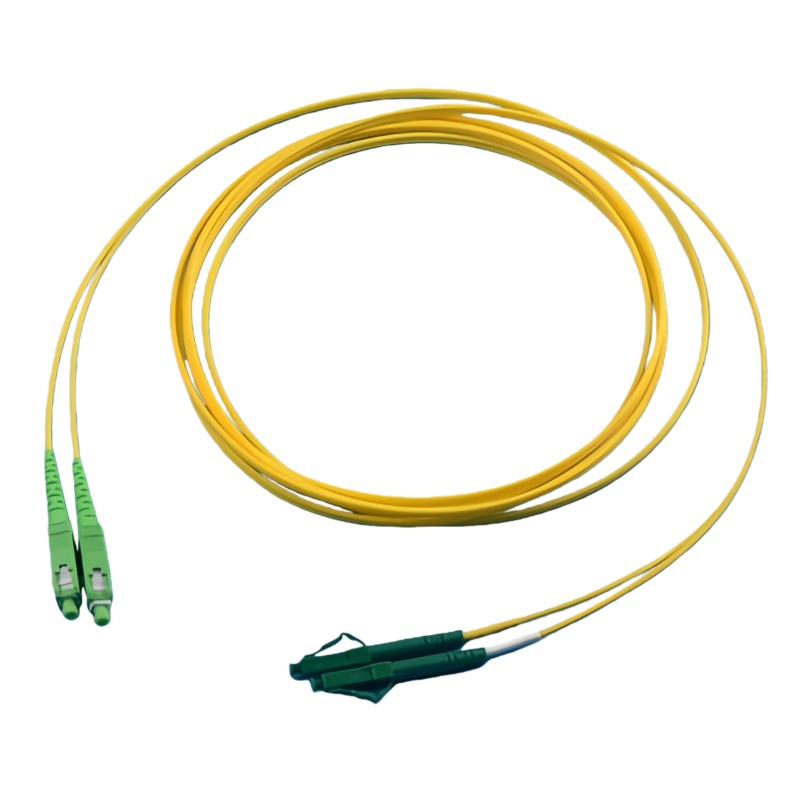
Contaminated fiber connectors are the single largest cause of network problems. In fiber optic networks, 80% of problems are caused by dirty or damaged optical connectors. Implementing proper cleaning protocols dramatically reduces troubleshooting time and improves network reliability.
Critical practices to follow:
| Practice | Why It Matters |
|---|---|
| Clean before every connection | Prevents contamination transfer from connector to connector |
| Inspect with a fiber scope before mating | Detects contamination invisible to the naked eye |
| Clean both ends—never assume one end is clean | Even a “clean” connector can be contaminated |
| Use only fiber-specific cleaning tools (reel cleaners, lint-free wipes) | Household products leave residue or scratch end-faces |
| Dry clean first; use isopropyl alcohol only for stubborn contamination | Wet cleaning can leave residue if not dried properly |
| Cap connectors when not in use | Prevents dust intrusion and physical damage |
The only acceptable solution for cleaning dust covers is isopropyl alcohol. Never use water for cleaning fiber optic components.
A simple but powerful rule: inspect, clean, inspect, connect. This four-step process eliminates the majority of connector-related network failures.
| Step | Action | Tool |
|---|---|---|
| 1 | Inspect | Fiber scope (200x–400x magnification) |
| 2 | Clean | Fiber reel cleaner or lint‑free wipe + IPA |
| 3 | Inspect again | Fiber scope |
| 4 | Connect | Mate the SC connector |
IX. Table 1: SC Connector Specifications for Single-Mode Links
| Parameter | Value | Notes |
|---|---|---|
| Fiber type | 9/125μm single-mode | G.652D compliant |
| Ferrule material | Zirconia ceramic | 2.5mm diameter |
| Typical insertion loss (UPC) | 0.05–0.12 dB | Premium grade |
| Maximum insertion loss (UPC) | 0.25–0.30 dB | Industry standard |
| Typical return loss (UPC) | ≥ 55 dB | <0.0003% reflected power |
| Typical insertion loss (APC) | 0.10–0.20 dB | Premium grade |
| Maximum insertion loss (APC) | 0.25–0.30 dB | Industry standard |
| Typical return loss (APC) | ≥ 65 dB (≤ 70 dB premium) | 8° angled end-face |
| Durability | ≥ 1,000 mating cycles | <0.1 dB change typical |
| Operating temperature | –40°C to +85°C | Industry standard |
| Housing color (UPC) | Blue | TIA/EIA standard |
| Housing color (APC) | Green | TIA/EIA standard |
| Standards compliance | IEC 61754-4, TIA-604-3 (FOCIS 3), Telcordia GR-326 |
Data compiled from Senko, TTI Fiber, and JAE product specifications.
X. Table 2: SC Connector Specifications for Multimode Links
| Parameter | Value | Notes |
|---|---|---|
| Fiber types | OM1 (62.5/125μm), OM2, OM3, OM4, OM5 (50/125μm) | All common multimode types |
| Ferrule material | Zirconia ceramic | 2.5mm diameter |
| Typical insertion loss (OM1/OM2) | 0.15–0.20 dB | Premium grade |
| Typical insertion loss (OM3/OM4/OM5) | 0.15–0.20 dB | Premium grade |
| Maximum insertion loss | 0.30 dB | Industry standard |
| Typical return loss | ≥ 25 dB | Adequate for multimode systems |
| Durability | ≥ 1,000 mating cycles | <0.1 dB change typical |
| Operating temperature | –40°C to +85°C | Industry standard |
| Housing colors | Beige (OM1/OM2), Aqua (OM3/OM4), Lime green (OM5) | TIA/EIA standard |
| Standards compliance | IEC 61754-4, TIA-604-3 (FOCIS 3), Telcordia GR-326 |
Data compiled from Senko, TTI Fiber, and JAE product specifications.
XI. Table 3: SC Connector Market Forecast and Industry Trends
| Metric | Value | Source / Year |
|---|---|---|
| Global fiber optic connectors market (2025) | USD 5.61 billion | Research and Markets, 2026 |
| Global fiber optic connectors market (2026 projection) | USD 5.98 billion (6.5% CAGR) | Research and Markets, 2026 |
| Global fiber optic connectors market (2030 projection) | USD 7.57 billion (6.1% CAGR) | Research and Markets, 2026 |
| Alternative market estimate (2025) | USD 6.77 billion | TechSci Research, 2025 |
| Alternative market estimate (2031 projection) | USD 12.07 billion (10.12% CAGR) | TechSci Research, 2025 |
| SC connector segment status | Mature but stable; dominates FTTH and PON | Industry analysis, 2025 |
| LC connector segment growth rate | Fastest-growing segment | TechSci Research, 2025 |
| Primary growth drivers | 5G deployment, data center expansion, cloud infrastructure, FTTH | Multiple sources |
| Key trend for SC | Continued dominance in FTTH drop cables and ONT terminations | Industry analysis, 2025 |
| Key trend for high-density | Transition to VSFF (SN, MDC) for hyperscale data centers | TechSci Research, 2025 |
| Major manufacturers | Corning, Amphenol, TE Connectivity, Molex, Senko, US Conec | Industry reports |
Note: Market figures vary by methodology and scope. Research and Markets focuses on connectors specifically, while TechSci Research includes broader fiber optic interconnect systems.
Market Context and Implications
The growth in fiber optic connectors is driven by several factors: expansion of broadband communication networks, rising deployment of FTTH connections, increasing data center construction, accelerating 5G deployment, and growing adoption of cloud computing infrastructure.
For SC connectors specifically, the market remains robust despite competitive pressure from LC connectors in high-density applications. SC remains the dominant connector in FTTH, especially drop cables and ONT terminations. Major trends in the forecast period include increasing demand for high-density fiber connectivity, expansion of fiber deployment in smart infrastructure, and enhanced focus on low-loss optical performance—all areas where SC connectors continue to perform admirably.
Network designers should note that while LC connectors are the fastest-growing segment and dominate new data center deployments, SC connectors remain the standard for FTTH, CATV, and telecommunications infrastructure—a position that shows no signs of changing in the coming decade.
XII. Table 4: SC Connector Comparison Across Connector Types
| Connector Type | Ferrule Diameter | Mating Mechanism | Density Rating | Primary Applications | SC Preference Factor |
|---|---|---|---|---|---|
| SC | 2.5mm | Push-pull latch | Medium | FTTH, PON, CATV, telco, data center | Baseline reference |
| LC | 1.25mm | Push-pull latch | High | Hyperscale data center, enterprise backbone | SC preferred for FTTH, rugged environments |
| ST | 2.5mm | Bayonet twist | Medium | Legacy systems, industrial | SC has largely replaced ST in new deployments |
| FC | 2.5mm | Threaded screw | Low | Telecom, high-vibration | SC easier for frequent connects/disconnects |
| MPO/MTP | Multiple fibers | Push-pull latch | Very high | 40G/100G/400G data centers | SC for simplex/duplex; MPO for parallel optics |
| SN/MDC (VSFF) | 1.25mm | Push-pull | Ultra-high | Hyperscale 400G/800G | Emerging; SC remains mainstream |
This comparison makes clear that SC connectors are not “obsolete” but rather occupy a specific and valuable position in the connector ecosystem. Their medium density, robust design, and excellent optical performance make them ideal for applications where reliability and ease of use matter more than packing the maximum number of ports into a rack unit.
For short-reach applications like server racks, simplex LC connections remain common. For 400G and beyond, MPO connectors become indispensable. But for the vast middle ground of telecommunications infrastructure, FTTH, and enterprise networking, SC connectors continue to deliver exactly what network operators need.
XIII. Common Installation Mistakes and How to Avoid Them
Even experienced technicians can make errors that compromise SC connector performance. Understanding these common pitfalls helps avoid costly rework.
Mistake 1: Mixing UPC and APC Connectors
As noted earlier, UPC and APC connectors are physically incompatible and should never be mated. The angled end-face of an APC connector will not seat properly against the domed end-face of a UPC connector, causing air gaps that destroy return loss performance and potentially damage both connectors.
Avoid by: Always verify housing colors before mating—blue (UPC) to blue, green (APC) to green. If unsure, inspect the connector end-face with a fiber scope.
Mistake 2: Failing to Clean Connectors Before Mating
Contamination is invisible to the naked eye but devastating to optical performance. A single particle of dust on a fiber core can block the entire signal path.
Avoid by: Adopting the “inspect, clean, inspect, connect” discipline. Never assume a connector is clean just because it looks clean to the naked eye.
Mistake 3: Over-tightening or Improper Seating
SC connectors require only firm push until the latch clicks. Over-torquing or attempting to “tighten” the connection can damage the ferrule or housing.
Avoid by: Listening for the audible click—that indicates proper mating. Never use tools to force an SC connection.
Mistake 4: Using Single-Mode Connectors on Multimode Fiber (or Vice Versa)
While the SC connector body is identical, the ferrule bore diameter differs between single-mode (125.5μm) and multimode (127μm) variants. Using the wrong type causes excessive insertion loss and potential fiber damage.
Avoid by: Following color codes: single-mode uses blue or green housing; multimode uses beige, aqua, or lime green.
Mistake 5: Exceeding Bend Radius During Installation
Fiber optic cables have minimum bend radius specifications. Exceeding this radius causes microbending losses and, in severe cases, fiber fracture.
Avoid by: Maintaining a bend radius of at least 10× the cable diameter for long-term installations; use bend-insensitive fiber for tight spaces.
Mistake 6: Neglecting Cable Strain Relief
Tension on the fiber cable transmits directly to the connector-ferrule interface, potentially causing misalignment or ferrule damage.
Avoid by: Always secure cables with proper strain relief mechanisms, including cable ties (not overtightened), ladder racks, and cable management fingers in patch panels.
XIV. Future Outlook: SC Connectors in the 5G and Beyond Era
The 5G Impact
5G networks require significantly higher fiber density compared to previous generations to support low latency and high data rates. This network densification drives procurement of connectors capable of withstanding outdoor environments while maintaining signal integrity.
SC connectors are particularly well-suited for 5G fronthaul and backhaul applications due to their:
- Environmental robustness: Operating temperature range of –40°C to +85°C covers all outdoor deployment scenarios
- Ease of field termination: Field-installable SC connectors enable rapid deployment in remote locations
- Established supply chain: SC connectors are available from dozens of manufacturers worldwide
PON Evolution
As PON technologies evolve from GPON (2.5G downstream) to XGS-PON (10G symmetric) to NG-PON2 (40G), the demands on connectors remain consistent: low insertion loss and high return loss. SC APC connectors meet these requirements for all current and near-future PON generations.
The physical-layer requirements for higher-speed PON (higher launch powers, more sensitive receivers) actually increase the importance of connector quality. Dirty or damaged connectors cause more severe signal degradation at higher data rates. SC connectors’ robust design and widespread adoption make them the default choice for PON evolution.
The High-Density Challenge
The shift toward miniaturized very small form factor (VSFF) designs like SN and MDC is accelerating in hyperscale data centers, driven by the need to support 400G and 800G speeds with triple the connection density of traditional systems.
However, these VSFF connectors are unlikely to displace SC in telecommunications, FTTH, or enterprise environments for several reasons:
- Field termination complexity: VSFF connectors are more difficult to terminate in the field, requiring precision tooling and skilled technicians
- Higher cost per connection: The precision manufacturing required for VSFF connectors increases material and production costs
- Legacy ecosystem: Hundreds of millions of SC-terminated ports are already deployed worldwide; wholesale replacement is economically impractical
- Sufficient density for most applications: SC density is adequate for the vast majority of telecommunications and enterprise applications
The Balanced View
For new hyperscale data center deployments, LC and VSFF connectors will continue to gain share. For FTTH, PON, CATV, telecommunications, and industrial applications, SC connectors will remain the standard for the foreseeable future. The two markets are complementary, not competitive.
The most important trend for SC connector users is the ongoing improvement in manufacturing quality. Premium SC connectors today achieve insertion loss values (0.05 dB typical) that were unthinkable a decade ago. As manufacturing tolerances continue to tighten, SC connectors will remain competitive even as higher-density alternatives emerge.
XV. Frequently Asked Questions (FAQs)
Q1: Can I use an SC single-mode connector on multimode fiber?
Yes, but it is generally not recommended. While the SC connector body is the same, single-mode connectors are manufactured with tighter ferrule tolerances (125.5μm bore diameter) than multimode connectors (127μm bore diameter). Using a single-mode connector on multimode fiber may cause higher insertion loss and potential fiber damage due to the tighter fit. The reverse—using a multimode connector on single-mode fiber—is even more problematic, as the larger ferrule bore allows the fiber to shift, causing misalignment and significant signal loss.
If mixed deployment is unavoidable, use hybrid patch cords specifically designed for this purpose, and always verify performance with an OTDR or power meter.
Q2: Is the SC connector available in both single-mode and multi-mode configurations?
Yes, absolutely. The SC Connector is available in both single-mode and multi-mode configurations, making it one of the most versatile connector types on the market. The SC features a square shape, a 2.5mm ferrule compatible with FC and ST via hybrid adapters, and a reliable push-pull latching mechanism. The fiber type is indicated by the connector housing color: blue for single-mode UPC, green for single-mode APC, and beige/aqua/lime green for multimode.
Q3: What is the difference between SC UPC and SC APC connectors, and can they be mixed?
SC UPC (Ultra Physical Contact) features a slightly domed end-face that provides physical contact at the fiber core, achieving return loss of ≥55 dB. SC APC (Angled Physical Contact) features an 8-degree angled end-face that directs reflected light into the cladding, achieving return loss of ≥65 dB.
They cannot be mixed. Mating UPC and APC connectors will create misalignment between the mated connectors, permanently damaging both end-faces and destroying optical performance. Always match UPC to UPC and APC to APC, using color codes (blue for UPC, green for APC) as your guide.
Q4: Which is better for FTTH: SC or LC?
For FTTH, SC is overwhelmingly preferred—specifically SC APC. SC remains the dominant connector in FTTH, especially drop cables and ONT terminations. The SC APC provides the low return loss required by PON systems and has become the industry standard for FTTH deployments worldwide. LC connectors are more common in data center environments where port density is the primary constraint, but they have not gained significant traction in the FTTH access network.
Q5: Can a single-mode transceiver work with multimode fiber using SC connectors?
Not directly. Standard single-mode transceivers launch laser light into a very small spot at the fiber core. When connected directly to multimode fiber, this concentrated launch causes differential mode delay (DMD), severely limiting transmission distance. A mode conditioning patch cord (MCP) is required to spread the launch across multiple modes of the multimode fiber. These patch cords contain a short length of single-mode fiber spliced to graded-index multimode fiber on the transmit side, enabling the interconnection of single-mode and multimode equipment. Most MCPs are available with SC connectors on both ends.
Q6: How many mating cycles can an SC connector withstand?
SC connectors are rated for a minimum of 1,000 mating cycles with less than 0.1 dB change in insertion loss. Premium-grade connectors can withstand significantly more cycles while maintaining performance specifications. For perspective, a connector mated once per business day would reach 1,000 cycles after approximately four years of daily use—well within most network operational lifetimes.
Q7: How do I clean an SC connector properly?
Proper cleaning requires a four-step process:
- Inspect the connector end-face using a fiber optic inspection scope (200–400x magnification).
- Dry clean using a fiber optic reel cleaner or lint-free wipe designed for fiber connectors. For SC connectors, insert the cleaning pen into the adapter and push gently while rotating.
- Inspect again to verify contamination is removed. If stubborn contamination remains, moisten a lint-free wipe with isopropyl alcohol (never water), clean in a single direction, and allow to dry completely before reconnecting.
- Connect only after inspection confirms cleanliness.
Always cap connectors when not in use, clean both ends before mating (never assume one end is clean), and avoid touching the ferrule end-face with bare fingers.
Q8: Are SC connectors becoming obsolete with the rise of LC and MPO?
No. While LC connectors have become the standard for high-density data center applications and MPO connectors dominate 400G+ parallel optics, SC connectors remain the dominant choice for FTTH, PON, CATV, telecommunications central offices, industrial networking, and outdoor installations.
The global fiber optic connectors market continues to grow strongly (projected CAGR of 6.1–10.12% through 2030), and SC connectors represent a mature but stable segment within that growth. The market has room for multiple connector types serving different application needs—SC for reliability and standardization, LC for density, MPO for parallel optics, and emerging VSFF designs for hyperscale data centers.
Q9: What is the typical insertion loss I should expect from a high-quality SC connector?
For premium single-mode SC UPC connectors, typical insertion loss is 0.05–0.12 dB with maximum of 0.15–0.25 dB. For single-mode SC APC, typical insertion loss is 0.10–0.20 dB with maximum of 0.25–0.30 dB. For multimode SC connectors, typical insertion loss is 0.15–0.20 dB with maximum of 0.30 dB.
These values apply to factory-terminated connectors. Field-installable connectors typically achieve slightly higher insertion loss (0.2–0.3 dB typical) but remain within industry standards.
Q10: Can I field-terminate SC connectors without specialized equipment?
Yes. Field-installable mechanical splice SC connectors (such as Corning UniCam, Senko XP-FIT, and AFL FUSEConnect) require no adhesives, polishing, or electrical power. Terminating a connector requires only a few basic tools (fiber stripper, cleaver, and the termination kit) and takes approximately 2 minutes per connector.
For permanent installations requiring the lowest possible loss, fusion splicing of factory-terminated SC pigtails is the recommended approach, but this requires a fusion splicer (a specialized and expensive tool).
Conclusion: The SC Connector’s Enduring Value Proposition
The SC connector has earned its place as a preferred solution for both single-mode and multimode links through a combination of design excellence, optical performance, and practical field usability. Its 2.5mm ceramic ferrule provides precise fiber alignment, its push-pull latching mechanism enables quick, one-handed operation with an audible confirmation click, and its standardized color-coding system prevents costly installation errors.
Key takeaways for network designers and installers:
- For new FTTH, PON, or CATV deployments: Choose SC APC connectors for single-mode links. SC remains the standard and will continue to be supported by equipment vendors for the foreseeable future.
- For data center applications: Evaluate density requirements. LC connectors offer higher port density, but SC remains viable for lower-density racks and legacy infrastructure.
- For mixed fiber types: Mode conditioning patch cords (available with SC connectors) enable single-mode transceivers to operate over multimode fiber when absolutely necessary. However, new deployments should use matching fiber types.
- For maintenance: The “inspect, clean, inspect, connect” protocol eliminates the majority of connector-related network problems. SC connectors’ robust design and wide availability make them among the easiest to maintain.
- For the future: SC connectors are not obsolete. They will continue to serve as the backbone of telecommunications and access networks even as LC, MPO, and VSFF connectors address the specific demands of hyperscale data centers.
In a technology landscape where standards come and go, the SC connector’s three-decade reign is no accident. It works reliably, installs easily, and performs consistently across both single-mode and multimode links—exactly what network operators need from the connectors that hold their infrastructure together.
Disclaimer: Specifications and performance data provided in this guide are drawn from industry standards and manufacturer datasheets as of 2026. Actual performance may vary by manufacturer, installation quality, and operating conditions. Always consult specific product documentation for exact specifications and follow manufacturer installation guidelines.