
1. Introduction
In modern fiber‑optic networks—from broadband FTTH (Fiber to the Home) deployments to enterprise data centers—the type of connector polish plays a critical role in signal quality, insertion loss, return loss, and long‑term performance. Among all connector types used today, SC UPC connectors remain one of the most widely deployed options in single‑mode and multimode systems.
But what exactly is SC UPC? How does it differ from SC APC and SC PC? Why does the “Ultra Physical Contact” polishing method matter, and when should you choose UPC over APC?
This comprehensive guide explains everything you need to know about SC UPC connectors, including:
• SC connector basics
• The meaning of UPC (Ultra Physical Contact)
• Key optical performance metrics
• Applications and typical use cases
• Differences between UPC, APC, and PC
• A comparison of SC UPC performance from industry‑standard values
• Selection guidelines for installers and network designers
By the end, you’ll have a complete understanding of how SC UPC works and when it is the best choice for your network.
2. What Does “SC UPC” Mean?
2.1 SC = Subscriber Connector / Standard Connector
The SC connector is one of the most widely used fiber optic connector types in telecommunications.
Key features of SC connectors include:
- Square-shaped form factor
- 2.5mm ferrule
- Simple push‑pull latching mechanism
- High durability and repeatability
- Standardized interface, widely compatible across brands
Originally introduced by NTT (Japan), the SC connector gained early global adoption due to its simple design and low manufacturing cost.
2.2 UPC = Ultra Physical Contact
UPC (Ultra Physical Contact) refers to the polishing geometry of the connector’s ferrule end-face.
The ferrule is the part that holds the fiber in place and aligns it with the mating connector.
Compared with standard PC (Physical Contact), UPC polishing uses a more refined, ultra‑smooth polishing process to reduce insertion loss and enhance return loss.
UPC characteristics:
- Ferrule end‑face has a slight convex curve
- Extremely smooth surface finishing
- Designed to reduce reflectance
- Typical return loss around −50 dB to −55 dB
2.3 SC UPC = SC Connector + Ultra Physical Contact Polish
Combining both concepts:
SC UPC = an SC connector polished using the Ultra Physical Contact method.
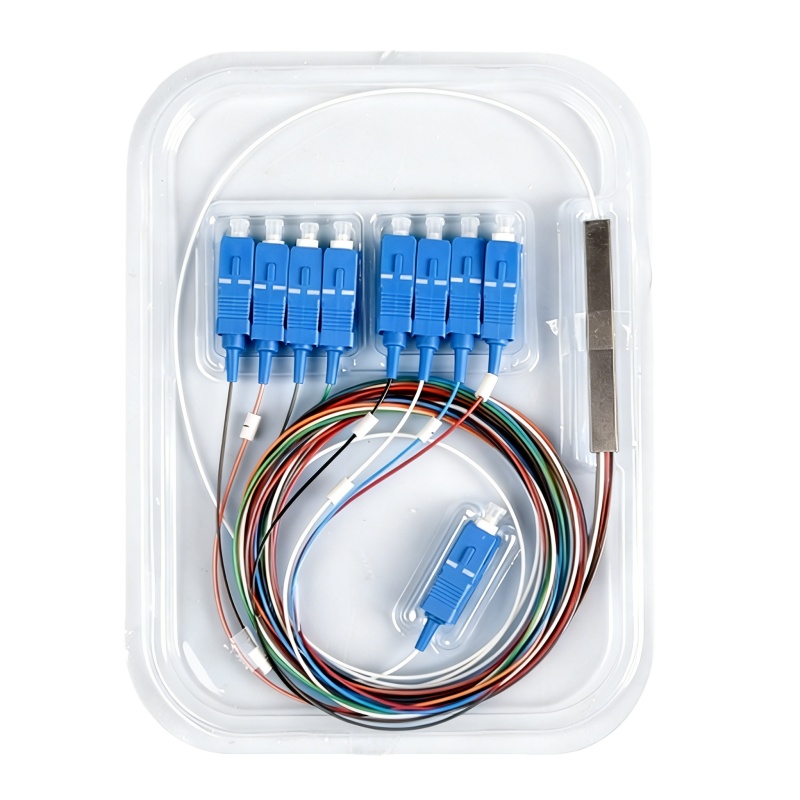
You can recognize SC UPC connectors by their blue color coding (industry standard).
3. Physical Structure of an SC UPC Connector
While the SC connector family shares similar physical construction, the UPC polishing process shapes the ferrule surface differently, giving SC UPC its distinctive optical behavior.
Key Components:
- Housing (Blue) – Industry color standard for UPC
- 2.5mm Zirconia Ceramic Ferrule
- Boot / Strain Relief
- Fiber (Single-mode or Multimode)
- Connector Body with Push‑Pull Mechanism
End-Face Geometry:
UPC end-face characteristics:
- Slight convex spherical shape
- Excellent surface smoothness due to fine‑grit polishing films
- Minimizes air gaps and reduces back reflections compared to PC
This polishing method is why UPC connectors achieve better optical performance than traditional PC connectors.
4. Optical Performance of SC UPC
Performance metrics for SC UPC connectors fall into two primary categories:
4.1 Insertion Loss (IL)
- Typical: 0.2 dB – 0.3 dB
- Maximum allowed (standard): ≤ 0.5 dB
Insertion loss measures how much optical power is lost when the connector is inserted. Lower is better.
4.2 Return Loss (Reflectance)
Return loss indicates how much light reflects back into the transmitter.
- Typical SC UPC return loss: ≥ −50 dB
- Premium SC UPC: ≥ −55 dB
Higher absolute values (more negative) mean less reflection, which protects the transmitter’s laser and improves signal stability.
5. SC UPC vs SC APC vs SC PC: What’s the Difference?
Table 1 — Comparison of SC UPC, SC APC, and SC PC
| Feature | SC PC | SC UPC | SC APC |
|---|---|---|---|
| Color | Beige | Blue | Green |
| Polish Type | Physical Contact | Ultra Physical Contact | Angled Physical Contact |
| Ferrule End‑Face Geometry | Slight curve | More refined curve | 8° angled surface |
| Typical Return Loss | −35 dB ~ −40 dB | −50 dB ~ −55 dB | −60 dB ~ −70 dB |
| Insertion Loss | 0.3–0.5 dB | 0.2–0.3 dB | 0.2–0.3 dB |
| Best Use Case | Short links | General networks, datacenters | FTTH, CATV, RF overlay |
| Reflections | Medium | Low | Very low |
| Mating Compatibility | PC | UPC | APC only |
Key Points:
- UPC has better performance than PC, but not as good as APC in terms of return loss.
- UPC connectors must not be mated with APC connectors.
- UPC is a good balance of cost and performance.
6. When Should You Use SC UPC?
SC UPC connectors are ideal for networks requiring:
6.1 Low Insertion Loss
Where minimal signal loss is required, such as:
- Data centers
- Enterprise networks
- Short-to-medium telecom links
6.2 Low-to-Moderate Return Loss Requirements
Systems without extreme reflection sensitivity (unlike CATV).
6.3 High Repeatability
SC UPC is designed to withstand repeated plugging cycles, making it suitable for test environments.
6.4 Patch Panels and Cross-Connects
SC UPC is commonly used in:
- ODF (Optical Distribution Frame)
- Patch cords
- Adapter plates
- Fiber distribution frames
6.5 Ethernet and DWDM/CWDM Networks
SC UPC is compatible with most single-mode interfaces in:
- Metro networks
- Backbone connections (short haul)
- CWDM/DWDM terminal equipment
7. Where SC UPC Should NOT Be Used
SC UPC is NOT recommended for:
7.1 FTTH (Fiber to the Home) PON Networks
Most operators require SC APC (green) because PON systems are extremely sensitive to back reflection.
7.2 CATV and RF Overlay
UPC connectors cannot meet the tight return loss of RF systems.
7.3 Long-Haul Transmission (100+ km)
Reflections can accumulate and degrade coherent/long-distance signals.
In these cases, use SC APC connectors.
8. Technical Standards for SC UPC Connectors
SC UPC production and performance follow major global standards:
International Standards:
- IEC 61754-4 (SC connector standard)
- IEC 61755 (Optical connector geometrical parameters)
- IEC 61300 (Fiber optic connector testing)
Industry Specs:
- Telcordia GR-326-CORE (Connector reliability requirements)
HDX, Corning, CommScope, YOFC, and many global manufacturers follow these performance metrics.
9. Manufacturing Process of SC UPC Connectors
A typical SC UPC manufacturing workflow includes:
- Ferrule and housing assembly
- Fiber stripping and epoxy bonding
- Curing in an oven
- Multiple-stage polishing:
- Coarse lapping
- Medium polishing
- Fine polishing
- Final UPC polishing with ultra-fine film
- Cleaning and inspection (interferometry)
- Testing (IL/RL)
- Connector termination and boot installation
The polishing stage is the most critical step.
10. Performance Comparison Table: UPC vs APC in Telecom Networks
Table 2 — Return Loss & Insertion Loss Comparison
| Connector Type | Return Loss (dB) | Insertion Loss (dB) | Typical Applications |
|---|---|---|---|
| SC UPC | −50 to −55 dB | 0.2–0.3 dB | Datacenters, backbone jumpers |
| SC APC | −60 to −70 dB | 0.2–0.3 dB | FTTH, CATV, ODN splitter frames |
Even though insertion loss is similar, the APC return loss is dramatically better.
11. Types of SC UPC Connectors Available Today
11.1 SC UPC Fiber Patch Cords
- Simplex or duplex
- Single-mode or multimode
- Common lengths: 1m, 2m, 3m, custom
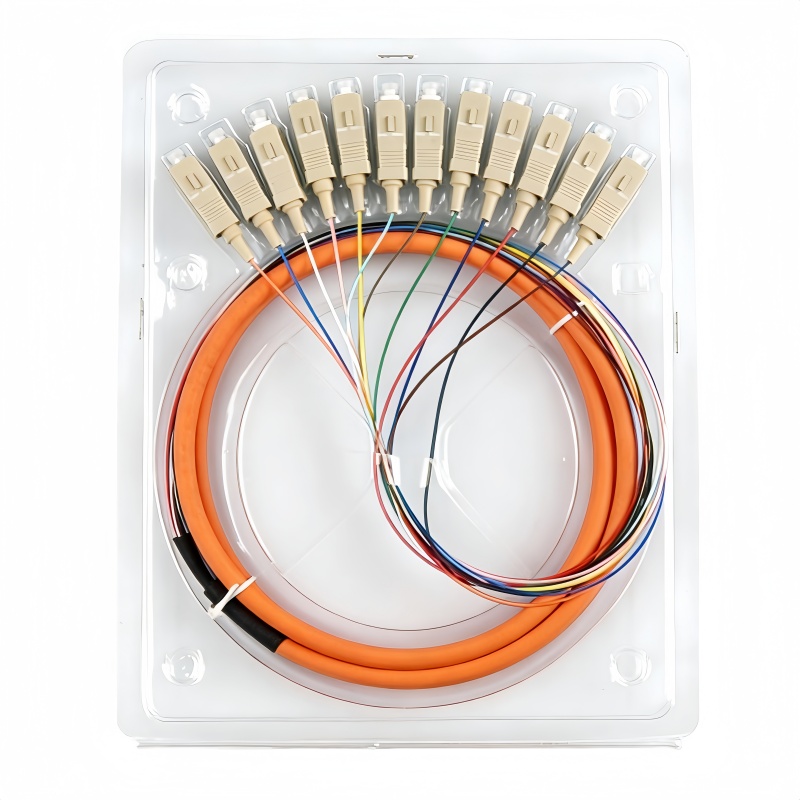
11.2 SC UPC Pigtails
- Used for fusion splicing
- Fabricated in standardized colors
- 0.9mm tight-buffered fiber
11.3 SC UPC Field-Installable Connectors
- Mechanical splice connectors
- Used for emergency repairs
- Slightly higher IL than factory-terminated SC UPC
11.4 SC UPC Adapters
- Used to connect two UPC jumpers
- Blue core color
12. SC UPC Ferrule Geometry Specifications
Table 3 — Ferrule Geometry Requirements (Industry Standards)
| Parameter | Typical Value | Purpose |
|---|---|---|
| Radius of curvature | 7–25 mm | Ensures proper physical contact |
| Apex offset | ≤ 50 µm | Reduces lateral misalignment |
| Fiber height | 0–100 nm | Controls contact pressure |
| End-face angle | < 0.3° | Ensures smooth contact surface |
These geometry requirements are stricter for UPC than for PC connectors.
13. How SC UPC Affects Network Performance
13.1 Stable Low-Loss Connections
UPC connectors maintain consistent insertion loss over repeated connections.
13.2 Lower Back Reflection
UPC is suitable for systems where reflection is undesirable but not catastrophic.
13.3 Laser Health
Lower reflectance reduces potential damage to laser diodes in transmitters.
13.4 Better High-Speed Transmission
UPC connectors help maintain optical signal-to-noise ratios (OSNR) in high-speed systems such as:
- 10G
- 40G
- 100G
- 400G
14. Common Misconceptions About SC UPC
Misconception #1 — UPC and APC Are Interchangeable
False.
They should never be mated. UPC-to-APC connections create high reflectance that degrades both connectors.
Misconception #2 — UPC Has While APC Is Only for FTTH
UPC is still dominant in:
- Data centers
- Enterprise networks
- Test environments
Misconception #3 — UPC Cannot Be Used for Long Distances
UPC can be used for short backbone links; only high-reflectance-sensitive systems require APC.
15. How to Choose Between SC UPC and SC APC
Choose SC UPC if:
- You are building a data center or corporate network
- Low-to-moderate return loss is acceptable
- Cost efficiency is important
- You need simple patching and cross-connecting
Choose SC APC if:
- You are deploying FTTH / PON
- You are carrying RF overlay or analog video
- You need the lowest possible back reflection
- You are designing long-distance, high-power systems
16. Summary
SC UPC connectors remain one of the most important building blocks in fiber networks worldwide. Their combination of low insertion loss, stable performance, simple operation, and lower cost makes them ideal for enterprise networks, backbone jumpers, and most single-mode applications outside of FTTH.
Understanding the differences between UPC and APC is essential for ensuring network stability, compatibility, and long-term optical performance.
Professional FAQ: SC UPC Fiber Optic Connectors
Q1: Can SC UPC connect to SC APC?
No.
SC UPC (blue) and SC APC (green) are not compatible.
Mating them will:
- Cause very high return loss
- Potentially damage ferrules
- Produce unstable performance
Q2: What is the typical return loss of an SC UPC connector?
Most modern SC UPC connectors achieve:
- −50 dB to −55 dB
- Premium connectors may reach −58 dB
Q3: Is SC UPC or SC APC better for FTTH networks?
SC APC is better for FTTH due to stringent reflectance requirements.
UPC is insufficient for PON systems using splitters.
Q4: Can SC UPC support 40G/100G links?
Yes.
UPC connectors are common in short-to-medium reach:
- 10GBASE‑LR
- 40GBASE‑LR4
- 100GBASE‑LR4
They support stable performance at high speeds when properly cleaned and maintained.
Q5: Are SC UPC connectors used in data centers?
Yes.
SC UPC is widely used for:
- Patch panels
- Cross-connects
- Single-mode jumpers
Especially in legacy systems where SC interfaces remain.