
A fiber optic adapter is the smallest line item on a typical bill of materials, yet it is the most common root cause of an unexpected link-budget failure. When the wrong adapter is installed the optical path still looks physically correct on a visual inspection, but return loss collapses, insertion loss drifts, or the panel refuses to seat a connector. The rework cost — climbing the rack, recrimping patch cords, swapping bulkheads — far exceeds the unit price of the part. Getting the adapter specification right at the inquiry stage is one of the most consequential decisions in any FTTH, data-center, or telecom rollout.
An adapter is a precision sleeve housed in a body. The sleeve aligns the two ferrules from either side so the optical cores line up inside a fraction of a micron. Everything else — color, flange, locking tab, dust shutter, mounting footprint — exists to make that alignment reproducible after hundreds of mating cycles.
LC remains the de-facto high-density format in data centers and 5G fronthaul. MPO/MTP adapters now dominate 40G, 100G, and 400G links. PON and FTTH greenfield builds converge on APC polish because of their aggressive return-loss budgets. The procurement question is no longer “which connector do we already use” — it is which interface family, polish, port count, and hybrid combination fits this deployment.
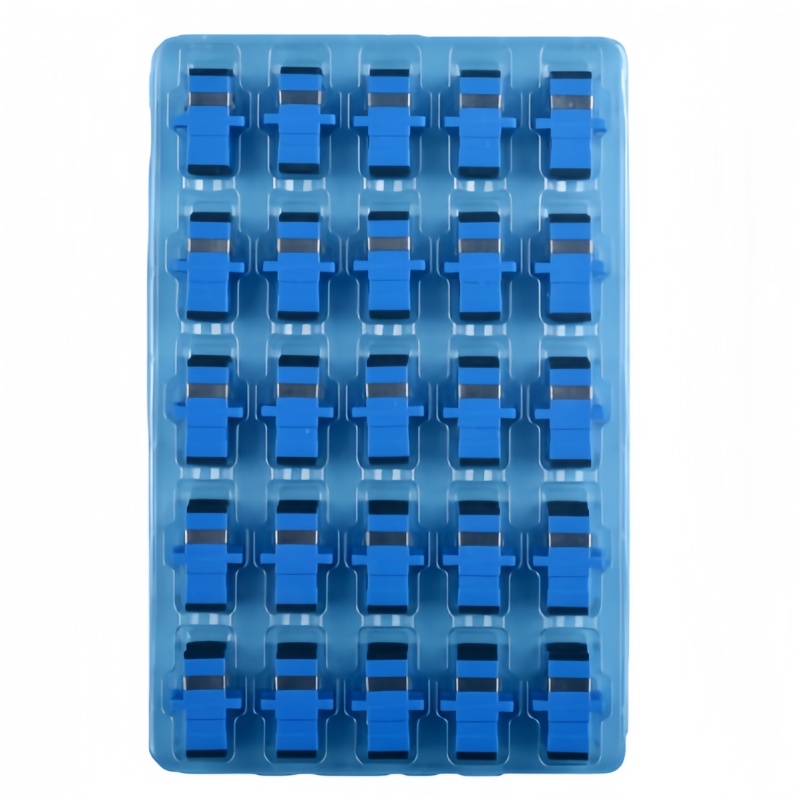
Where a Fiber Optic Adapter Fits Inside the Link
An adapter sits at every passive mating point: between a patch cord and an active port, on an ODF cross-connect, between a pigtail and a drop cable, between an MPO trunk and a fanout, and between a hardened connector and an indoor enclosure. In every position the adapter does one job — hold the alignment sleeve so both ferrules enter the same axis at the right depth.
The sleeve is the working part. Zirconia ceramic for tight-tolerance applications (single-mode, APC, panels that re-patch often); phosphor bronze for legacy multimode and cost-sensitive deployments. The housing color and key orientation are the visible indicators — green for APC single-mode, blue for UPC single-mode, beige for UPC multimode, aqua for OM3/OM4.
Every adapter introduces one extra mating pair into the loss budget. A 1U 24-port LC patch panel cross-connected to another 24-port panel is 48 mated pairs, which is why the math in any insertion-loss budget calculation consumes connector-pair loss before the cable plant itself is counted. A reliable procurement file therefore specifies the adapter — ferrule, sleeve, polish, color, durability, IL/RL — rather than treating it as an accessory.
Interface Families Compared — LC, SC, FC, ST, and MPO
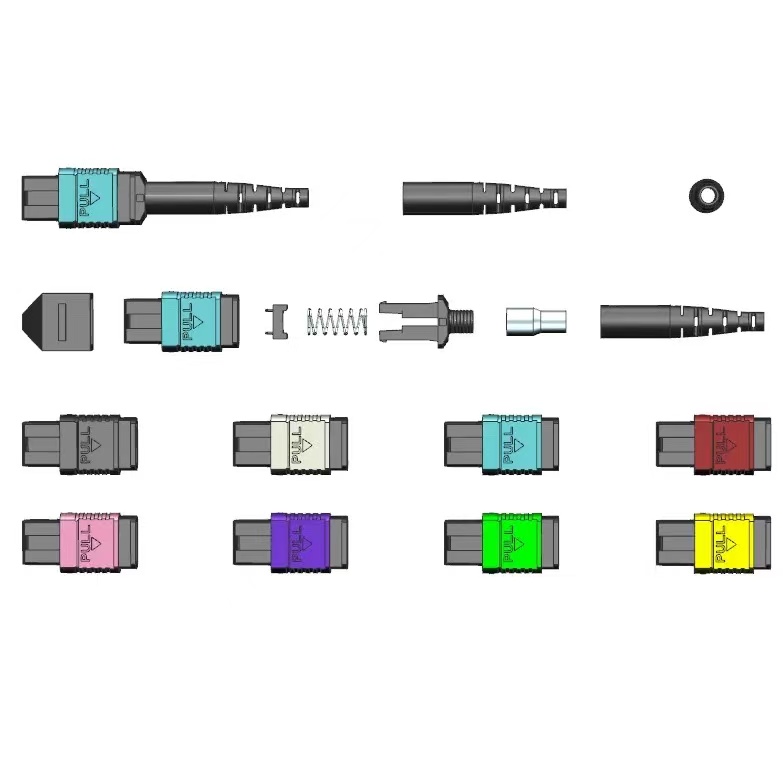
Each adapter family is built around one connector interface. Polish (APC or UPC), port format (simplex, duplex, quad) and sleeve material are the second-level choices. The five families below cover most plant installations; regional variants (E2000 shuttered, MU, MT-RJ, DIN) appear in legacy European plants and are usually specified per project rather than stocked generically.
| Interface | Ferrule | Locking | Polish options | Typical deployments |
|---|---|---|---|---|
| SC | 2.5 mm zirconia | Push-pull, square body | UPC, APC | FTTx distribution panels, ODFs, telecom central offices |
| LC | 1.25 mm zirconia | Latch, small form factor | UPC, APC | High-density panels, SFP-class equipment, data centers |
| FC | 2.5 mm zirconia | Threaded barrel | UPC, APC | Legacy telecom, instrumentation, test equipment |
| ST | 2.5 mm zirconia | Bayonet, round body | UPC (mostly) | Legacy campus backbones, industrial multimode |
| MPO/MTP | MT rectangular, 12 or 24 fibers | Keyed push-pull with guide pins | APC typical, UPC available | Parallel-optics trunks, FTTA hardened variants, 40G/100G/400G |
LC adapters physically take half the panel space of SC, which is why they dominate high-density frames. MPO/MTP adapters carry 12 or 24 fibers in one mate, which is why they are mandatory at 40G SR4, 100G SR4, and 400G DR4. SC remains the workhorse for FTTx distribution because its push-pull action is faster than LC latch under gloved conditions. FC and ST survive mostly in legacy installations and on test benches — a 2026 plant rarely specifies them new, but a brownfield project may have to terminate into existing ST or FC bulkheads.
APC vs UPC Polish — The Single Most Common Adapter Failure Mode
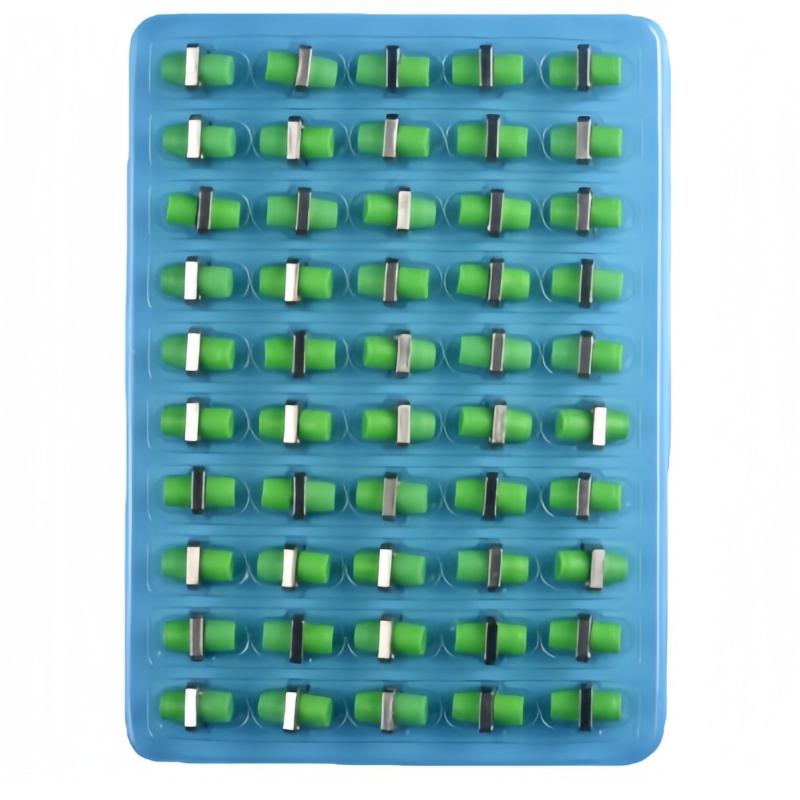
Polish is a property of the ferrule, but the adapter body has to carry the correct color code and keying. The two polishes behave differently on return loss, and the gap is wide enough that a wrong mate is one of the easiest field failures to diagnose after the fact and one of the easiest to prevent at the inquiry stage.
| Characteristic | UPC (Ultra Physical Contact) | APC (Angled Physical Contact, 8°) |
|---|---|---|
| End-face geometry | Flat, slightly domed polish | 8-degree angled polish |
| Typical return loss | ≥ 50 dB (SM), ≥ 35 dB (MM) | ≥ 60 dB (SM) |
| Housing color | Blue (SM UPC), beige (MM UPC), aqua (OM3/OM4) | Green (SM APC) |
| Common deployment | Enterprise, datacom, equipment interconnects | PON / FTTx access, CATV, RF overlay |
| Mating rule | Do not mate into APC | Do not mate into UPC — opposite angles scar both ferrules |
The mating rule is not theoretical. The 8-degree angle on an APC ferrule exists to deflect reflected light out of the fiber core instead of back into the laser cavity. Reversing the geometry — pushing a UPC ferrule into an APC adapter — leaves an air gap and a damaged ferrule edge. Both connectors in that pair then need re-polishing or replacement. PON deployments in particular have moved wholesale to APC because the return-loss budget on a 1:64 split is unforgiving.
The reference specification for SM adapter performance is ITU-T G-series for system-level return loss and IEC 61754-4 (SC) / 61754-20 (LC) for connector intermateability. TIA equivalents are documented under TIA-604 (FOCIS) series.
Simplex, Duplex, Quad, and Hybrid Port Choices
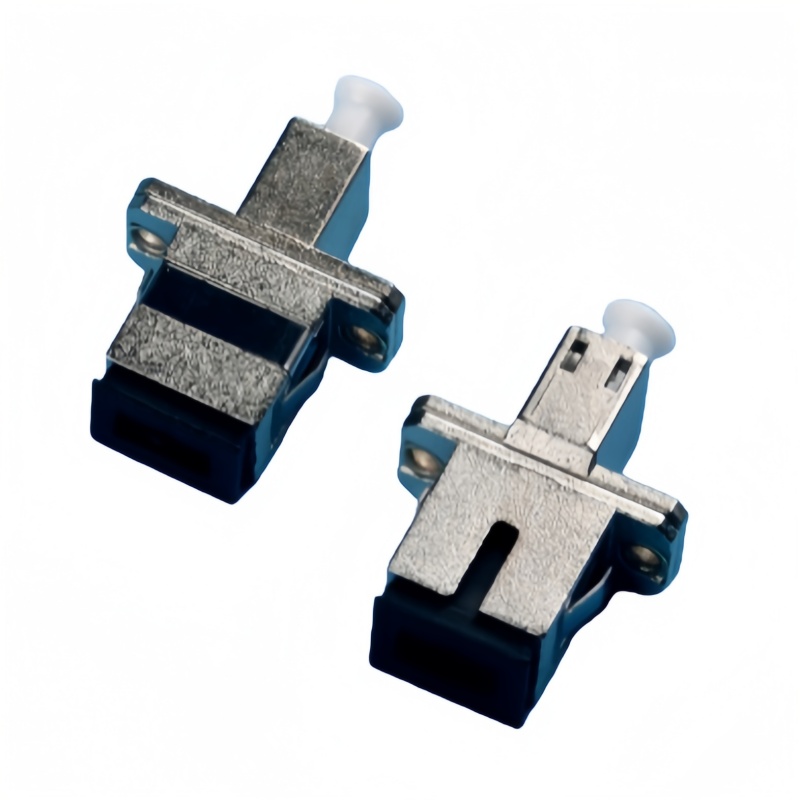
Adapter port count is bound to the equipment behind the panel. Simplex adapters carry one ferrule and are used for single-fiber links (video overlay, return path). Duplex adapters bond two ferrules with polarity coding (A on one side, B on the other) and are required for any 1000BASE-LX, 10G-LRM, or 25G breakout link that transmits and receives on a single connector pair. Quad adapters fit four LC ferrules in one SC form-factor footprint — they exist primarily for QSFP-to-four-SFP fanouts at 40G and are now common at 100G-to-25G breakouts where cabinet real estate is constrained.
Hybrid adapters bridge two interface families in one body. The most common is SC-to-LC, used when a panel still carries older SC patch cords but the active gear uses SFP+ LC ports. FC-to-ST, FC-to-LC, and SC-to-ST appear in industrial plants where instrumentation was FC and the network ports migrated to LC. Specify both sides of a hybrid adapter on the inquiry — a single-side spec is the most common sourcing error in retrofits, and the wrong hybrid adapter seats but produces high loss because the sleeve is tuned to one ferrule diameter.
Fenxi stocks simplex, duplex, and quad fiber optic adapters across the SC, LC, FC, ST, and MPO families, with hybrid SC-LC, LC-FC, and FC-ST bodies for brownfield plants. The matching LC connector, SC connector, and MPO/MTP patch cord lines are stocking-friendly for distributors building a single-vendor fiber bill of materials.
Acceptance Plan at Goods Receipt — Field Release Note
A supplier declaration of “GR-326 compliant” or “IEC 61754-4 intermateable” is a starting point, not a release. The FOA connector identification reference documents the visual checks inspectors should run, and Fluke Networks’ loss-budget knowledge base documents the per-pair IL/RL test against a master reference jumper. Run these seven steps before any adapter is loaded into a panel.
- Unpack on a clean surface. Photograph the carton if damage is suspected; many ferrule scratches begin here.
- Verify housing color and keying against the inquiry. Green for APC, blue or beige for UPC. Wrong color is the cheapest defect to catch and the most expensive one to find after installation.
- Inspect the sleeve material. Zirconia ceramic is white and dry-pressed; phosphor bronze has a metallic sheen.
- Mate against a known-good master reference jumper. Use 9/125 SM master for SM adapters, OM3/OM4 master for multimode. The clean reference is the only way to isolate the adapter as the loss source.
- Measure IL and RL against the published spec. A zirconia SM LC adapter should measure ≤ 0.2 dB IL and ≥ 50 dB RL against a UPC master; APC should be ≤ 0.2 dB IL and ≥ 60 dB RL.
- Run a 100-mating-cycle durability test on three adapters per lot. Re-measure IL at cycle 100; drift beyond 0.1 dB is a release-blocking defect.
- Inspect the mated master jumper end-faces. Scoring on the ceramic indicates sleeve burr or lot contamination.
Cross-mating rules to flag at receipt, not after deployment, are listed below. None of these combinations are covered by a standard warranty, and all of them show up as field tickets.
| Combination | Result | Recommended action |
|---|---|---|
| APC ferrule + UPC adapter | Air gap, ferrule damage, RL collapse | Reject both ends; send for re-polish |
| UPC ferrule + APC adapter | Ferrule chip, low RL | Reject both ends |
| SM adapter + MM patch cord (data path) | 1–3 dB extra loss, modal-bandwidth drop | OK for test leads only; replace in service |
| MM adapter + SM patch cord | Misalignment, +1 dB typical | Acceptable for service loops; test before commissioning |
| LC (1.25 mm) ferrule + SC (2.5 mm) sleeve | Mechanical mismatch; ferrule will not seat | Use hybrid SC-LC adapter; do not force |
| MPO/MTP + single-fiber ferrules | Impossible by geometry | Use fanout module; do not field-modify |
Frequently Asked Questions
Can a single-mode adapter carry a multimode patch cord? The ferrule and sleeve mechanically mate, so the connector seats and the link lights. Optical performance suffers — typical penalty is 1–3 dB extra loss and reduced modal bandwidth. Reserve this for test leads; never use it as a data-path patch in a production plant.
Are LC and MPO interchangeable? No. The ferrule sizes (1.25 mm LC vs MT rectangular MPO), alignment mechanism, and locking style are different. The supported bridge is an MPO-to-LC fanout module that breaks the 12-fiber MPO into six duplex LC pairs.
What sleeve material for outdoor panels? Zirconia ceramic for any panel with frequent re-patching or any SM/APC line. Phosphor bronze for legacy MM/ST/FC installations where mating cycles stay below a few hundred per year.
How often do adapters need cleaning? Every unmated cycle is a contamination opportunity. Inspect every ferrule before mating (per IEC 61300-3-35 zone criteria) and clean any adapter that has been uncapped in the field before the next mate.